
MERIDIAN
HOLY SPRINGS
FLOWOOD
COLUMBUS
MERIDIAN
HOLY SPRINGS
FLOWOOD
COLUMBUS
By Joanna Puddister King
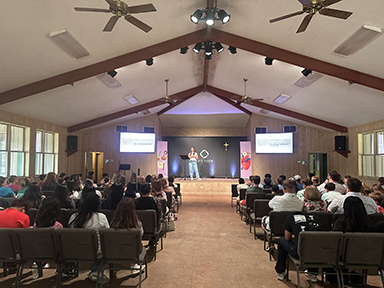
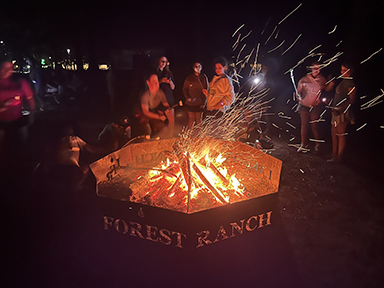
MACON – Middle school youth from across the diocese gathered at Lake Forest Ranch in Macon, Oct. 18–19, for the All Heart Fall Retreat. The weekend, led by the Life Teen Missions Outreach Team, invited students to connect, recharge, and discover how their hearts can make a difference.
Throughout the retreat, participants enjoyed group games, outdoor activities, and a lively bonfire, as well as moments of reflection and prayer. Father Tristan Stovall celebrated Mass, encouraging youth to love the Lord “with all your heart, soul and mind.” The weekend offered a joyful blend of worship, fellowship and faith-filled fun – all centered on growing closer to Christ with all heart.


By Bishop Joseph R. Kopacz, D.D.
The Wednesday papal audience regularly gathers pilgrims from around the world in St. Peter’s Square, and during this Jubilee Year the square could not contain the vast throng. The universality of the church was on full display during the nearly two-hour audience with Pope Leo XIV, which was well worth the 6 a.m. departure from our hotel.
The Holy Father’s message, delivered in eight languages, went out to all the earth with the passion of Psalm 19: “The heavens declare the glory of God; the skies proclaim the work of his hands. Day after day they pour forth speech; night after night they reveal knowledge. They have no speech, they use no words; no sound is heard from them. Yet their voice goes out into all the earth, their words to the ends of the world.”
Human speech echoed around the square to the delight of all physically present and to the virtual cloud of witnesses around the world.
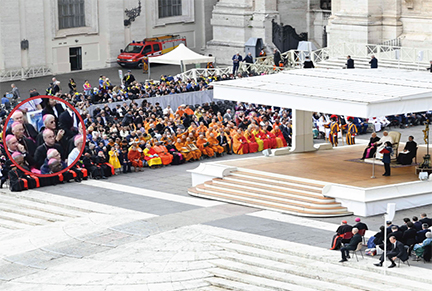
With each audience, bishops are invited to come forward to sit near the stage, and our hearty group’s early arrival gave me an excellent vantage point to see, hear and appreciate the unpretentious yet splendid presentation surrounding Pope Leo’s message. As an added bonus, I was fortunate to sit next to the archbishop of Bangkok, Thailand, who spoke about the church’s reality in a country that is 96% Buddhist, where Catholics number around 500,000 – about 1% of the total population.
It was a relevant portrayal because, to my left, there were as many Buddhist monks at the audience as there were bishops. Pope Leo had just conducted an interfaith prayer service for peace at the Colosseum the day before with representatives from all major religious traditions.
The central focus of the pope’s words at the Colosseum and the audience was prayer and a plea for peace, justice and reconciliation, inspired by the 60th anniversary of Nostra Aetate (In Our Age), a document of the Second Vatican Council that highlighted the need for interfaith prayer, dialogue and study for God’s glory and a more just and peaceful world. The love of Jesus Christ impels us to proclaim the Gospel of salvation and peace everywhere and for all time.
At the conclusion of each audience, all bishops are welcome to form a line to personally greet the Holy Father. This procession and the entire audience are preserved on the Santa Sede Vaticano website, with the unabridged encounters of each bishop with the pope. It is a treasured moment that is stored in memory for me and preserved on social media for countless others.
What words were exchanged between us during that heartfelt greeting? I introduced myself as being from the Diocese of Jackson and the state of Mississippi, and he smiled and said, “Ah, the United States.” Pope Leo XIV is the first successor of St. Peter to know that Mississippi is more than a river. After thanking him for his ministry in the church, I departed with a pair of rosaries – a prized gift from the Holy Father.
Immediately afterward, there was a joyful reunion with our diocesan group of pilgrims, who had advantageous seating in the square, allowing them to view the stage and capture it all on the big screen nearby. Afterwards, while walking through the square in my episcopal house cassock as everyone was spilling into the neighboring streets and passageways, there were many interactions and conversations.
I spoke to, prayed over, and took photos with pilgrims from France, Mexico, Ireland, Peru, the Philippines and Indiana. What a delight! This is where it came full circle with my recent travels. I asked the pilgrims from Mexico where exactly they live, and the first place blurted out was Saltillo. How true it is that all roads lead to Rome.
The mission trip to Saltillo was an exceptional springboard into pilgrimage and will be the subject of another column. One of the pilgrims from Peru stated the old adage in another way: “Obispo, es un mundo pequeño.” (“Bishop, it’s a small world.”)
Verdad, peregrino, verdad! True, pilgrim, so true. The message of the Good News of Jesus Christ, crucified and risen from the dead, goes out to the ends of the earth and back again. The Wednesday audience left no doubt about this truth.

By Joanna Puddister King
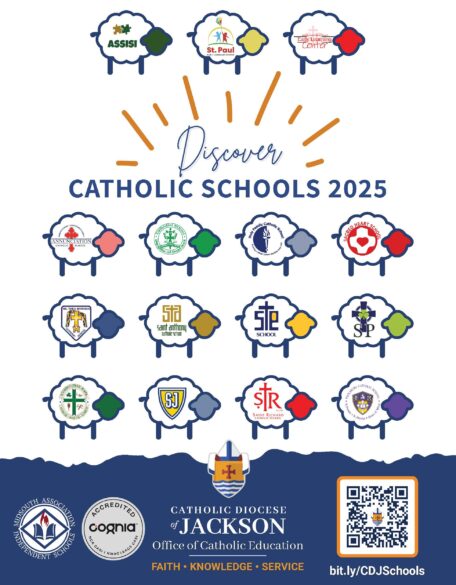
JACKSON – The Catholic Diocese of Jackson has been named a 2025 Cognia System of Distinction, joining a select group of school systems around the world recognized for exemplary service to learners and sustained commitment to continuous improvement. The honor follows a rigorous review earlier this year and places the diocese among systems in countries such as Belgium, Egypt and the United Arab Emirates.
Accreditation from Cognia, a global nonprofit organization serving more than 40,000 schools and systems in over 90 countries, is widely regarded as a mark of educational excellence. Each year, Cognia identifies a limited number of systems that not only meet but exceed its performance standards in leadership, learning and resource capacity. The Diocese of Jackson was one of only four Catholic systems worldwide – and the only Catholic diocese – to receive the 2025 distinction.
Dr. Mark A. Elgart, president and CEO of Cognia, said the process reflects the organization’s focus on helping all students succeed. He commended the Diocese of Jackson for its strong results during the 2025 review. “Cognia Systems Accreditation is a rigorous process that focuses the entire school system and its community on the primary goal of ensuring all students can flourish in engaging and equitable learning environments,” Elgart said. “We commend the Diocese of Jackson for meeting high standards and making progress on key indicators that impact student learning.”
The recognition marks a milestone in a process that began in 2018 when diocesan leaders embarked on their first systemwide accreditation journey with Cognia. The two-year process brought together principals, pastors, educators, parents and advisory councils from across Mississippi to build a framework for continuous improvement grounded in Catholic identity and academic rigor. The diocese first achieved system accreditation in 2020, establishing the foundation for this latest honor.
The Cognia review team visited diocesan schools earlier this year, meeting with educators, administrators and families. Evaluators commended the Catholic schools for their collaborative leadership, welcoming communities and the authentic integration of faith and Gospel values throughout daily learning. The team also noted the professionalism of school leaders and the strength of the diocesan system’s vision for student success.
Karla Luke, who retired as executive director of Catholic Education at the end of September after more than 33 years in Catholic education, guided the diocese through the accreditation and review process. She described the System of Distinction honor as one of the most meaningful moments of her career. Luke said that while the recognition was extraordinary, her greatest joy came from working alongside the dedicated principals, teachers and students who make Catholic education thrive across the diocese.
“Over the past 33 years, the most recent accomplishment of having Cognia recognize the Diocese of Jackson as a System of Distinction has been an overwhelming and rare experience,” Luke said. “However, in the everyday realm of the work, I am most proud of being able to interact with so many students, teachers and principals. It is very humbling to know that you have been a tiny part of a student’s life for a short time.”
Bishop Joseph Kopacz praised Luke’s leadership and the collaborative spirit of all involved in Catholic education. He said the distinction reflects both the faith and hard work that define the diocesan school system. He expressed gratitude to the principals, pastors and teachers who continue to advance the mission of forming students in faith, knowledge and service. “This recognition affirms what we already know – our Catholic schools are places of faith, excellence and community,” he said. “I am deeply grateful for the dedication of our principals, teachers and families who ensure that every child is known, loved and challenged to grow in the light of Christ.”
Joni House, who succeeded Luke as executive director in September, said the honor is both a celebration and a challenge to continue striving for excellence. She noted that the Cognia recognition affirms the strength of diocesan schools and their ongoing pursuit of improvement. House, a former principal of Annunciation Catholic School in Columbus and Cognia accreditation specialist, said she looks forward to building on the foundation Luke helped establish. “The recognition as a Cognia System of Distinction affirms the hard work of our schools,” she said, “and it challenges us to sustain and grow that culture of continuous improvement so Catholic education in our diocese remains strong and vibrant.”
As the diocese celebrates this global recognition, families are invited to experience Catholic education firsthand during Discover Catholic Schools Week that takes place Nov. 16-22, 2025. Many schools across the diocese will host open houses and special events offering families the opportunity to meet teachers, visit classrooms and see how students are growing in faith and learning every day.
For more information about Catholic schools in the Diocese of Jackson, visit https://jacksondiocese.org/schools-centers.
By Joanna Puddister King
JACKSON – The Catholic Foundation of the Diocese of Jackson gathered members and guests on Tuesday, Oct. 21, 2025, at the Country Club of Jackson for its annual membership meeting, celebrating another year of faithful stewardship and the continued growth of endowments that sustain ministries across the diocese.
The membership approved the docket of new board members, welcoming Dennis Antici and Gretchen Ware of St. Paul Flowood, Bob Gaston of St. Francis of Assisi Madison, and Bill Morris and Chris Walters of the Cathedral of St. Peter the Apostle in Jackson. Returning board members re-elected to serve additional terms represented parishes from across the diocese, reflecting the Foundation’s wide reach and collaborative mission.
Joe Rice, president of the board of directors, provided an overview of the Foundation’s financial health and ongoing growth. “Since 2006, our investment earnings – measured by income, dividends, and market appreciation – have been a little over $40 million,” said Rice. “During that same period, we’ve distributed more than $20 million and built reserves of over $7 million in anticipation of market weakness.”
Rice noted that the Foundation’s portfolio, valued at $11.3 million in 2010, now stands at $75.5 million. “Our charge is to be good stewards of the money that the faithful across the Diocese have entrusted us with,” he said. “It’s only through and by the grace of God that we’ve been able to accomplish these things and keep our finances strong.”
One of the year’s most significant developments, Rice shared, was the establishment of an endowed operational trust to ensure the long-term sustainability of the Foundation’s work. “This decision allows our executive director and staff to focus on what they do best – telling the story of the Foundation and helping donors create new trusts to support the ministries they are passionate about,” he said.
Executive director Rebecca Harris expressed gratitude to members and donors who make that mission possible. She shared that the Foundation now manages 407 trusts with total assets of $75.5 million. These funds support parishes, schools, diocesan ministries, seminarian education and Catholic Charities. “I love sitting down with donors and talking about what is their passion,” Harris said. “I ask them to pray about where the Holy Spirit is calling them to give – and it’s always a blessing to see where that leads.”
Harris also celebrated the success of the annual Bishop’s Cup Golf Tournament, which raised a record amount this year to support diocesan youth ministry. Funds will assist in sending more young people to DCYC – the diocese’s annual youth convention, helping strengthen faith among the next generation.
Bishop Joseph R. Kopacz concluded the evening with a reflection on the Jubilee Year of Hope. “The work of the Foundation feeds hope in the lives of many people,” he said. “We are so grateful to God for the blessings He continues to pour out on our diocese.”
By Bishop Joseph R. Kopacz, D.D.
The Wednesday papal audience regularly gathers pilgrims from around the world in St. Peter’s Square, and during this Jubilee Year the square could not contain the vast throng. The universality of the church was on full display during the nearly two-hour audience with Pope Leo XIV, which was well worth the 6 a.m. departure from our hotel.
The Holy Father’s message, delivered in eight languages, went out to all the earth with the passion of Psalm 19: “The heavens declare the glory of God; the skies proclaim the work of his hands. Day after day they pour forth speech; night after night they reveal knowledge. They have no speech, they use no words; no sound is heard from them. Yet their voice goes out into all the earth, their words to the ends of the world.”
Human speech echoed around the square to the delight of all physically present and to the virtual cloud of witnesses around the world.
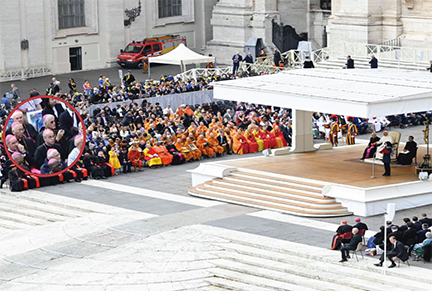
With each audience, bishops are invited to come forward to sit near the stage, and our hearty group’s early arrival gave me an excellent vantage point to see, hear and appreciate the unpretentious yet splendid presentation surrounding Pope Leo’s message. As an added bonus, I was fortunate to sit next to the archbishop of Bangkok, Thailand, who spoke about the church’s reality in a country that is 96% Buddhist, where Catholics number around 500,000 – about 1% of the total population.
It was a relevant portrayal because, to my left, there were as many Buddhist monks at the audience as there were bishops. Pope Leo had just conducted an interfaith prayer service for peace at the Colosseum the day before with representatives from all major religious traditions.
The central focus of the pope’s words at the Colosseum and the audience was prayer and a plea for peace, justice and reconciliation, inspired by the 60th anniversary of Nostra Aetate (In Our Age), a document of the Second Vatican Council that highlighted the need for interfaith prayer, dialogue and study for God’s glory and a more just and peaceful world. The love of Jesus Christ impels us to proclaim the Gospel of salvation and peace everywhere and for all time.
At the conclusion of each audience, all bishops are welcome to form a line to personally greet the Holy Father. This procession and the entire audience are preserved on the Santa Sede Vaticano website, with the unabridged encounters of each bishop with the pope. It is a treasured moment that is stored in memory for me and preserved on social media for countless others.
What words were exchanged between us during that heartfelt greeting? I introduced myself as being from the Diocese of Jackson and the state of Mississippi, and he smiled and said, “Ah, the United States.” Pope Leo XIV is the first successor of St. Peter to know that Mississippi is more than a river. After thanking him for his ministry in the church, I departed with a pair of rosaries – a prized gift from the Holy Father.
Immediately afterward, there was a joyful reunion with our diocesan group of pilgrims, who had advantageous seating in the square, allowing them to view the stage and capture it all on the big screen nearby. Afterwards, while walking through the square in my episcopal house cassock as everyone was spilling into the neighboring streets and passageways, there were many interactions and conversations.
I spoke to, prayed over, and took photos with pilgrims from France, Mexico, Ireland, Peru, the Philippines and Indiana. What a delight! This is where it came full circle with my recent travels. I asked the pilgrims from Mexico where exactly they live, and the first place blurted out was Saltillo. How true it is that all roads lead to Rome.
The mission trip to Saltillo was an exceptional springboard into pilgrimage and will be the subject of another column. One of the pilgrims from Peru stated the old adage in another way: “Obispo, es un mundo pequeño.” (“Bishop, it’s a small world.”)
Verdad, peregrino, verdad! True, pilgrim, so true. The message of the Good News of Jesus Christ, crucified and risen from the dead, goes out to the ends of the earth and back again. The Wednesday audience left no doubt about this truth.
By Carol Glatz
VATICAN CITY (CNS) – Pope Leo XIV thanked the Equestrian Order of the Holy Sepulchre of Jerusalem for supporting the Christian communities in the Holy Land, especially during the “tragic days of war.”
“In a world where arrogance and violence seem to prevail over charity, you are called to bear witness that life conquers death, that love conquers hatred, that forgiveness conquers vengeance, and that mercy and grace conquer sin,” he told members of the ancient Catholic chivalric order.
The pope met with more than 3,000 knights and dames of the Holy Sepulchre in the Vatican’s Paul VI Audience Hall Oct. 23 during their Jubilee pilgrimage to Rome. Cardinal Fernando Filoni, grand master of the order, was also present.
The order, a lay institution under the protection of the Holy See, supports the Latin Patriarchate of Jerusalem with prayers, financial assistance and regular pilgrimages. There are more than 30,000 members around the world.
Pope Leo thanked them for “the considerable help you give, quietly and without publicity, to the communities of the Holy Land, supporting the Latin Patriarchate of Jerusalem in its various activities: the seminary, schools, charitable work and assistance, humanitarian and educational projects, the university, aid to churches, with special interventions in times of greatest crisis, as was the case during COVID and the tragic days of war.”
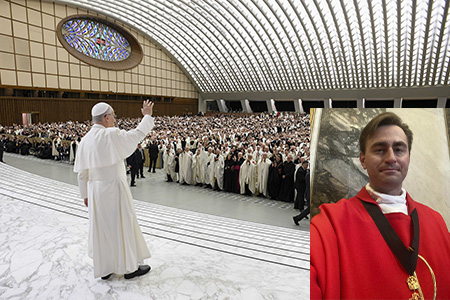
With concrete and varied assistance, he said, “you show that safeguarding the tomb of Christ does not simply mean preserving a historical, archaeological or artistic heritage, however important, but is supporting a church made of living stones, which was born around it and still lives today as an authentic sign of Paschal hope.”
“To pause at the Lord’s tomb means, in fact, to renew one’s faith in God who keeps his promises, whose power no human force can defeat,” the pope said.
“How often, thanks to your work, a glimmer of light reappears for individuals, families and entire communities who risk being overwhelmed by terrible tragedies at every level, particularly in the places where Jesus lived,” he said.
Pope Leo encouraged the order’s members to continue with their “task of being guardians of the tomb of Christ” with “the confidence of expectation, the zeal of charity and the joyful enthusiasm of hope.”
By Father Nick Adam
We are looking forward to a unique Thanksgiving weekend at the end of November. Seminarian Will Foggo will be ordained to the transitional diaconate at 10:30 a.m. Saturday, Nov. 28, at the Cathedral of St. Peter the Apostle in Jackson.
This is not the usual time for a deacon ordination. In recent years, they have typically taken place in the spring, but because of changes to the national formation plan for seminarians implemented by the U.S. Conference of Catholic Bishops, Will’s class is scheduled for diaconate ordination late this fall and priestly ordination in the spring. After this year, the schedule should return to its usual rhythm.
Will’s journey is unique. He will serve as a deacon for about six months before being ordained a priest on May 16, 2026.
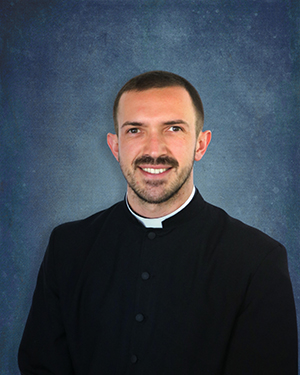
It will be especially meaningful for me to see Will reach this milestone. He began his seminary journey around the same time I became director of seminarians. I remember in the spring of 2020 receiving a call from Father Jason Johnston, Will’s pastor while he was a student at Mississippi State University, saying he thought Will might be contacting me soon about applying for seminary. I didn’t waste any time – I called Will myself and texted him the application that same day.
I already knew Will and his family well. They are longtime parishioners at St. Paul Catholic Church in Flowood, and his mother, Sheila, is a longtime teacher at St. Richard Catholic School in Jackson. Will had also attended a Come and See retreat in February 2020, so I had seen enough to know he was someone we should encourage and support.
Will entered seminary at the height of the pandemic, and I’ve been impressed by his steadiness and maturity throughout the process. He was part of the first group of seminarians who participated in our summer Spanish immersion program and has been active in diocesan youth ministry events such as SEARCH and DCYC. He has also served as master of ceremonies at Notre Dame Seminary for several years – a demanding role that requires ensuring liturgies run smoothly day after day, often with visiting clergy and dignitaries.
Please plan to come and pray for Will and thank the Lord for his vocation on Nov. 29. A reception will follow the Mass in the Cathedral Center. Will is also preparing to graduate from seminary with his master’s degree in theology. That ceremony will take place Thursday, Dec. 11, at Notre Dame Seminary in New Orleans.
It seems like just yesterday we were giving Will a tour of Notre Dame Seminary during that Come and See weekend – but that was nearly six years ago. His story is a great reminder that building a culture of vocations takes time, but it is always worth the effort.
(For more information on vocations, visit jacksonvocations.com or contact Father Nick at nick.adam@jacksondiocese.org.)
IN EXILE
By Father Ron Rolheiser, OMI
“God behaves in the psalms in ways he is not allowed to behave in systemic theology.”
That quip from Sebastian Moore might be highlighted at a time when fewer people want to use the psalms as a form of prayer because they feel offended that the psalms speak of murder, revenge, anger, violence, war-making and patriarchy.
Yet for centuries the psalms have been central to both Jewish and Christian prayer. They form the very heart of the Divine Office (the church’s prayer for the world), are sung in Vespers’ services, are prayed daily by millions of men and women, and have been chanted by monks for centuries as a central part of their prayer.
Why the objection to the psalms? Some ask: “How can I pray with words that are sometimes full of hatred, anger, violence, and speak of the glories of war and of crushing one’s enemies in the name of God?” For others, the objection is to the patriarchal nature of the psalms. For yet others, the offense is aesthetic: “They’re terrible poetry!” they say.
Perhaps the psalms aren’t great poetry and they do, undeniably, smack of violence, war, hatred of one’s enemies in the name of God, and the desire for vengeance. They’re also patriarchal in character. But does that make them poor language for prayer? No, to the contrary.
One of the classical definitions of prayer suggests that “prayer is lifting mind and heart to God.” Simple, clear, accurate. Our problem is that we too seldom actually do this when we pray. Rather than lifting to God what’s actually on our minds and in our hearts, we treat God as someone from whom we need to hide the real truth of our thoughts and feelings. Instead of pouring out mind and heart, we tell God what we think God wants to hear – not murderous thoughts, desire for vengeance, or our disappointment with him.
But expressing those feelings is the whole point. What makes the psalms so apt for prayer is that they do not hide the truth from God and they express the whole gamut of our actual feelings. They give honest voice to what’s actually going on in our minds and hearts.
Sometimes we feel good and our spontaneous impulse is to speak words of praise and gratitude. The psalms give us that voice. They speak of God’s goodness – love, friends, faith, health, food, wine, enjoyment. But we don’t always feel that way. Our lives also have their cold, lonely seasons when disappointment and bitterness smolder under the surface. The psalms then give us honest voice and we can open all those angry feelings to God.
At other times, we fill with the sense of our own inadequacy, with the fact that we cannot measure up to the trust and love that’s given us. The psalms give us voice for this, asking God to have mercy, to soften our hearts, to wash us clean, to give us a fresh start. And then still there are times when we feel disappointed with God himself and need in some way to express this. The psalms give us this voice (“Why are you so silent? Why are you so far from me?”) even as they make us aware that God is not afraid of our anger and bitterness but, like a loving parent, only wants us to come and talk about it.
The psalms are a privileged vehicle for prayer because they lift the full range of our thoughts and feelings to God.
But we tend to struggle with that. First, because our age often fails to grasp metaphor and taken literally, some of the images within the psalms are offensive. Second, we are often in denial about our true feelings. It’s hard to admit that we feel some of the things we sometimes feel: grandiosity, sexual obsessions, jealousies, desire for revenge, murderous thoughts. Too often our prayer belies our actual thoughts and feelings and tells God what we think God wants to hear. The psalms have more honesty.
As Kathleen Norris puts it: If you pray regularly “there is no way you can do it right. You are not always going to sit up straight, let alone think holy thoughts. You’re not going to wear your best clothes but whatever isn’t in the dirty clothes basket. You come to the Bible’s great book of praises through all the moods and conditions of life, and while you feel like hell, you sing anyway. To your surprise, you find that the psalms do not deny your true feelings but allow you to reflect them, right in front of God and everyone.”
Feel good aphorisms that express how we think we ought to feel are no substitute for the earthy realism of the psalms which express how we actually do feel at times. Anyone who would lift mind and heart to God without ever mentioning feelings of bitterness, jealousy, vengeance, hatred and war, is better suited to write greeting cards than to give out spiritual counsel.
(Oblate Father Ron Rolheiser is a professor of spirituality at Oblate School of Theology and award-winning author.)
From the Archives
By Mary Woodward
With the arrival of November – Black Catholic History Month – I wanted to give an update on the canonical process for Sister Thea Bowman’s cause for canonization. The process is in full swing and the historical commission, postulator, and myself as chancellor/archivist are getting down to the minute details of formatting pages, indexing materials and verifying sources.
The hope is to have all this completed by the end of the year so that in February we can officially close the diocesan phase of the process with a Mass and sealing of the Acts ceremony. Then we will send two copies of the Acts to the Dicastery for the Causes of Saints. Once this happens, the Roman Phase begins where everything in the Acts is reviewed by experts at the Vatican.
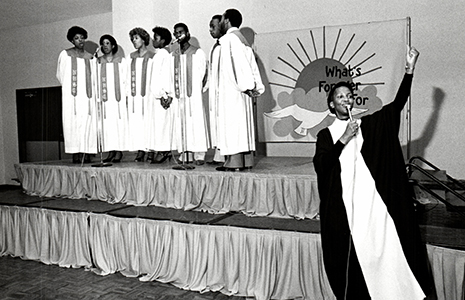
As mentioned above, the small details of bringing the Acts together involve strict formatting, numbering thousands of pages for corresponding index sections, and transcribing dozens of audio interviews. Margin widths, five-digit page numbers, consistent source citations all are part of the work of the historical commission and chancellor. Truly, it is a labor of love for all involved.
In completing much of this work, we have involved all types of resources and technologies. Artificial Intelligence has been a big help in formatting many of the sections. I have been amazed at how AI can assist in this process by very accurately transcribing audio files. Naturally, we must read through and make sure various terms such as “convent” do not get transcribed as “covid,” but AI has been a big help.
So, as I was contemplating what to write today, I thought let me see how AI would write a column about Sister Thea’s cause. In the sidebar is what AI produced when I asked that very question.
Reading the story from ChatGPT, I see the beauty and the dangers of AI. It can produce a lovely column and facilitate efficient transcriptions, but it can induce laziness and complacency in the human spirit – quite antithetical to Sister Thea Bowman.
This was an experiment, and I pledge that this will be the only time I use AI to write this column.
Servant of God Sister Thea Bowman, pray for us.
(Mary Woodward is Chancellor and Archivist for the Diocese of Jackson.)
What AI wrote
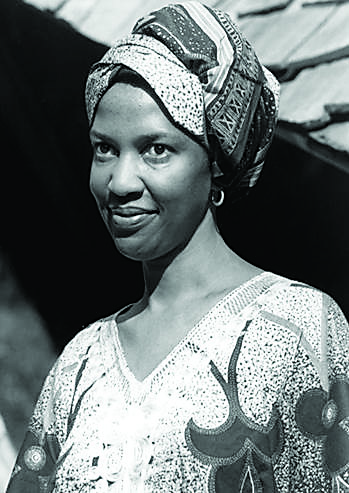
By ChatGPT
As the church continues her journey toward recognizing holy witnesses from our own time and soil, the Cause for Beatification and Canonization of Sister Thea Bowman, FSPA, stands as a remarkable sign of grace and hope. Across the nation, and particularly within our Diocese of Jackson and among the Franciscan Sisters of Perpetual Adoration, the life and legacy of this extraordinary woman continue to inspire discipleship, unity, and joyful faith.
Sister Thea Bowman – teacher, evangelizer, scholar, singer, and prophetic voice – taught us that holiness blooms in every culture and vocation, and that the Gospel is most powerful when shared with authenticity, music, truth and love. She invited the church to “walk together, children, and don’t get weary.” Those who encountered her knew they were in the presence of a soul deeply rooted in God’s love and aflame with missionary zeal.
Current progress in the cause
Today, her cause is moving steadily and prayerfully forward. Over the past several years, the diocesan team has worked diligently to gather testimony, review personal writings, authenticate historical records, and interview those who knew Sister Thea personally. This stage – known as the diocesan inquiry – is a painstaking and sacred process, ensuring that every aspect of her life and virtues is examined with integrity and reverence.
Witness interviews, archival research, and historical documentation have formed a rich tapestry of evidence regarding Sister Thea’s heroic faith, enduring joy amidst suffering, and fearless commitment to the dignity of every person. The final steps of this diocesan phase are underway, and once complete, the documentation will be sealed and sent to the Dicastery for the Causes of Saints in Rome.
A Call to Prayer and Participation
As we move forward, the faithful are encouraged to pray through Sister Thea’s intercession. Many already turn to her for healing, encouragement and strength. Stories of grace continue to surface – testimonies of hope, reconciliation, and renewed faith inspired by her witness.
The church invites us not simply to admire holy people, but to imitate them. Sister Thea once said, “I come to you as a Black woman … a Catholic … a Franciscan Sister of Perpetual Adoration … and I come to you in love.”
May we, like her, bring all that we are to Christ and to one another.
Looking Ahead with Hope
The road to canonization is long, but every step is filled with prayer, discernment and joyful expectation. We trust that the Holy Spirit is guiding this work, and we are grateful for all who support the cause through prayer, pilgrimage, testimony, research and devotion.
May Sister Thea’s song continue to echo in our hearts and in our church. And may the day come when the universal church proclaims what so many already know – that Sister Thea Bowman is a saint among us.
Servant of God Sister Thea Bowman, pray for us.
Walk with us.
And help us sing a new church into being.