Por Obispo Joseph R. Kopacz, D.D. Durante el corazón de la temporada de Pascua, celebré mi 49º aniversario del sacerdocio. Desde el santuario de la Catedral de San Pedro en Scranton el 7 de mayo de 1977, hasta el santuario de San Pedro Apóstol en Jackson el 6 de febrero de 2014, hasta este momento presente, he estado atrapado, en palabras del Papa San Juan Pablo II, en este “don y misterio” del sacerdocio de Jesucristo.
De hecho, mi primera celebración de ordenación ocurrió el 23 de abril de 1976, con la llamada al diaconado. Por eso, durante más de 50 años, por la gracia de Dios, he luchado la buena batalla y mantenido la fe, pero aún no he terminado la carrera. Que queden muchos años más en el plan de la providencia de Dios.
De hecho, demos gracias por todos nuestros sacerdotes, pasados y presentes, conscientes de quienes celebran sus aniversarios en esta época del año. ¡Ad multos annos!
La Diócesis de Jackson celebra este fin de semana la ordenación sacerdotal de Will Foggo, quien celebrará su primera misa en St. Paul en Flowood.
Durante la Pascua, la Iglesia también se regocija en el derramamiento del Espíritu Santo en el Sacramento de la Confirmación. Nuestros catecúmenos y candidatos que ingresaron en la Iglesia durante la Vigilia Pascual fueron los primeros en recibir el regalo del espíritu amoroso de Dios, seguidos por candidatos en muchas parroquias de toda la diócesis.
De hecho, los viajes de un obispo a través de su diócesis en la temporada pascual reflejan los viajes misioneros retratados en los hechos de los Apóstoles, cuando los apóstoles y los primeros evangelistas recorrieron todo el mundo mediterráneo para llevar el Evangelio atreves del mundo mediterráneo y fortalecer las primeras comunidades cristianas. La proclamación del Evangelio a las naciones y la santificación de las comunidades existentes y de los creyentes individuales es obra del Espíritu Santo, inicia en Pentecostés y que continúa hasta que Cristo vuelva.
Con Pentecostés en el horizonte, que haya una marea ascendente en nuestro interior para suplicar un derramamiento del Espíritu Santo sobre la Iglesia. Que también conozcamos y comprendamos el poder de la presencia del Espíritu Santo y la pobreza de su ausencia. Estamos invitados por lo tanto a profundizar nuestra relación con el Espíritu Santo, tanto en la oración como en la vida cotidiana, escuchando su voz dentro de nosotros.
“El Espíritu Santo, aliento de Jesús y atmósfera del cielo, es también el aliento de su cuerpo, la Iglesia. Y somos conscientes de su presencia si la Iglesia es ella misma en el sentido completo; es decir, si es el reino de Dios, el cielo desciende a la tierra, por la unidad. Se nos recuerda que, sin el Espíritu Santo, Dios está lejos, Cristo permanece en el pasado, el Evangelio es letra muerta, la Iglesia es una mera organización y la ‘misión’ es mera propaganda. Pero al estar en el Espíritu Santo, el mundo se glorifica y suplica en la gestación del reino de Dios, el Cristo resucitado está presente, el Evangelio es el poder de la vida, la Iglesia significa comunión trinitaria y la ‘misión’ es un Pentecostés.” (Chiara Lubich, Escritos esenciales)
“Ven, Espíritu Santo, llena los corazones de tus fieles y enciende en ellos el fuego de tu amor.”
Por Junno Arocho Esteves ROMA (OSV News) – El Papa León XIV ha dedicado su intención de oración para el mes de mayo a uno de los retos más persistentes de la humanidad: el hambre.
En un mensaje en video difundido el 30 de abril por la Red Mundial de Oración del Papa, el pontífice hizo un llamado a los católicos de todo el mundo para que enfrenten el problema de la inseguridad alimentaria tanto con la oración como con acciones concretas.
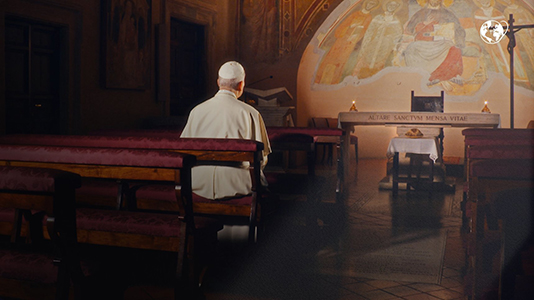
“Hoy reconocemos con dolor que millones de hermanos y hermanas siguen padeciendo hambre, mientras tantos bienes se desperdician en nuestras mesas”, dijo el Papa en el video, grabado en el interior de la iglesia de San Pellegrino en la Ciudad del Vaticano. La intención de oración de este mes es: “Por una alimentación para todos”.
En un mensaje en video publicado el 30 de abril de 2026 por la Red Mundial de Oración del Papa, el Papa León XIV hizo un llamado a los católicos de todo el mundo para que enfrenten el problema de la inseguridad alimentaria tanto con la oración como con acciones concretas. La intención de oración del Santo Padre para el mes de mayo es: Por una alimentación para todos. (Captura de pantalla de OSV News/Red Mundial de Oración del Papa)
Se prevé que al menos 318 millones de personas se enfrenten a condiciones de crisis alimentaria o peores este año, según el Panorama Global 2026 del Programa Mundial de Alimentos. La guerra en curso en Oriente Medio podría empujar a otros 45 millones de personas a una situación de hambre grave antes de mediados de año. En 2025, se registraron dos hambrunas en algunas zonas de Gaza y Sudán. Al mismo tiempo, el Programa de las Naciones Unidas para el Medio Ambiente informa de que cada año se desperdician más de 1.000 millones de toneladas de alimentos en todo el mundo, un contraste que el Papa abordó directamente en su mensaje.
El Papa León hizo un llamado a alejarse de lo que describió como “la lógica del consumo egoísta” y a transformarla en “una cultura de la solidaridad”, instando a las comunidades católicas a adoptar medidas prácticas, como bancos de alimentos, campañas de concientización y estilos de vida más sencillos y responsables.
“Que nuestras comunidades promuevan gestos concretos”, dijo el Papa, añadiendo que los creyentes deben abordar cada comida con gratitud, consumir con sencillez y “compartir con alegría”, sabiendo que los frutos de la tierra están “destinados a todos, no solo a unos pocos”.
La Red Mundial de Oración del Papa, también conocida como Apostolado de la Oración, publica cada mes una intención de oración del Papa como parte de su misión de unir a los católicos en oración por las preocupaciones globales de la Iglesia.
El padre Cristóbal Fones, director de la Red Mundial de Oración del Papa, dijo que la intención es una preocupación profundamente personal para el Papa.
“Esta intención nace del corazón del Papa. Le duele profundamente que tantas personas en el mundo no puedan acceder a algo tan esencial y tan humano como es la comida”, dijo el padre Fones en una nota de prensa. “Por eso nos convoca a todos a no quedarnos indiferentes, sino a actuar con determinación, desde la oración y desde los gestos concretos de solidaridad”.
(Courtney Mares es la editora del Vaticano para OSV News. Síguela en X en @catholicourtney.)
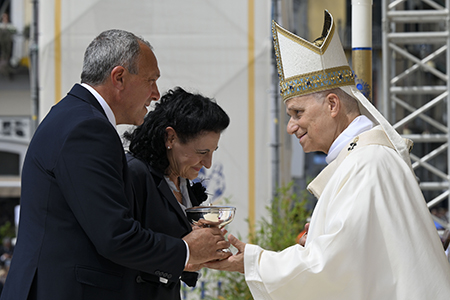
El papa León XIV recibe las ofrendas mientras celebra la misa en la Piazza Bartolo Longo, frente al Santuario Pontificio de la Santísima Virgen del Rosario de Pompeya, cerca de Nápoles (Italia), el 8 de mayo de 2026, en el primer aniversario de su elección como primer pontífice estadounidense. (Foto de OSV News/Simone Risoluti, Vatican Media)
NACIÓN CHICAGO (OSV News) – Una divertida anécdota sobre una llamada al servicio al cliente del papa León XIV está llamando la atención de muchos y ofreciendo a numerosos católicos una visión del lado más cotidiano del pontífice. El padre agustino Tom McCarthy, futuro superior provincial de los agustinos del Medio Oeste, afirmó haberse sorprendido por la reacción que ha suscitado desde que compartió la anécdota en un encuentro para padres e hijos celebrado el 29 de abril en la parroquia de San Pedro y San Pablo, en Naperville, a las afueras de Chicago. Según el padre McCarthy, el ex cardenal Robert Prevost – ahora el papa León XIV – llamó a su banco de Chicago varios meses después de su elección para actualizar su número de teléfono y la información de su cuenta. Después de responder a varias preguntas de seguridad, al papa le dijeron que los cambios no se podían hacer a menos que se presentara en el banco en persona. El padre McCarthy dijo que el papa León explicó que eso sería difícil porque estaba “fuera de la ciudad”. Cuando finalmente añadió: “¿Importaría si les digo que soy el papa León?”, el representante de servicio al cliente le colgó el teléfono. El asunto se resolvió más tarde después de que un compañero agustino se pusiera en contacto con el presidente del banco, quien accedió a realizar el cambio antes que arriesgarse a perder “la cuenta del papa”.
WASHINGTON (OSV News) – Los niños “sufren las peores consecuencias” de las violaciones internacionales a la libertad religiosa, señalaron los panelistas durante una audiencia celebrada el 30 de abril por la Comisión de los Estados Unidos sobre Libertad Religiosa Internacional (USCIRF, por sus siglas en inglés). Vicky Hartzler, presidenta de la USCIRF (una comisión federal gubernamental estadounidense, independiente y bipartidista, que supervisa la libertad religiosa en todo el mundo) y exmiembro republicana de la Cámara de Representantes por el estado de Missouri, declaró que el grupo está “profundamente preocupado por aquellos países donde los gobiernos restringen la educación religiosa e impiden que los niños aprendan o practiquen su fe”. “Estas políticas están diseñadas para erosionar la identidad religiosa al impedir que las familias transmitan sus creencias a la siguiente generación”, afirmó. En los regímenes de todo el mundo que, según la USCIRF, cometen violaciones contra la libertad de religión o de creencias, “los niños son quienes sufren las peores consecuencias de las violaciones a la libertad religiosa”, declaró Hartzler. “Los perpetradores los toman como blanco porque están indefensos, sabiendo que dañar a niñas y niños puede desestabilizar a las familias y a comunidades de fe enteras; las consecuencias son graves”, afirmó. “La cohesión social se deteriora. La esperanza en el futuro se desvanece, y la propia supervivencia e identidad de estas comunidades se ven puestas en riesgo”.
VATICANO POMPEYA, Italia (OSV News) – El papa León XIV conmemoró el primer aniversario de su elección el 8 de mayo con una peregrinación al santuario mariano de Nuestra Señora del Santo Rosario en Pompeya, donde encomendó su pontificado a la Virgen María. Al celebrar la misa ante unas 20 000 personas, el papa recordó que su elección en 2025 coincidió con la fiesta de Nuestra Señora de Pompeya. “Por eso tenía que venir aquí para poner mi ministerio bajo la protección de la Santísima Virgen”, dijo. El primer año del papa agustino incluyó viajes internacionales, canonizaciones y eventos jubilares. En su homilía, el papa León habló extensamente sobre la importancia del rosario e instó a los católicos a poner su esperanza en Cristo. “Hermanos y hermanas, ningún poder terrenal salvará al mundo, sino solo el poder divino del amor”, dijo. El papa León también honró a San Bartolo Longo, el antiguo satanista convertido en santo que fundó el santuario mariano y sus obras de caridad para huérfanos e hijos de presos. El papa concluyó con un renovado llamamiento a la paz en medio de los conflictos globales en curso. Tenía previsto continuar su visita pastoral con un viaje a la cercana ciudad de Nápoles antes de regresar a Roma en helicóptero por la tarde.
MUNDO VARSOVIA, Polonia (OSV News) – Un santuario mariano en Gietrzwald – conocido a menudo como el “Lourdes polaco”– podría atraer pronto la atención mundial, ya que se ha invitado al papa León XIV a visitar el lugar donde, según se dice, la Virgen María se habría aparecido unas 160 veces. Al entrar la Iglesia en mayo, el mes mariano, se están llevando a cabo los preparativos para el 150.º aniversario de las apariciones de 1877. Los obispos polacos y el presidente Karol Nawrocki han extendido la invitación papal, lo que ha despertado la esperanza de que se produzca un gran momento de peregrinación. Las apariciones, vividas por dos niñas, se encuentran entre las más intensas de la historia de la Iglesia, y es el único lugar de apariciones marianas en Polonia reconocido por el Vaticano. A diferencia de Lourdes o Fátima, incluyeron conversaciones prolongadas con María. “Ese es un aspecto único”, dijo el cineasta Jan Sobierajski. El mensaje de María se centró en la oración y la conversión: “Recen el rosario todos los días”, dijo la hermana Anna Wojciechowska, añadiendo la seguridad de María: “No tengan miedo, porque yo siempre estaré con ustedes”. La historia de Gietrzwald es inseparable de las dos jóvenes videntes que la protagonizan: Bárbara Samulowska y Justyna Szafrynska. Ambas eran niñas –Samulowska tenía solo 12 años–cuando afirmaron haber visto a la Virgen María. En marzo, la Iglesia reconoció las virtudes heroicas de la hermana Bárbara, otorgándole el título de venerable y avanzando en su causa de canonización.
DEBEL, Líbano (OSV News) – Una foto en la que se ve a un soldado israelí que parece profanar una estatua de la Virgen María en el Líbano ha desatado una nueva ola de indignación por los incidentes anticristianos vinculados al actual conflicto regional. La imagen, compartida en línea el 6 de mayo, parece mostrar a un soldado de las Fuerzas de Defensa de Israel (FDI) acercando un cigarrillo a la boca de una estatua mariana. El portavoz de las FDI, el teniente coronel Nadav Shoshani, condenó el acto, afirmando que el comportamiento del soldado “se desvía por completo de los valores que se esperan” del personal militar. Dijo que el incidente, que según se informa fue fotografiado semanas antes en la aldea libanesa de Debel, está siendo investigado. La controversia se produce tras otro incidente reciente en la misma zona en el que un soldado fue fotografiado golpeando una estatua de Jesús con el lado romo de un hacha. El Ministerio de Relaciones Exteriores de Polonia criticó duramente el último episodio, afirmando que tales acciones ofenden los sentimientos religiosos de los cristianos y socavan los esfuerzos de paz en el Medio Oriente. El incidente también se produce días después de que un colono israelí fuera acusado de agredir a una monja francesa cerca del Cenáculo en Jerusalén, tradicionalmente venerado como el lugar de la Última Cena.
(OSV News) — Una diócesis de Nuevo México denunció una violación de las protecciones de libertad religiosa al rechazar a los esfuerzos de la administración Trump por expropiar terrenos de un lugar de peregrinación para construir un tramo del muro fronterizo.
La Diócesis de Las Cruces respondió el 8 de mayo a una demanda del gobierno federal que reclama el derecho de expropiación (“eminent domain”) — o el poder del gobierno para confiscar propiedad privada para uso público, con una “compensación justa” según requiere la Quinta Enmienda de la Constitución de EE.UU. — sobre aproximadamente 14 acres que incluyen el Monte Cristo Rey en Sunland Park, Nuevo México.
El monte de 4.675 pies de altura es conocido como Mount Cristo Rey y en su cima se encuentra una estatua de piedra caliza de Jesucristo de 29 pies, ha sido un lugar de oración durante casi un siglo.
Cada año, miles de personas recorren el escarpado sendero hasta la imagen, que representa a Cristo con túnica y los brazos extendidos sobre la cruz, dominando el paisaje de El Paso, Texas, y el sur de Nuevo México.
Según documentos judiciales, el Departamento de Justicia ha intentado durante meses acceder a la montaña, situada en terrenos de propiedad de la diócesis, para construir un tramo del muro fronterizo. La medida forma parte de la amplia ofensiva de la administración Trump contra la inmigración no autorizada.
El 7 de mayo, el gobierno federal presentó una demanda en la Corte de Distrito de Estados Unidos para el Distrito de Nuevo México contra la diócesis y el tesorero del condado de Doña Ana, Nuevo México, para tomar posesión del terreno.
A cambio, la compensación justa legalmente requerida, determinada por el valor justo de mercado de la propiedad, sería de 183.071 dólares, según la propuesta del gobierno.
Un portavoz de la Oficina de Aduanas y Protección Fronteriza de Estados Unidos (CBP, por sus siglas en inglés) señaló a OSV News en un correo electrónico del 12 de mayo que la agencia “está trabajando en toda la frontera suroeste para adquirir los terrenos necesarios para la construcción de un Muro Inteligente, que incluirá un muro de postes de acero, junto con caminos, tecnología de detección, cámaras e iluminación”.
“CBP prefiere siempre obtener en forma voluntaria los derechos sobre bienes raíces”, agregó el portavoz de la agencia “Sin embargo, si CBP no puede obtener voluntariamente el acceso necesario dentro de un plazo razonable, CBP remite el asunto al Departamento de Justicia para adquirir el derecho de propiedad necesario mediante expropiación”.
Pero el intento de confiscación por parte del gobierno federal “impondrá una carga sustancial sobre el libre ejercicio de la religión por parte de la Diócesis, sus feligreses y los demás fieles que buscan comunicarse con Dios en propiedades diocesanas”, señaló la respuesta presentada el 8 de mayo por la Diócesis de Las Cruces. La diócesis está representada por el bufete Mann Morrow y el Instituto para la Defensa y Protección Constitucional de Georgetown Law.
La diócesis indicó que planeaba invocar tanto la cláusula de libre ejercicio de la Primera Enmienda de la Constitución como la Ley de Restauración de la Libertad Religiosa (RFRA, por sus siglas en inglés), la cual amplía las protecciones para el ejercicio religioso más allá de las cubiertas por la Primera Enmienda.
La RFRA prohíbe al gobierno imponer una carga sustancial sobre el ejercicio religioso de una persona sin que exista un interés gubernamental imperioso y, aun en esas circunstancias, exige que lo haga por los medios menos restrictivos.
En su presentación, la diócesis afirmó que la RFRA “modifica el alcance” de la Ley de Declaración de Expropiación, que agiliza el proceso de expropiación al permitir que el gobierno obtenga el título de propiedad después de presentar una declaración y depositar la compensación justa estimada ante el tribunal.
La diócesis está solicitando al tribunal que rechace la declaración y el depósito del gobierno federal hasta que se hayan debatido las preocupaciones relacionadas con la RFRA y el libre ejercicio religioso.
La presentación también hizo referencia a la respuesta previa de la diócesis cuando CBP anunció por primera vez, en junio de 2025, planes para construir un tramo de muro de 1.3 millas a lo largo del lado sur del Monte Cristo Rey.
En comentarios públicos realizados entonces, la diócesis afirmó que la construcción del muro “a través o junto a este sitio sagrado podría dañar irreparablemente su santidad religiosa y cultural, obstruir rutas de peregrinación y transformar un espacio sagrado en un símbolo de división”. También constituiría “una importante violación de la libertad religiosa y de los derechos de culto” bajo la Primera Enmienda y la RFRA.
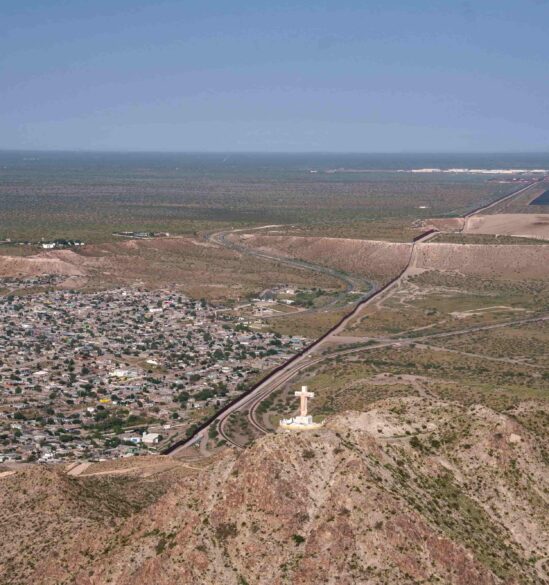
Una vista aérea muestra una cruz en la cima del Monte Cristo Rey, cerca de la frontera entre Estados Unidos y México, en Sunland Park, Nuevo México, el 8 de agosto de 2025. La Diócesis de Las Cruces ha respondido a una demanda presentada contra la diócesis y otros demandados por la administración Trump, que busca expropiar el terreno del Monte Cristo Rey, en la frontera entre Estados Unidos y México, para construir partes de su muro fronterizo. (Foto de OSV News/Paul Ratje, Reuters) Traducción realizada con la versión gratuita del traductor DeepL.com
En la presentación del 8 de mayo de la diócesis, la asesora jurídica general Kathryn Brack Morrow expresó que la diócesis había “recibido múltiples consultas y solicitudes” durante “los últimos meses” por parte del Departamento de Justicia de Estados Unidos, “solicitando acceso al Monte Cristo Rey”, mientras que la diócesis expresó consistentemente su oposición.
Morrow señaló que, durante las comunicaciones entre la diócesis y la agencia, “el alcance del acceso solicitado por el Departamento de Justicia cambió significativamente”.
También afirmó que el impacto del proyecto, tal como fue propuesto durante el período de comentarios públicos de junio de 2025, “no está claro y no parece ser coherente con las solicitudes realizadas previamente a la diócesis”.
El lugar es considerado por los fieles que lo visitan “no solo como un monumento, sino también como un lugar de oración donde la fe trasciende fronteras”, añadió.
Ruben Escandon, oficial de relaciones públicas del grupo voluntario de restauración del Monte Cristo Rey y cuidador de tercera generación del sitio, manifestó a OSV News que el lugar sagrado representa “una herencia familiar”, ya que sus padres, abuelos y familiares ayudaron a desarrollar el lugar moviendo piedras y transportando tierra.
“Tengo 60 años, y probablemente he subido allí durante 50 de ellos”, agregó Escandon, cuya organización trabaja bajo la guía de la Diócesis de Las Cruces.
Una peregrinación tradicional celebrada el último domingo de octubre solía reunir entre 18.000 y 20.000 personas, señaló Escandon.
“Hemos tenido personas que suben de rodillas. Ves a gente subir descalza”, subrayó.
Escandon explicó que los peregrinos “suben allí para pagar sus ‘mandas’”, es decir, “para cumplir sus promesas” o votos hechos a Dios cuando los favores por los que habían orado les son concedidos.
El sitio web del Mount Cristo Rey señala que “hasta 40.000 fieles” han asistido a las celebraciones de aniversario que conmemoran la finalización del monumento.
En los últimos años, la peregrinación de octubre se trasladó para coincidir con la festividad de Cristo Rey, lo que ha provocado cierta disminución en la asistencia, probablemente debido al clima más frío, dijo Escandon. Sin embargo, destacó que entre 12.000 y 14.000 personas participaron en la peregrinación de Viernes Santo de este año.
Además, agregó Escandon, “otras personas hacen peregrinaciones más pequeñas. Las iglesias se organizan y llevan grupos de 50, o incluso 100 personas”.
“Estar allí frente a la imagen … de alguna manera te llena de humildad sentarte allí y contemplar no solo la vista, sino también el monumento mismo y su significado”, manifestó.
El lugar fue concebido inicialmente en 1933 por el padre Lourdes Costa, cuando el área todavía formaba parte de la Diócesis de El Paso.
Tras contemplar la montaña desde su residencia, el padre Costa soñó con colocar una cruz en la cima y convertirla en un lugar accesible para la oración. El obispo de El Paso aprobó el plan y la diócesis compró cerca de 200 acres de los terrenos circundantes.
Voluntarios –incluidas mujeres y niños– trabajaron para construir el camino de 2.5 millas hasta la cima, que primero estuvo marcada por una cruz de madera y luego por una de hierro, antes de que el padre Costa encargara al reconocido escultor Urbici Soler diseñar y crear la estatua actual. Esta fue terminada en 1939.
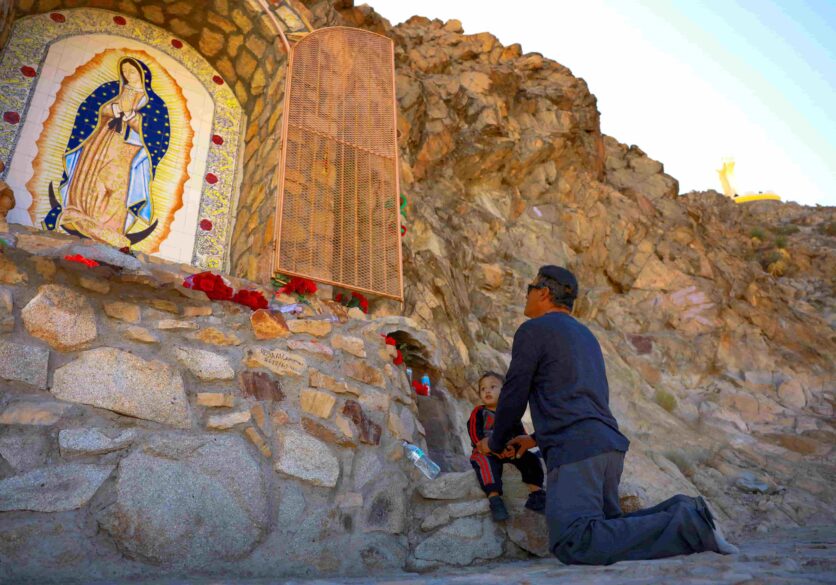
Un hombre reza con un niño frente a una imagen de Nuestra Señora en el Monte Cristo Rey, en Sunland Park, Nuevo México, durante una peregrinación celebrada el 23 de noviembre de 2024 con motivo de la fiesta de Cristo Rey. La Diócesis de Las Cruces ha respondido a una demanda presentada contra la diócesis y otros demandados por la administración Trump, que busca confiscar el sitio del Monte Cristo Rey en la frontera entre Estados Unidos y México para construir partes de su muro fronterizo. (Foto de OSV News/José Luis González, Reuters)
En 1989, con motivo de su 50º aniversario, se realizó la coronación del monumento, siete años después de que San Juan Pablo II estableciera la Diócesis de Las Cruces a partir de las zonas occidentales de la Diócesis de El Paso.
Escandon destacó tanto la importancia artística del Monte Cristo Rey como su valor religioso.
Conservacionistas han expresado alarma por los planes federales de expropiar la montaña, ya que el levantamiento del muro fronterizo probablemente pondría en peligro varias especies y ejercería presión sobre los recursos hídricos durante su construcción.
Defensores de los migrantes también han advertido que el muro fronterizo podría provocar más víctimas, ya que las personas que intenten cruzar hacia Estados Unidos podrían tratar de escalar la estructura, arriesgándose a sufrir lesiones graves.
Preguntado por OSV News sobre qué haría si la confiscación federal del Monte Cristo Rey tuviera éxito, Escandon — quien no habló sobre los aspectos legales del caso — respondió: “Esperemos simplemente que eso no suceda”.
Gina Christian es reportera multimedia de OSV News. Sígala en X en @GinaJesseReina. La reportera de OSV News Kate Scanlon, desde Washington, contribuyó a este informe. Sígala en X en @kgscanlon.
(OSV News) – To mark the 800th anniversary of the beloved saint’s death, Pope Leo XIV has proclaimed a special Jubilee Year in honor of St. Francis of Assisi. It began on Jan. 10.
Given the dramatic nature of his conversion and the long-lasting, widespread influence of the family of religious orders he founded, it’s no surprise that the life of St. Francis has often been portrayed on film. As early as 1918, a silent Italian production, “Frate Sole” (“Brother Sun”), directed by Ugo Falena, was devoted to the subject.
Following, in alphabetical order, are capsule reviews of four of these movies. All are currently available to viewers in various formats.
“Brother Sun, Sister Moon” (1972)
Director Franco Zeffirelli’s version of the oft-told story of Francis of Assisi (Graham Faulkner) treats him as secular saint and social heretic, emphasizing parallels between his age and our own. The strength of the movie lies in its rich visualization of the natural beauties of the Umbrian hills and the Romanesque architecture of medieval Assisi. While the lush and lavish production has nothing to do with the Franciscan spirit of poverty and simplicity, it is a pictorially beautiful movie which succeeds quite well in celebrating nature and the quest for finding more to life than accumulating material goods. Brief rear male nudity in a nonsexual context. The OSV News classification is A-II – adults and adolescents. The Motion Picture Association rating is PG – parental guidance suggested. Some material may not be suitable for children.
“The Flowers of St. Francis” (1950)
Remarkable Italian production about the beginnings of the Franciscan Order as its founder sets the example of humility, simplicity and obedience for his first followers at Portiuncula, a little chapel near Assisi, Italy, from which they depart into the world to preach peace. Directed by Roberto Rossellini from a script co-written with Federico Fellini, the movie’s form is as simple and sincere as the subject of the narrative. Its series of little incidents is related realistically, yet marvelously conveyed with an infectious sense of joy by an anonymous cast of monks from a Roman monastery. Subtitles. The OSV News classification is A-I – general patronage. Not rated by the Motion Picture Association.
“Francesco” (1989)
Overwrought Italian production portrays St. Francis of Assisi (Mickey Rourke) as a spiritual agitator challenging the accepted values of his 13th-century contemporaries by embracing a life of utter poverty and simplicity. Director Liliana Cavani builds an elaborate picture of the period’s social injustices but fails to evoke any convincing sense of religious conviction from Rourke’s embarrassingly vacuous performance. English-language version. Occasional scenes of violence, desperate poverty and brief nudity. The OSV News classification is A-III – adults. The Motion Picture Association rating is PG-13 — parents strongly cautioned. Some material may be inappropriate for children under 13.
“Francis of Assisi” (1961)
Uneven dramatization of the life of the 13th-century saint (Bradford Dillman) who founds a religious community based on absolute poverty, seeks its approval by the pope (Finlay Currie), encourages longtime friend Clare (Dolores Hart) to head a similar women’s order, then journeys to the Holy Land, preaches to the Sultan (Pedro Armendariz) and returns to find his order spreading but changing. Directed by Michael Curtiz, the production is well-mounted and well-intended but the script is a muddle of historical fact and dramatic fiction, with results that barely scratch the surface of Franciscan spirituality. The OSV News classification is A-I – general patronage. Not rated by the Motion Picture Association.
(John Mulderig is media reviewer for OSV News. Follow him on Twitter @JohnMulderig1.)
By Joanna Puddister King JACKSON – The Diocese of Jackson has entered an important period of listening and discernment as it explores the possibility of a future diocesan-wide capital campaign. This effort, known as a feasibility study, is being led by the Catholic Foundation of the Diocese of Jackson and is designed to gather input from clergy, parish leaders and parishioners across the diocese.
A feasibility study is a critical first step in determining whether a campaign is both needed and achievable. It allows diocesan leadership to better understand the needs, hopes and priorities of the faithful before making any decisions. Rather than beginning with assumptions, the diocese is committed to ensuring that any future campaign reflects the real needs of parishes, ministries and the broader Church.
“This is first and foremost a listening process,” said Rebecca Harris, executive director of the Catholic Foundation. “We want to hear what matters most to our parishioners and how we can best support the mission entrusted to us as a diocese.”
Bishop Joseph Kopacz also emphasized the importance of participation in a recent letter to parishioners: “I write to you with gratitude and hope as our diocese enters a time of prayerful listening and discernment … Your voice is essential in this process.” His invitation underscores the central goal of the study which is to ensure that every voice has the opportunity to be heard.
The feasibility study will explore several key areas, including support for parish needs, a retired priest endowment, parish endowments, and the Bishop Houck Lay Leader Center endowment. Another component of the campaign being tested is seminarian education. As the diocese continues to experience growth in vocations, the financial commitment required to educate and form future priests has also increased.
“As we look to the future, investing in seminarian education is essential to the life of our Church,” Harris said. “We are seeing great momentum in vocations, and we must ensure we have the resources to support these men as they prepare for the priesthood.”
Participation from across the diocese is essential to the success of this effort. Feedback gathered during this phase will help determine not only whether to move forward with a capital campaign, but also what priorities it should include if it proceeds.
As part of the process, parishioners should have received a Flocknote message inviting them to complete a brief survey. This survey is one of the primary tools being used to collect input from parishioners around the diocese. All parishioners are encouraged to take a few minutes to share their thoughts.
Results of the feasibility study are expected in mid-May and will guide diocesan leadership in determining next steps.
“This is a moment of opportunity for our diocese,” Harris added. “By listening carefully and planning responsibly, we can ensure that any future campaign strengthens our parishes, forms future priests, and supports the mission of the Church for generations to come.”
All are invited to participate and to keep this effort in prayer as the Diocese seeks to follow God’s guidance in the months ahead.
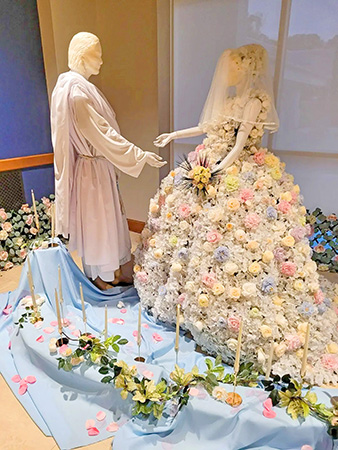
By Joanna Puddister King FLOWOOD – A life-size bride dressed in handmade flowers greeted parishioners at St. Paul Church this Easter, her gown a delicate arrangement of soap petals crafted by members of the parish just weeks before.
Inside the church, those same flowers adorned the altar, the result of a daylong, bridal-themed workshop that invited participants to reflect on the Church as the Bride of Christ and her call into the “Divine Dance.”
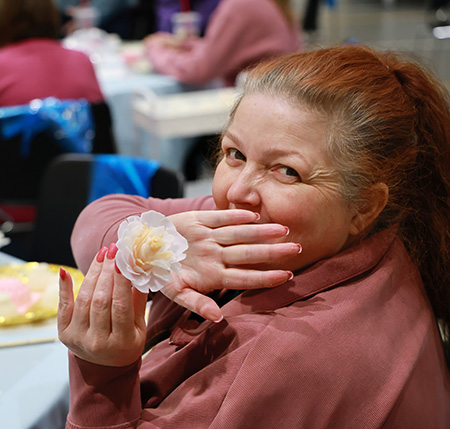
More than 100 parishioners gathered March 14 for the Easter soap flower workshop led by Amber Earles, owner of A’Marie’s Bath Flower Shop, along with Cecilia Carlton, director of liturgy at St. Paul, and parishioner Pam Harkins. Guests of all ages filled tables, shaping delicate soap petals into flowers that would become part of the parish’s Easter environment.
The event blended creativity, catechesis and celebration, with each element of the bridal theme pointing to a deeper spiritual meaning.
“We’ve worked on this for a year, just letting things come to us from the Holy Spirit,” Earles said. “It wasn’t forced – it just unfolded, like the flowers.”
Earles, a St. Paul parishioner, began her business more than a decade ago after creating a bouquet of soap flowers for her hospitalized mother-in-law. When her mother-in-law hesitated to use them because they were “too pretty,” Earles developed a petal-by-petal design that could be enjoyed both visually and practically.
While her handcrafted flowers are now shipped nationwide, Earles said opportunities like the parish workshop remain central to her mission.
“This is why I do what I do,” she said. “Yes, I work to live, but this – seeing people come together, creating and finding joy – this is the purpose behind it.”
Throughout the day, participants created mostly white flowers symbolizing the purity of the Bride of Christ, along with multicolored blooms representing the unique gifts within the Body of Christ. These were later incorporated into both the altar display and the atrium scene depicting Jesus inviting His Bride into the Divine Dance.
A life-size display depicting Jesus inviting His Bride, the Church, into the “Divine Dance” is featured in the atrium of St. Paul Catholic Church for Easter. (Photo by Amber Earles)
During a midday reflection, Carlton guided participants into the theological meaning behind the imagery.
“We are not meant to stand apart from the Lord,” Carlton said. “We are invited to the feast of the Lamb – invited into relationship, into communion, into the dance itself.”
Drawing from Scripture and tradition, Carlton described the Divine Dance as the movement of love within the Trinity and the invitation extended to all believers.
“No more standing at a distance,” she said. “There is a place set for you at the table.”
The bridal theme carried through the day with a wedding-style cake, a bouquet toss and soap flower bases given as favors – lighthearted touches that reinforced the central message of the wedding feast of the Lamb.
By the end of the workshop, the room that once buzzed with conversation and careful handiwork reflected a shared sense of joy and participation in something greater.
“It’s not just about making something beautiful,” Earles said. “It’s about being invited into something deeper – into God’s love.”
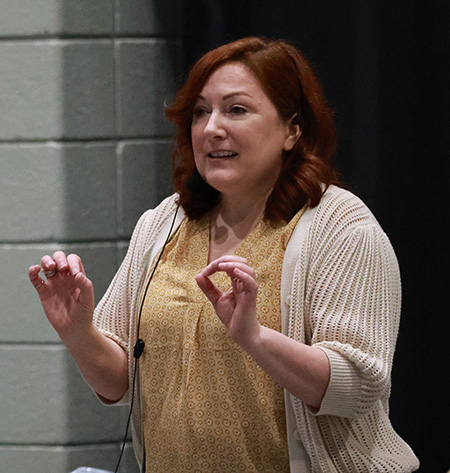
(Above) Kerry Doyle, a parishioner of St. Paul Church, displays a handmade soap flower she crafted during a March 14 workshop preparing decorations for the Easter altar and atrium. (On right) Amber Earles speaks to participants about the origins of her handcrafted soap flowers and A’marie’s Bath Flower Shop. (Photos by Joanna King – For more photos visit jacksondiocese.zenfoliosite.com.)
From the Archives By Mary Woodward Occasionally, we have people wandering in wanting to stroll through our diocesan archives hoping to find long lost information about a parish event in 1950 or a baptismal record for a great grandparent. Often, these items are available at the local parish.
As a gentle reminder, the diocesan archives house the historical papers of each bishop and are open by appointment to scholars and historical researchers writing dissertations and articles for historical and church journals. Right now, we are doing some cleaning and reorganizing so the archives are closed to researchers until that is completed.
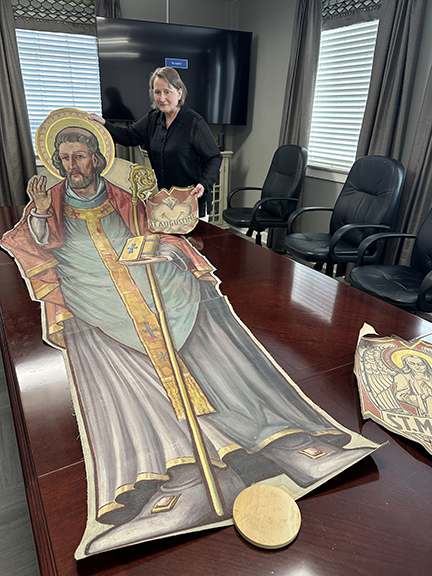
JACKSON – Chancellor and archivist Mary Woodward examines a recently recovered canvas painting of St. Augustine, one of eight works that once hung in the sanctuary of the Cathedral of St. Peter the Apostle before being removed during a mid-20th-century renovation. The paintings, long thought lost, have now been returned to the diocesan archives for preservation and future restoration. (Photos from archives)
However, on the Thursday before Holy Week an old friend showed up in the chancery lobby and asked to see me. He had with him something I thought was lost forever – a large canvas painting of St. Augustine that once adorned the walls of the sanctuary in our Cathedral of Saint Peter the Apostle.
The current St. Peter’s was completed in 1900. It is the third church building. [The first burned in 1863; the second built in 1868 was moved in 1913 a few blocks north to become the first Holy Ghost church.] Its interior has gone through several renovations over the last 126 years, most recently in 2011-2012.
During a renovation in the 1950s, eight large canvas paintings of the four evangelists and four church fathers – Augustine, Ambrose, Athanasius and John Chrysostom were added to the sanctuary walls. The saints would gaze down upon the sacred mysteries with great joy and serenity.
In a later renovation, the interior went through a monochromatic phase and the eight canvases were removed. I had seen photos of them, but I never thought I would see them in person. But right here in front of me was one of them.
My friend explained that a former organist of the cathedral had found them discarded during renovation and took them home. Just recently he was moving and contacted my friend to come and get a few things he was not taking with him. Augustine was among those things.
What is even better is my friend told me he had seven more of these at home and would be happy to donate them to our archives. He just wanted me to see one and decide if we could take them on. (n.b., we do not take everything, so please call or email before bringing items for archives.)
The next day he brought in the remaining seven and all now reside safely in an ancillary archive room waiting for an opportunity to be cleaned and restored. We have just the spot for them.
The lesson is: when a renovation occurs at a parish, keep meticulous notes and records in a parish file of all contractors, architects, artists and craftsmen who do the work. If items are removed document where they go – to the parish hall or parish school, another parish, or if they are destroyed properly. Fifty to 100 years later, they may be the perfect piece needed to complete a renovation.
(Mary Woodward is Chancellor and Archivist for the Diocese of Jackson.)
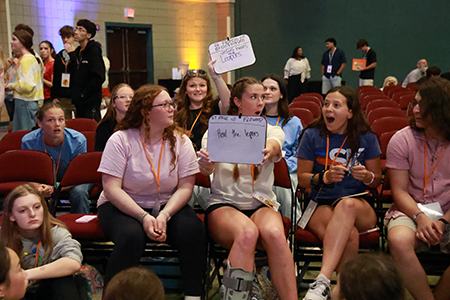
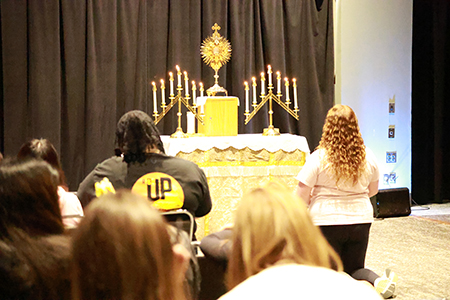
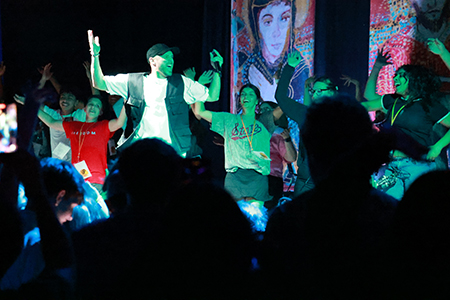
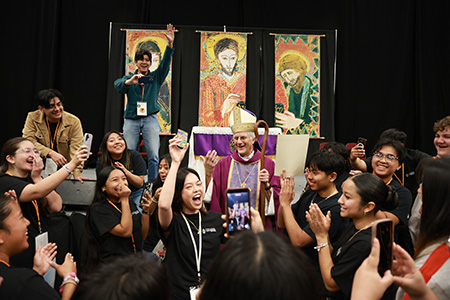
VICKSBURG – More than 300 youth from across the Diocese of Jackson gathered March 20-22 for the Diocesan Catholic Youth Conference (DCYC) at the Vicksburg Convention Center, embracing the theme “Rise Up.” The weekend featured keynote presentations, small group sessions, games, Mass, Reconciliation, Adoration and a high-energy concert with Catholic hip-hop artist Joe Melendrez and DJ Code.
“This weekend is about helping our young people encounter Christ in a real and personal way and giving them the confidence to rise up and live their faith,” said Abbey Schuhmann, diocesan coordinator for the Office of Youth Ministry.
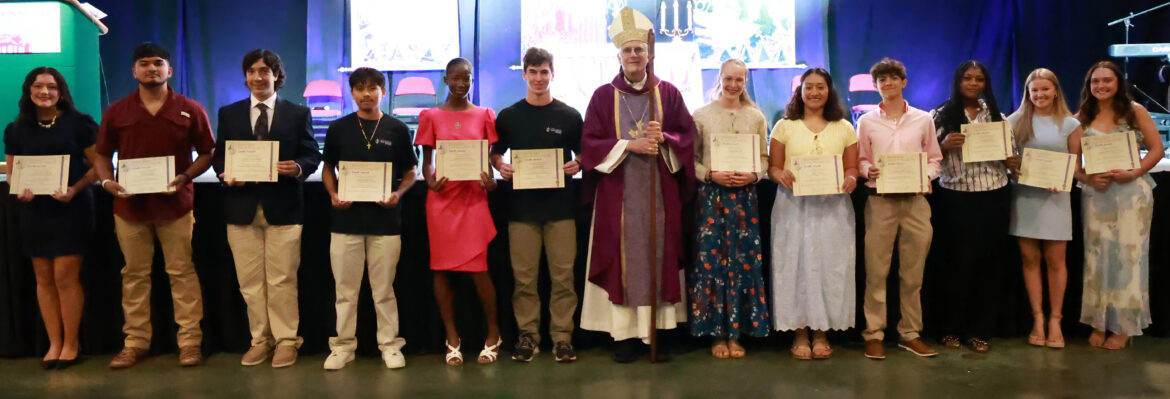
The conference concluded with Mass celebrated by Bishop Joseph Kopacz and the presentation of the Bishop Chanche Youth Service Awards to 12 youth from around the diocese.
Can you solve it?
Youth react during a group game at DCYC, using emoji clues to identify moments from Scripture. Can you solve the emoji clue above?Bishop Joseph Kopacz is pictured with Bishop Chanche Youth Award recipients, from left, Cheyenne Vrbicky of Holy Cross, Phildelphia; Jessie Torres of Sacred Heart, Greenville; Gabriel Theunissen of St. Joseph, Greenville; Edwin Sebastian of St. Michael, Forest; Amenia Rozzelle of St. Alphonsus, McComb; James Ross of St. Joseph, Meridian; Dori Paczak of St. Jude, Pearl; Arely Gomez of St. Patrick, Meridian; Alexander Glass of St. Francis, Madison; Kameron Fox of Holy Ghost, Jackson; Hayden Bell of St. Paul, Vicksburg; and Anna Christine Antici of St. Joseph, Gluckstadt.