
By Msgr. Owen Campion
(OSV News) – Every December, we priests try to guide our people toward an observance of Advent. The liturgical season has a certain starkness about it, and this is fitting. It is the time when the Church calls us to prayer and penance in preparation, not simply for the coming of Dec. 25 on the calendar, but for the feast of Christmas as a moment when truly the Lord Jesus comes into our hearts with the wonder and promise of newborn life.
Such most worthy spiritual themes, with all their sobriety and solemnity, do not play well in our culture. In the circumstance in which we live, the weeks preceding Christmas usually are not at all accommodating for what should be the mood of Advent – but it is possible to identify and recall spiritual values in the busy time of buying presents and having parties.
Look at the Christmas decorations and use them to tell a religious story.
– The Christmas tree. Queen Victoria’s husband, Prince Albert, was from a minor German principality, but he had an impact on his wife’s country. He placed in Windsor Castle at Christmas a Christmas tree, remembering Christmas trees back home in Germany.
A Christmas tree is no ordinary tree. It is evergreen. Its foliage is bright and alive. Unlike trees that shed their leaves in the cold season, its leaves do not die with the coming of winter. Its leaves live in the cold as well as in the warm. It bears fruit, not apples or pears, but fruit of gold and color that sparkle. It bears the most precious of fruit.
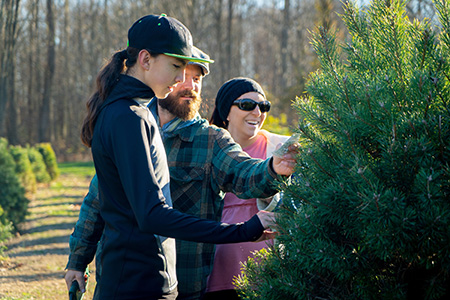
The Christmas tree shines in the dark with lights of many colors. These colors suggest the spectrum of the aurora borealis, visible in the sky in Northern Europe. The lights have a heavenly quality. They suggest Jesus, the Light of the World.
Each Christmas tree stands alone in a family living room, but picture the tree in a forest. The Christmas tree gleams with light. Of all the trees, it is unique and beckoning. Of all humanity, Jesus stands supreme, calling us to salvation, and guiding us to our goals.
– Christmas gifts. Here we go overboard, and merchants have us under their spell. Extravagance is an issue. The gifts can teach a lesson, however. The Magi brought the choicest gifts to the Infant. We select gifts with care. We try to give those whom we love gifts that will be appreciated and that will signal our love.
When gifts are given at Christmas, they can reflect our belief that each of us is God’s precious creation, and that through the Incarnation Jesus lives in each of us.
And, we should care for them so much that we select for them the best.
Finally, our gifts at Christmas come in brilliantly wrapped containers. They are special, not just other ordinary boxes.
– Holly. Of all plants, holly has most often been associated with Christmas in our culture. It has a Christian message. Evergreen, it is alive and brilliant on the coldest winter day. It reminds us of the Lord, alive and forthcoming in love and mercy on the bleakest of days.
The Lord fulfilled His divine mission of redemption on Calvary. He died on the cross, wearing a crown of thorns, pressed upon his brow by unbelieving, cruel people as mockery. The sharp points on the holly leaves represent this crown of thorns. The red berries symbolize the drops of the precious blood that flowed as the crown pierced the Lord’s forehead.
Jesus wore the crown, and in the kingdom of heaven, he lives forever.
– Carols. No holy day, or any holiday, in Western society is more accompanied by its particular music than is Christmas. The hymns are sung everywhere, “Silent Night,” “O Little Town of Bethlehem,” “O Holy Night,” and so on. Inspiring the tradition of the carols was Luke 2:13-14, that tells of the angels proclaiming the birth of the Savior. Listen to the carols. Listen to the words. They exclaim the great joy and relief of knowing that God is with us.
– Wreath. In the past generation or so in this country, many Catholic churches have displayed Advent wreaths in the weeks preceding Christmas. Other Christian denominations have done the same.
Wreaths were part of Christmas before Advent wreaths, however. Christmas wreaths teach a lesson. Always, they are evergreen, even in Hawaii and Florida where palm trees are much more plentiful! Evergreen, again, symbolizes life even in the face of darkness, gloom, cold and death. The circle symbolizes the eternity and perfection of God.
Inevitably, red ribbons and bows festoon Christmas wreaths, not blue bows – interestingly, since historically blue has been the Christian color – and not white, the color of the innocence of infants; not gold, the symbol of triumph; not purple, the color of royalty. The ribbon must be red. It is the color of the precious blood, shed for us by Jesus on Calvary.
– Red. Walk through any shopping mall during the days before Christmas. Look over the congregation at a Mass on Christmas. Vividly evident will be garments of red: red shirts, red ties, red blouses, red coats, red caps and red scarves. No color is more identified with Christmas.
Red, as noted above, refers to the shedding of the precious blood and to the salvation achieved for us through this shedding. At times, in homilies during the season, noting the preponderance of red, I thank the people for wearing “Christian uniforms,” for proclaiming with their very vesture that Jesus is the Savior, the Crucified, the Giver of Life. The return glances suggest that many never considered Christmas red in that way!
– Christmas dinner. Festive meals are associated with many events, weddings, retirements, graduations, holidays and even funerals. None, however, matches the family’s Christmas dinner. The bonds of love and relationship are stretched wide and far. People invite to their Christmas dinners relatives and friends whom they have not seen for a long time. Many invite strangers or people who are alone. Collectively, these families represent the Lord. He welcomed all. He was a special friend to the lonely and the hurting. He loved all.
– Mass. For Catholics, the greatest moment at Christmas, the indispensable moment, is the Mass. No pastor fails to realize this special aspect of the feast. Choirs practice for weeks. Churches are richly decorated. Churches place in very prominent places creches, depictions of the Nativity of Jesus. Pastors work long and hard on preparations.
Many people still come to Mass in the middle of the night, at times despite bad weather. All want to be reassured in the fact that in Jesus, God has come, with hope, forgiveness, strength and life. This intense interest in, and commitment to, the Mass at Christmas are lessons in themselves.
Observe and think as you go about all the busy work at Christmas. Look at the Christmas trees with their bright lights and their stars. Look at the evergreen wreaths. Look at the brightly decorated gifts. Look at the red coats and shirts. Look at the lists for selecting the very best of groceries for Christmas dinners. Look at the plans to get to Christmas Mass. Look at all these things – and think.
These things are about Jesus, the Son of God and son of Mary, who came into our world at Bethlehem 2,000 years ago and is still our hope and our strength.
(Msgr. Owen Campion is a well-known Catholic prelate, author and journalist who serves as the chaplain for Our Sunday Visitor.)