
By OSV News
Pope Leo XIV concluded his first trip to Africa April 23, capping a four-country visit marked by urgent calls for peace, direct engagement with conflict zones and a backdrop of international political tension.
Traveling April 13–23 through Algeria, Cameroon, Angola and Equatorial Guinea, the pope met civil and religious leaders, celebrated public Masses and encouraged Catholics to remain steadfast witnesses to the Gospel.
His visit brought him into regions scarred by violence, including Cameroon’s separatist conflict, while also addressing inequality and corruption in Angola, promoting interreligious dialogue in Algeria and a just society in Equatorial Guinea.
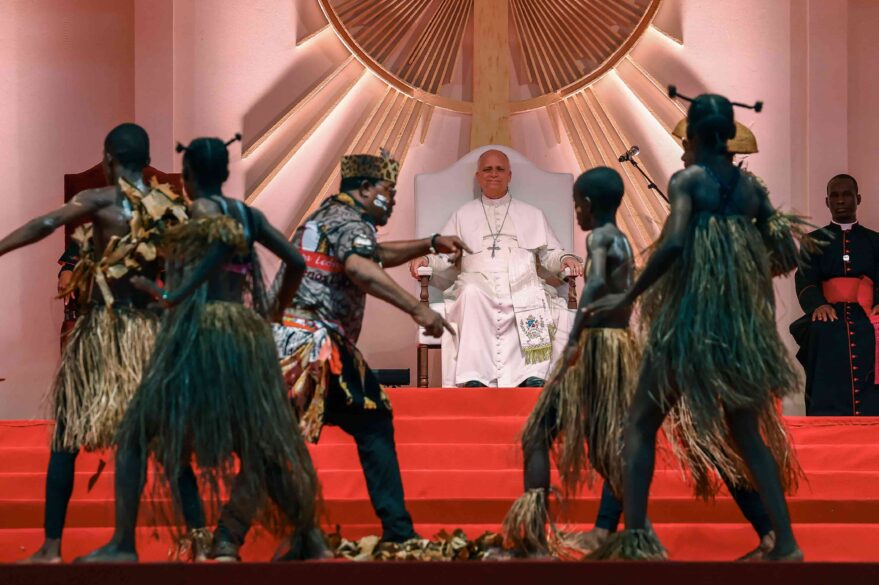
– Algeria –
Pope Leo’s 11-day trip began with an unexpected controversy after U.S. President Donald Trump criticized him in a late-night April 12 post on Truth Social.
Trump called the pope “weak on crime” and “terrible for foreign policy,” accusing him of believing “it’s OK for Iran to have a nuclear weapon.” The remarks followed the pope’s criticism of the Iran war and his repeated calls for peace.
Journalists aboard the papal flight quickly pressed for a response.
“I have no fear, neither of the Trump administration nor of speaking out loudly of the message of the Gospel, which is what I believe I am here to do,” Pope Leo said.
“We are not politicians,” he added. “We are not looking to make foreign policy … but I do believe in the message of the Gospel: ‘Blessed are the peacemakers’ is the message that the world needs to hear today.”
The remarks sparked backlash from religious and political leaders, but the pope declined to escalate tensions.
“I don’t want to get into a debate,” he said, emphasizing that his mission is to proclaim peace.
“I don’t think that the message of the Gospel is meant to be abused in the way that some people are doing.”
Despite the dispute, Pope Leo struck a positive tone before landing, saying he was “very happy to visit the land of St. Augustine again.”
In Algiers, he visited the Great Mosque, calling the encounter a sign “that we can learn to respect one another, live in harmony and build a world of peace.”
Later, at the Basilica of Our Lady of Africa overlooking the Mediterranean, he honored Algeria’s Christian martyrs and highlighted interreligious dialogue in the Muslim-majority nation.
The basilica, he said, is a “sign of our desire for peace and unity,” symbolizing “a Church of living stones, where communion between Christians and Muslims takes shape.”
On April 14, the pope traveled to Annaba, near the ruins of ancient Hippo Regius, where St. Augustine spent his final years. The visit held personal significance; Pope Leo has often described himself as “a son of Augustine.”
Celebrating Mass at the Basilica of St. Augustine, he urged Christians to follow the saint’s example, “fervently seeking the truth and serving Christ with ardent faith.”
“Be heirs to this tradition, bearing witness through fraternal charity … as a hope of salvation for the world,” he said.
Addressing Algeria’s small Christian community, he praised their quiet witness.
“Your presence in this country is like incense,” he said. “A glowing grain that spreads fragrance because it gives glory to the Lord and joy and comfort to so many.”
– Cameroon –
During his flight to Cameroon, Pope Leo reflected on Algeria as “a special blessing,” noting that St. Augustine’s life offers a vision of unity and respect across differences.
That message carried into Cameroon, a country scarred by separatist violence. Addressing authorities in Yaoundé, the pope acknowledged the suffering caused by conflict in the English-speaking northwest and southwest regions.
Since 2017, fighting between separatist militias and government forces has killed more than 6,500 people and displaced over 500,000.
“Lives have been lost, families displaced, children deprived of schooling and young people no longer see a future,” he said. “Behind the numbers are the faces, stories and shattered hopes of real people.”
Days before his arrival, separatist groups declared a three-day ceasefire to allow safe travel during the visit.
The highlight of the April 15–18 stop was the pope’s visit to Bamenda, in the heart of the conflict zone. Addressing Catholics at St. Joseph’s Cathedral, the pope was met with enthusiasm after declaring, “I am here to proclaim peace.”
After hearing testimony from local residents – including a chief imam who described a deadly attack on a mosque – the pope strongly condemned violence carried out in God’s name.
“But woe to those who manipulate religion and the very name of God for their own military, economic and political gain,” he said, warning against dragging what is sacred “into darkness and filth.”
Celebrating Mass for 20,000 people at Bamenda’s airport, he urged hope rooted in faith.
“This is the moment to change, to transform the story of this country,” he said. “The time has come, today and not tomorrow.”
He called on Cameroonians to “restore the mosaic of unity” by embracing the country’s diversity.
On April 17, he celebrated Mass in Douala for an estimated 120,000 faithful, urging Africans to share God’s love by feeding the hungry and offering spiritual nourishment.
Though the visit brought hope, media coverage continued to frame the trip through the lens of tensions with Trump – something the pope later addressed directly.
– Angola –
While the pope’s warning to those who use God to justify violence resonated with suffering Cameroonians in Bamenda, several media outlets ran headlines insinuating that Pope Leo was making an indirect dig at Trump.
En route to Angola, Pope Leo clarified that his remarks in Cameroon had been prepared weeks earlier and were not directed at the U.S. president.
“My speeches were written well before the president ever commented,” he said. “It is not in my interest to debate,” adding “there has been a certain narrative that has not been accurate in all its aspects.”
Arriving in Luanda, he shifted focus to Angola’s challenges and the Church’s role in offering hope. Home to more than 20 million Catholics, Angola has deep Christian roots but continues to struggle with inequality, corruption and the legacy of a civil war that claimed up to 800,000 lives.
Addressing government leaders, the pope urged them to prioritize the common good.
“Place the common good before every particular interest,” he said. “Never confuse your own part with the whole.”
He warned that the people have suffered when power is abused.
“They bear the scars not only of material exploitation, but also of the presumption of imposing an idea upon others,” he said.
On April 19, Pope Leo celebrated Mass for about 100,000 faithful in Kilamba. Reflecting on the Gospel story of the road to Emmaus, he cautioned against despair in societies marked by prolonged suffering.
“When one is long immersed in a history characterized by pain, one can risk losing hope and remaining paralyzed by discouragement,” he said.
Afterward, he traveled to the Sanctuary of Mama Muxima, southern Africa’s most visited Catholic shrine, where tens of thousands had gathered – many camping for days in intense heat.
Calling the shrine a place where “the heart of the Church” is alive, he noted its enduring role in Angola’s spiritual life.
“For centuries, many have prayed here in joy and sorrow,” he said. “Mama Muxima has quietly kept the heart of the Church alive and beating.”
On April 20, the pope flew east to Saurimo, near Angola’s largest diamond mine. There, he visited a nursing home housing 74 elderly residents, many rejected by their families due to superstitious beliefs.
“The care of the weakest is a sign of the quality of a nation’s social life,” he said. “The elderly must not only be assisted, but listened to, because they preserve the wisdom of a people.”
Celebrating Mass for tens of thousands, he also addressed exploitation linked to the diamond industry.
“How often the hope of many is frustrated by violence, exploited by the overbearing and defrauded by the rich,” he said.
“We were not born to become slaves,” he added. “Every form of oppression, violence and dishonesty negates the resurrection of Christ, the supreme gift of our freedom.”
– Equatorial Guinea –
The final leg of Pope Leo’s 11-day journey took him to Equatorial Guinea. Upon landing on the island of Malabo, the pope was welcomed by President Teodoro Obiang Nguema Mbasogo, who has ruled the oil-rich Central African nation since seizing power in a 1979 coup and is widely regarded as one of the world’s most authoritarian leaders.
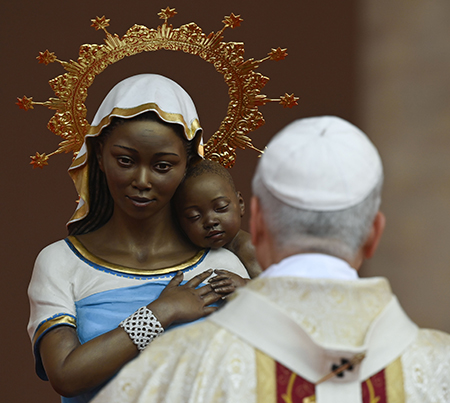
Nevertheless, in his address to the country’s civil authorities, the pope appealed for justice and ethical governance in a country long criticized for corruption and human rights abuses.
Drawing from St. Augustine’s classic work “The City of God,” Pope Leo noted that the “city of God” is characterized by love, especially for the poor, while the “earthly city … is centered upon the proud love of self, on the lust for power and worldly glory that leads to destruction.”
“Every human being can benefit from the ancient realization of living on earth as a pilgrim,” he said. “It is essential to discern the difference between that which lasts and that which passes, remaining free from the pursuit of unjust wealth and the illusion of dominion.”
Celebrating Mass April 22 at the Basilica of the Immaculate Conception in the eastern city of Mongomo, the second-largest Catholic Church in Africa, the pope renewed his call to the country’s leaders and citizens to prioritize the common good.
“May the Lord help you to become a society in which everyone, each according to their respective responsibilities, works ever more fully to serve the common good rather than private interests, bridging the gap between the privileged and the disadvantaged,” he said.
In his final Mass in Malabo Stadium April 23, Pope Leo offered a word of hope to the country’s Catholics, urging them to seek strength, justice and hope from the Gospel and the sacraments.
Encouraging the faithful to “joyfully proclaim” that “Christ is everything for us,” Pope Leo reminded Christians that in Jesus, “we find the fullness of life and meaning.”
“Our problems do not disappear in the Lord’s presence, but they are illuminated,” he said. “Just as every cross finds redemption in Jesus, so too the story of our lives finds its meaning in the Gospel.”
As the Mass concluded, the pope bid farewell to the African continent, saying that his visit was “an invaluable treasure of faith, hope, and charity.”
Highlighting the continent’s significance, the pope said that “today, Africa is called to contribute significantly to the holiness and missionary character of the Christian people.”
“I entrust this intention to the intercession of the Virgin Mary, to whom I commend myself wholeheartedly, as well as your families, your communities, your nation, and all the peoples of Africa,” the pope said.