By Cindy Wooden VATICAN CITY (CNS) – Many Christians “need to go back and re-read the Gospel” because they have forgotten that faith and love for the poor go hand in hand, Pope Leo XIV said in his first major papal document.
“Love for the poor – whatever the form their poverty may take – is the evangelical hallmark of a Church faithful to the heart of God,” the pope wrote in “Dilexi Te” (“I Have Loved You”), an apostolic exhortation “to all Christians on love for the poor.”
Pope Leo signed the document Oct. 4, the feast of St. Francis of Assisi, and the Vatican released the text Oct. 9.
The document was begun by Pope Francis, Pope Leo said, but he added to it and wanted to issue it near the beginning of his papacy “since I share the desire of my beloved predecessor that all Christians come to appreciate the close connection between Christ’s love and his summons to care for the poor.”
The connection is not new or modern and was not a Pope Francis invention, he said. In fact, throughout the Hebrew Scriptures “God’s love is vividly demonstrated by his protection of the weak and the poor, to the extent that he can be said to have a particular fondness for them.”
“I am convinced that the preferential choice for the poor is a source of extraordinary renewal both for the Church and for society,” Pope Leo wrote, “if we can only set ourselves free of our self-centeredness and open our ears to their cry.”
As he has done from the beginning of his papacy in May, the pope decried the increasing gap between the world’s wealthiest and poorest citizens and noted how women often are “doubly poor,” struggling to feed their children and doing so with few rights or possibilities.
Pope Leo also affirmed church teaching since at least the 1960s that there are “structures of sin” that keep the poor in poverty and lead those who have sufficient resources to ignore the poor or think they are better than them.
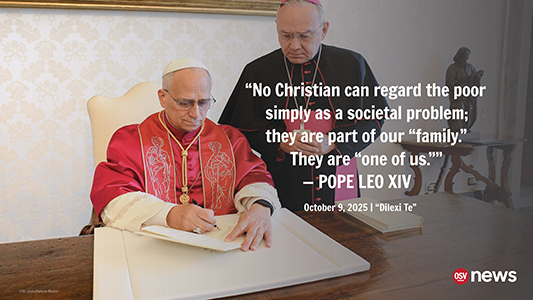
This is a quote from “Dilexi Te,” Pope Leo XIV’s first apostolic exhortation which promulgated Oct. 9, 2025. (OSV News graphic/Megan Marley)
When the church speaks of God’s preferential option for the poor, he said, it does not exclude or discriminate against others, something “which would be impossible for God.”
But the phrase is “meant to emphasize God’s actions, which are moved by compassion toward the poverty and weakness of all humanity,” he wrote.
“Wanting to inaugurate a kingdom of justice, fraternity and solidarity,” Pope Leo said, “God has a special place in his heart for those who are discriminated against and oppressed, and he asks us, his Church, to make a decisive and radical choice in favor of the weakest.”
That choice, he said, must include pastoral and spiritual care as well as education, health care, jobs training and charity – all of which the church has provided for centuries.
The document includes a separate section on migrants with the pope writing, “The Church has always recognized in migrants a living presence of the Lord who, on the day of judgment, will say to those on his right: ‘I was a stranger, and you welcomed me.’”
The quotation is from the Gospel of Matthew 25:35, which is part of the “Judgment of the Nations” in which Jesus clearly states that his followers will be judged on how they care for the poor, the sick, the imprisoned and the foreigner.
“The Church, like a mother, accompanies those who are walking” in search of a better, safer life for themselves and their families, Pope Leo wrote.
“Where the world sees threats, she (the church) sees children; where walls are built, she builds bridges,” he continued. “She knows that her proclamation of the Gospel is credible only when it is translated into gestures of closeness and welcome.”
The church knows, he said, “that in every rejected migrant, it is Christ himself who knocks at the door of the community.”
In his exhortation, Pope Leo went through biblical references to the obligation to love and care for the poor and cited saints and religious orders throughout history that have dedicated themselves to living with the poor and assisting them.
A section of the document focuses on the “fathers of the church,” the early theologians, who, he said, “recognized in the poor a privileged way to reach God, a special way to meet him. Charity shown to those in need was not only seen as a moral virtue, but a concrete expression of faith in the incarnate Word,” Jesus. Of course, for Pope Leo, an Augustinian, St. Augustine of Hippo was included in the document. The saint, “The Doctor of Grace, saw caring for the poor as concrete proof of the sincerity of faith,” the pope wrote. For Augustine, “anyone who says they love God and has no compassion for the needy is lying.”
And while the pope wrote that “the most important way to help the disadvantaged is to assist them in finding a good job,” he insisted that when that is not possible, giving alms to a person asking for money is still a compassionate thing to do.
“It is always better at least to do something rather than nothing,” Pope Leo wrote.
Still, the pope said, Christians cannot stand idly by while the global economic system penalizes the poor and makes some people exceedingly wealthy. “We must continue, then, to denounce the ‘dictatorship of an economy that kills,’” he said, quoting a phrase Pope Francis used.
“Either we regain our moral and spiritual dignity, or we fall into a cesspool,” he wrote.
“A Church that sets no limits to love, that knows no enemies to fight but only men and women to love,” Pope Leo said, “is the Church that the world needs today.”
From the Archives By Mary Woodward American Archives Month is national celebration led by the United States National Archives every October to promote the importance of archives in preserving cultural heritage and historical records. It’s a time when archives nationwide open their doors to highlight their collections, showcase stories, and celebrate the value of public records.
For the past five years through this column, we have been highlighting in various ways our diocesan archives. We have shared sacramental records dating back to the 1790s, stories from the travels of our bishops at home and abroad, our diocesan connection to the Gulf South region, unique characters and historical tidbits. A huge thank you to Bishop Richard Oliver Gerow who meticulously maintained our collection for more than 40 years.
Our archive collection is full of American history and church history. We currently are in a clean and reorganize mode. Papers and artifacts are getting a new look. Therefore, the vault is closed to any outside professional research at this time.
As much as we would like to allow visits to the archives, it simply is not the nature of the beast. Visits to our archive collection are reserved for professional scholars researching historical topics for dissertations and journal publications. We do not allow independent genealogical research among our records or the well-intentioned history buff.
With that understanding, we have tried to break open some of our cherished history for you to give you an image of how our Catholic faith has developed over the past 300 years in this little corner of God’s Kingdom. So, in celebration of American Archives Month let me feature a few of our favorite images from the collection.
(Mary Woodward is Chancellor and Archivist for the Diocese of Jackson.)
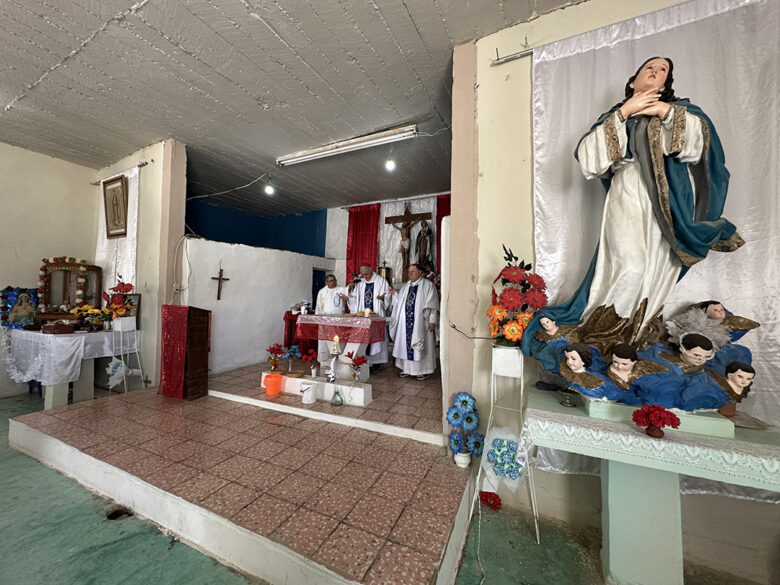
GARAMBULLO, MEXICO – Bishop Joseph R. Kopacz of Jackson (center) concelebrates Mass with Father David Martínez Rubio (left) and Bishop Louis Kihneman of Biloxi (right) during a visit to mission communities in the remote Saltillo region. The annual diocesan mission trip by the bishops continues the work begun decades ago by Father Patrick Quinn. (Photo by Tereza Ma)
SPIRITUAL ENRICHMENT DIOCESE/MADISON – Fall Faith Formation Day, Saturday, Nov. 15 at St. Francis, Madison from 10 a.m. to 3 p.m. The Department of Faith Formation welcomes all formation leaders and volunteers for a keynote by Robert Feduccia and a variety of breakout sessions to with the theme “Pilgrims of Hope Journeying Together.” Cost: $10. Register at https://bit.ly/FFFDay2025. Deadline is Nov. 5. Details: email fran.lavelle@jacksondiocese.org.
DIOCESE/MOBILE, Ala. – Sister Thea Bowman Jubilee of Hope Bus Pilgrimage, Nov. 15-16 to Mobile and Montgomery, Ala., for a powerful journey of faith, history and fellowship. Highlights include visits to the Africatown Heritage Center, the Equal Justice Initiative and more. Details: Visit https://bit.ly/srtheapilgrimage2025 for more info and to register.
DIOCESE/NATCHEZ – Diocesan Young Adult Pilgrimage to St. Mary Basilica in Natchez, Nov. 8. Register by Nov. 1. Cost $25. Fee does not include transportation, meals or optional overnight stay. Details: https://jacksondiocese.flocknote.com/signup/222556 or email amelia.rizor@jacksondiocese.org.
DIOCESE/CLINTON – Diocesan Youth Adult Day of Reflection “Prepare the Way,” Saturday, Dec. 6, from 10 a.m. to 2 p.m. at Camp Garaway, Clinton. Register at https://bit.ly/YAReflection25. Details: amelia.rizor@jacksondiocese.org.
CLINTON – Holy Savior, Parish Ladies Retreat, Saturday, Nov. 1, 8:30 a.m. to noon. Join us for a time of fellowship, reflection and prayer. Retreat includes Mass, presentations and lunch. Details: Register at https://bit.ly/HSLadiesRetreat112025.
GLUCKSTADT – St. Joseph, Millions of Monicas – Praying with confidence for our children, each Tuesday from 6:30-7:30 p.m. in the church. Join with other mothers and grandmothers as we pray for our children’s faithful return to the church. Details: email millionsofmonicas@stjosephgluckstadt.com.
PARISH & YOUTH EVENTS BROOKHAVEN – St. Francis, Trunk or Treat, Wednesday, Oct. 29 at 6 p.m. on the parish playground. Details: church office (601) 833-1799.
CLINTON – Holy Savior, Fall Festival/Trunk or Treat, Wednesday, Oct. 29 from 6-7:30 p.m. in the upper parking lot. Details: church office (601) 924-6344.
GREENVILLE – St. Joseph, Trunk or Treat, Wednesday, Oct. 29 at 5:30 p.m. in the Our Lady of Lourdes parking lot. Details: Katherine at (662) 836-6108.
JACKSON – Cathedral of St. Peter the Apostle, Parish Gala, Saturday, Nov. 1 at 6 p.m. at the Capitol Club Rooftop. Join us for this no tie occassion to raise funds for the Cathedral kitchen and promote community in the parish. Details: church office (601) 969-3125.
MADISON – St. Francis, Parish Mission “Hope and Pilgrimage,” Oct. 26-27 from 5:30-7:45 p.m., with speaker and author Joan Watson. All are welcome. Please RSVP. Details: church office at (601) 856-5556.
St. Francis, Trunk or Treat, Wednesday, Oct. 29, from 6:30-8 p.m. Details: church office (601) 586-5556.
NATCHEZ – St. Mary Basilica, Trunk or Treat and Halloween Carnival, Thursday, Oct. 30 in the parking lot on Union Street across from Memorial Park. Details: church office at (601) 445-5616 or secretary@stmarybasilica.org.
PEARL – St. Jude, Remembrance Mass, Wednesday, Nov. 5 at 6 p.m. Come for a special celebration in memory of our loved ones that have gone before us. Details: office@stjudepearl.org.
SOUTHAVEN – Christ the King, Halloween Bash, Friday, Oct. 31 from 6-8 p.m. Games, concessions and more. Cost of entry: one bag of candy. Details: church office (662) 342-1073.
STARKVILLE – St. Joseph, CYO Garage Sale, Saturday, Nov. 15 from 8-11 a.m. in the parish hall. Details: church office (662) 323-2257.
EMPLOYMENT JACKSON – Diocese of Jackson seeks a Facilities Manager to support parishes and schools. Oversees contract review, construction, and diocesan property/life-health-safety policies; manages maintenance and repairs for the Chancery and diocesan sites. Bachelor’s/associate degree in facilities or construction preferred; CFM preferred; 5+ years facilities/construction management required. Email résumé and cover letter to Cathy Pendleton at cathy.pendleton@jacksondiocese.org.
CATHOLIC SCHOOL ADMINISTRATOR POSITIONS – The Diocese of Jackson seeks qualified, faith-filled leaders to serve as administrators in our Catholic schools. Positions available at St. Joseph School, Madison (Grades 7–12), St. Joseph School, Greenville (Grades PK3–12), and St. Elizabeth School, Clarksdale (Grades PK3–6). Applicants should be practicing Catholics with leadership experience, strong communication skills, and a commitment to Catholic education. For details and applications, visit jacksondiocese.org/administrator-employment.
By Joanna Puddister King MADISON – The spirit of faith and generosity filled St. Francis of Assisi Parish on Saturday, Oct. 11, as nearly 300 guests gathered for the sixth annual Homegrown Harvest Festival – an evening of blues, barbecue and support for the future priests of the Diocese of Jackson.
The event raised a record $189,000, with donations still coming in. Funds from the night directly support the diocese’s 12 seminarians and the Office of Vocations’ efforts to promote priesthood.
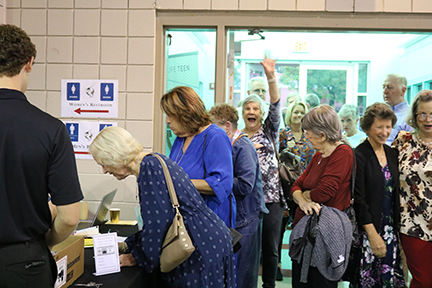
MADISON – Jo Ann Foret (center) waves with excitement as guests arrive for the Homegrown Harvest Festival at St. Francis of Assisi Parish on Oct. 11. The event celebrated the diocese’s seminarians and future priests.
For the first time, the event featured a live auction led by EJ Martin, who energized the crowd with a “raise your paddle” appeal. Guests pledged at various levels helping the live auction alone bring in $15,400.
“It was a wonderful evening,” said Father Nick Adam, diocesan director of vocations. “We had a record number of guests and raised a record amount for our seminarians. Every dollar supports our twelve current seminarians and our efforts to continue to promote the priesthood throughout the diocese.”
Father Nick noted that three additional men are currently applying for seminary next fall. “We would love to hit $200,000, which was our goal heading into the night,” he said. “If we do, that amount would help educate four of our seminarians for a year.”
The silent auction was another highlight of the evening, featuring dozens of donated items, including 12 themed baskets created by the families of each seminarian. The baskets reflected the personalities and favorite pastimes of the seminarians – from sports teams to snacks, and even a few with bottles of their favorite spirits.
“One of the greatest gifts of the evening was seeing our seminarian parents having such a great time and working together in support of our men,” said Father Nick. “They’ve really grown together over the past several months as they walk with their sons.”
A new touch this year were special buttons and ribbons worn by seminarian mothers, a visible sign of their pride and their sons’ ongoing discernment. Many families spoke about forming a prayer group to lift up their sons, Father Nick and future vocations.
Seminarian Grayson Foley, a graduate of St. Joseph School in Madison, drew laughter and applause when he shared his vocation story with the crowd. Using humor and heartfelt honesty, Foley told how God spoke to him through his love of basketball.
“I had an experience in adoration where I saw the Lord face to face,” he said. “I prayed, ‘Thy will be done,’ and for the first time I really meant it. I thought I was giving up basketball, but the Lord gave it back a hundredfold.”
Foley explained how he met then-Deacon Nick Adam on a basketball court years ago, where the two bonded over the sport that would later lead Foley to discern seminary. “Everything we do is for you,” Foley told attendees. “My life is not my own – it’s completely yours.”
Among the seminarians recognized was Will Foggo, who will be ordained to the transitional diaconate on Nov. 29 at Cathedral of St. Peter the Apostle in Jackson. Foggo, the most senior of the group, will serve as a deacon at St. Joseph Parish in Starkville until his priestly ordination in May 2026.
The cost of education, room and board for each seminarian runs close to $50,000 per year, underscoring the importance of continued support from across the diocese.
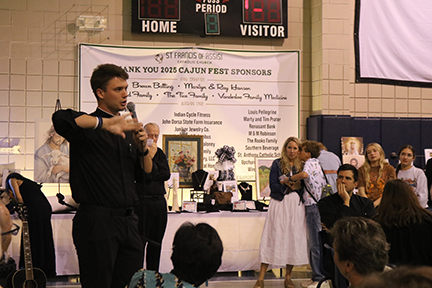
MADISON – Seminarian Grayson Foley speaks to guests at the Homegrown Harvest Festival at St. Francis of Assisi Parish on Oct. 11, sharing how God used basketball to lead him to discern the priesthood. (Photos by Joanna Puddister King)
“The work of calling forth more young men to consider priesthood is continuing,” said Father Nick. “We still have our goal of 33 seminarians by the year 2030. I know it sounds crazy, but with God, anything is possible.”
The night’s joyful fellowship, generous giving and laughter from stories like Foley’s showed that the seeds of that vision are already taking root.
(To support seminarian education, contact Rebecca Harris in the Office of Stewardship and Development at (601) 969-1880 or rebecca.harris@jacksondiocese.org.)
(OSV News) — Young Catholic adults are invited to apply for a “once-in-a-lifetime” journey with Jesus Christ in the Eucharist across the nation.
Eight perpetual pilgrims are being sought for the 2026 National Eucharistic Pilgrimage, which takes place May 21 to July 8.
Those selected will accompany the Blessed Sacrament for the full length of the pilgrimage, forming a core group that will participate in Eucharistic processions through towns and cities, while attending daily Mass and Holy Hours. They will also carry out both service and evangelization in local communities along the entire route.
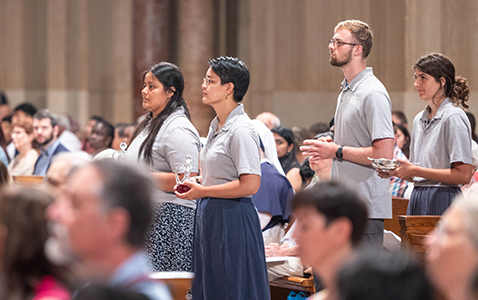
Four young adult Catholic “perpetual pilgrims” who are accompanying the Blessed Sacrament on the National Eucharistic Pilgrimage’s St. Elizabeth Ann Seton Eastern Route, bring up the offertory gifts during the National Eucharistic Pilgrimage Mass June 9, 2024, at the Basilica of the National Shrine of the Immaculate Conception in Washington. (OSV News photo/Mihoko Owada, Catholic Standard)
The effort is not for the faint of heart, according to the National Eucharistic Pilgrimage’s website.
“Serving as a Perpetual Pilgrim is an extraordinary call — and a serious commitment,” said its perpetual pilgrim application page. “This journey is demanding spiritually, mentally, socially, and physically — yet it is also a once-in-a-lifetime opportunity to walk in the footsteps of the Apostles.”
Applicants must baptized and confirmed Catholics ages 19-29, who are “rooted in the sacraments … faithful to the teachings of the Church and committed to daily prayer,” said the website.
In addition, pilgrims must be “flexible, resilient, and ready for communal team life on the road,” as well as “physically able to walk long distances,” which can stretch up to 15 miles on some days.
Perpetual pilgrims will engage with those they encounter along the way through faith sharing, witness talks and media interviews, and will stay in local host homes during their journey.
Training will be provided to assist the pilgrims in fundraising for mission expenses, and a spiritual director will guide the pilgrims before, during and after their trek.
Applications are due by Oct. 22.
An in-person pre-pilgrimage retreat for the perpetual pilgrims will be held Jan. 23-25, and weekly formation meetings will be conducted via Zoom on Monday evenings throughout the spring ahead of the anticipated May 21 pilgrimage start date.
The pilgrimage continues a key component of the National Eucharistic Revival, the 2022-2025 effort by the U.S. Catholic bishops to rekindle devotion to Jesus in the Eucharist. The initiative was sparked by a 2019 Pew Research Center report showing that only one third of the nation’s Catholics believed that Jesus Christ is truly present in the Eucharist.
Major highlights in the revival included the 10th National Eucharistic Congress, which took place in July 2024 in Indianapolis, and the 2024 and 2025 National Eucharistic Pilgrimages.
National Eucharistic Congress Inc., a nonprofit organization in a partnership with the USCCB, expects to continue to build on the revival’s work through its annual National Eucharistic Pilgrimages as well as diocesan, regional and national Eucharistic congresses. Organizers hope to hold the next National Eucharistic Congress in 2029, a proposal on which the U.S. bishops are expected to vote when they meet in November.
In the meantime, the upcoming 2026 pilgrimage will ” bring the healing presence of Christ across our nation, renewing the Church through encounter,” said pilgrimage organizers on the application website.
(Gina Christian is a multimedia reporter for OSV News. Follow her on X @GinaJesse Reina.)
(OSV News) — At the end of our earthly lives, our faith tells us there will be four last things: death, judgment, hell and heaven. Reflecting on such ominous topics in the month in November can seem quite appropriate for both the pessimist and the optimist alike.
On the one hand, the pessimist, who focuses exclusively on his or her demise, finds the cold, dark nights of late fall and early winter, with the season’s gaunt and barren trees, a perfect composition of death.
The optimist, on the other hand, while acknowledging the inevitability of death, takes comfort in the seeds of life that are buried beneath winter’s snows and that will rise again “like wheat that springeth green.” November’s two great feasts — All Saints and All Souls — remind one of the lasting hope we have in Jesus, who has saved the world by his cross and resurrection. The forces of darkness cannot overcome him who is the light of the world.
Clearly, bringing Jesus’ saving acts to bear upon the four last things makes all the difference. Without faith, death can be seen in a merely utilitarian way. Rather than being an experience that one “lives,” including reflecting on it and preparing for it, death becomes something to be forestalled at all cost when one’s life is going well and hastened when one’s life becomes unbearable.
Thus life itself becomes simply another possession that one can have or throw away, rather than a gift to be experienced. Moreover, without faith, judgment and hell and heaven are parts of a grand fairy tale made up by weak people unwilling to face “reality” (see “Evangelium Vitae,” No. 22).
The Christian, by contrast, sees the four last things precisely as parts of a very real and profoundly meaningful life with God that extends beyond the grave. Indeed, life cannot be understood fully without acknowledging all four. Each of them reflects God’s love and mercy and justice in its own way.
Given the promises of Jesus — that he would, once and for all, destroy the power of death and open the gates of heaven — every Christian (and everyone searching for the truth) should develop a healthy appreciation of the last things. Death, judgment, hell and heaven — understood in relation to Christ — must be a part of one’s overall examination of life. Otherwise, one may miss the blessings such an examination brings. Worse, if God and his truth are shut out willfully, one may suffer the fate of the damned (see “Gaudium et Spes,” No. 19; “Lumen Gentium,” No. 16).
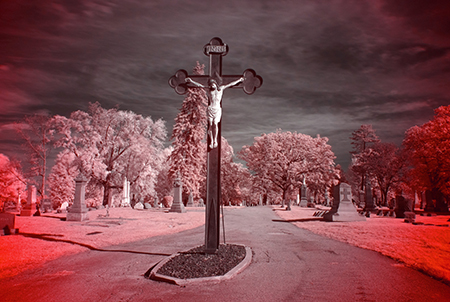
A crucifixion scene stands at one entrance of Allouez Catholic Cemetery in Allouez, Wis. All Saints’ Day, a holy day of obligation in the Catholic Church, is celebrated on Nov. 1. The photograph was taken Oct. 18, 2023, using an infrared camera filter. (OSV News file photo/Sam Lucero)
Death
Among the four last things, death is seen by both believers and nonbelievers as the end of the physical existence human beings enjoy on this earth, but that’s where the agreement ends. A faithless view stops at the grave; there’s nothing more to consider. The Catholic Church, on the other hand, sees death within the context of God’s revelation, and there’s a lot more to consider.
Based on Scripture and tradition, and ultimately on Jesus’ witness, the church recognizes death as the just punishment for the freely chosen sins of human beings: “God did not make death, nor does he rejoice in the destruction of the living. For he fashioned all things that they might have being. … It was the wicked who with hands and words invited death” (Wis 1:13-14, 16; see also Wis 2:23-24).
In the creation stories found in the book of Genesis, the authors convey the truth that God created a universe that is good, and it is designed according to his laws. God also created human beings to enjoy a relationship with him, which was to be marked not only by fidelity to his will but also by stewardship of his creation and even by the generation of new life. God made human beings in his image, male and female he made them: a communion of persons (reflecting the Trinity) who enjoyed — each one of them — the gifts of reason and free will.
In other words, when making man and woman, God did not desire automatons, but sons and daughters who would choose freely to love each other and their creator.
Human beings, however, chose not to honor their relationship with God, but instead invited death into the world by committing the original sin: rejecting the world as God created it and, instead, asserting themselves as equals to God. Hence the separation from God and the loss of mortal life. Before the first sin, human beings had eternal communion with God as a gift. After sin, an eternity without God is a real possibility.
But it’s not the only possibility. God, who gave the gift of freedom to man and woman, is supremely free. He could have responded to sin in a number of ways: scrap everything and start again, or create a new world with new creatures. God responds, however, by honoring the relationship with human beings, even though they did not. And he does so in a just and merciful way that allows both the consequences of sin to follow (i.e. death) and the gift of freedom to remain intact.
In a word, God’s response is Jesus. From the moment man and woman sinned, God set into motion his plan of salvation. Human beings could never offer an adequate recompense for their sins, so God offers it for them in the person of Jesus (see Rom 5:17). In effect, God opens the floodgates of his love. The world that had been marred by sin is thoroughly bathed in love through Jesus, “who destroyed death and brought life and immortality to light” (2 Tim 1:10).
The sinless one dies for the sinners. What could underscore so powerfully the goodness of creation and, at the same time, the evil of sin? What could convince human beings better — or more gently — that God still desires their eternal happiness than his responding to the evil of sin not with anger, not with bloodlust, but with love?
Jesus has saved the world through his life, death and resurrection. Human beings now have the opportunity to accept salvation, to turn back to God by receiving his forgiveness and yielding to his will and, after dying themselves, to enter eternal life.
Understood in the light of Jesus, death takes on a new meaning. It no longer has power over a person who abides in Jesus, for that person has been freed “from the law of sin and death” and received “the spirit of life in Christ Jesus” (Rom 8:2). St. Paul received this revelation more fully than most and ordered his life upon it: “For to me life is Christ, and death is gain. … I am caught between the two. I long to depart this life and be with Christ, (for) that is far better. Yet that I remain (in) the flesh is more necessary for your benefit” (Phil 1:21, 23-24).
St. Paul grasped the essential meaning of Jesus’ saving grace for humankind. While living, he was already united to Jesus, for the kingdom of God was already present in a hidden way (see Lk 17:20-21) and, by his ministry, Paul could bring more people to the faith as well. As for death, that would only deepen the union with Jesus.
Therefore, death need not be hastened or forestalled, but can be greeted with serenity when it comes. Passing from this life to the next is simply moving from one way of living in Jesus to another. St. Paul tried to peel away a bit of the mystery by saying, “that which is corruptible must clothe itself with incorruptibility, and that which is mortal must clothe itself with immortality” (1 Cor 15:53). Indeed, the Scriptures show that Jesus’ body had been transformed after the resurrection (see Mk 16:12; Lk 24:16; Jn 20:14, 21:4). The meaning is this: For one who remains faithful to Jesus, life is changed, not ended, at death.
Judgment
The church’s teaching on death can have both a comforting and sobering effect. It is comforting to know that life continues, but the fact that one’s time on this earth is limited should bring some weightiness to one’s decisions. But if death fails to do this, then the church’s teaching on judgment hopefully will (note that the church uses “man” in the universal sense, meaning “man and woman”): “Each man receives his eternal retribution in his immortal soul at the very moment of his death, in a particular judgment that refers his life to Christ: either entrance into the blessedness of heaven — through a purification or immediately — or immediate and everlasting damnation” (Catechism of the Catholic Church, No. 1022). There will also be a universal (or last) judgment of the entire universe at the end of time (see CCC, Nos. 1038-1041).
The basic meaning of the church’s teaching about judgment is that the choices one makes have value — they can be good or bad. Also, God determines the value of one’s choices and metes out the appropriate reward or punishment. This teaching tends to evoke two dominant feelings in people: fear and satisfaction.
Fear, of course, is not a bad feeling to have if one is living a sinful life; it might even prompt one toward conversion. Fear, in the sense of awe, is appropriate too, for God is able to judge everyone and every act in perfect justice and mercy. Only God knows the depths of each person’s heart; only he knows the advantages and disadvantages a person had; only he knows the full circumstances of every person’s life and every situation. God knows the full truth and will judge accordingly. The only bad kind of fear to have is one that is distrustful of God’s judgment, for how could God mistreat the very people he created and saved out of love?
Satisfaction is the other common feeling many people have regarding God’s judgment, which is good if by “satisfaction” one means a sense of contentment concerning God’s ultimate victory over all evil. A person who is content with God’s judgment is able to work diligently for justice on earth without vindictiveness or impatience, knowing that every good effort made at telling the truth, building solidarity, or righting wrongs cooperates with God’s victory. A “satisfaction” that hungers for revenge is not a good thing, for it reveals a distrust in God’s perfect judgment, which will have the final word (see Rom 12:17-21).
Hell
After a person has been judged, he or she will spend eternity in one of two states: hell or heaven. (Many people think of “hell” and “heaven” as places, but they are more accurately denoted vis-à-vis the relationship with God.) Hell is defined by the church as the “state of definitive self-exclusion from communion with God and the blessed” (CCC, No. 1033). God’s judgment in such a case would be to allow the person’s choice to take effect, as the Catechism relates: “God predestines no one to go to hell; for this, a willful turning away from God (a mortal sin) is necessary, and persistence in it until the end” (CCC, No. 1037).
The very mention of “hell” can cause some people to cry “unfair” (placing them in a long tradition going back at least to when Ezekiel was writing; see chapter 18). How could a loving and merciful God allow anyone to suffer eternal damnation? Other people even ignore hell and maintain that Jesus, who loves everyone, will also save everyone. Granted, the thought of hell may be horrifying, but the words of Jesus are clear: “The Son of Man will send his angels, and they will collect out of his kingdom all who cause others to sin and all evildoers. They will throw them into the fiery furnace, where there will be wailing and grinding of teeth” (Mt 13:41-42).
To understand the terrible mystery of hell, the church directs people to the mystery of freedom, which is a gift human beings have from God. It is a gift that bestows great dignity and enables the person “to initiate and control his own actions” (CCC, No. 1730). But freedom also means that the person is responsible for his or her choices. “The more one does what is good, the freer one becomes. There is no true freedom except in the service of what is good and just. The choice to disobey and do evil is an abuse of freedom and leads to the ‘slavery of sin'” (CCC, No. 1733).
Ultimately saying no to hell means saying yes to God. Again, God does not want robots that are forced to love him, but true sons and daughters who choose to love him and their brothers and sisters in freedom. Nevertheless, if they have the freedom to love, then they also must have the freedom not to love. The latter choice leads to hell.
Heaven
The alternative to hell is heaven, and whereas hell is the state of eternal separation from God, heaven is its opposite: “This perfect life with the Most Holy Trinity — this communion of life and love with the Trinity, with the Virgin Mary, the angels and all the blessed — is called ‘heaven.’ Heaven is the ultimate end and fulfillment of the deepest longings, the state of supreme, definitive happiness” (CCC, No. 1024).
And just as a person gets to hell by how he or she lives on earth, so it is with heaven. The crucial difference is that the person who chooses heaven uses his or her freedom to make every effort at yielding to and accepting God’s grace. Another difference is that a person can get to hell by oneself, but getting to heaven involves the whole body of Christ, head and members, as St. Paul reminded the Corinthians: “encourage one another and build one another up” (1 Thes 5:11).
The essence of heaven is the relationship that human beings enjoy with the Holy Trinity (which includes all the saints), a perfect communion that restores the order God intended when he first created everything. In fact, the church teaches that, following the Last Judgment, not only humanity but also the entire universe will be transformed into its glorified state (CCC, No. 1060). For human beings this means a reunification with their bodies, now immortal through the grace of the resurrection (see CCC, No. 1052).
Still, to enjoy this communion, human beings must act on God’s grace now, here on earth. What this means, practically speaking, is honoring one’s relationships as God intended. The book of Genesis suggests “that human life is grounded in three fundamental and closely intertwined relationships: with God, with our neighbor and with the earth itself” (“Laudato Si’,” No. 66). Sin disrupted these relationships, resulting in separation from God, alienation among neighbors and disharmony with the earth. God’s love in Jesus has made it possible to restore all three.
The choice is before each human person: to love as Christ loves, faithful to the Father, united in the Spirit, and working for the salvation of all. If a person joins this work now, he or she will experience its perfection in heaven.
The four last things properly understood in the context of Jesus’ life, death and resurrection need not be so ominous. For example, in what is most likely an apocryphal account, the story is told about St. Bonaventure eating a meal with his fellow friars. One of them asks Bonaventure what he would do if Jesus were to initiate the Last Judgment at that very moment. And Bonaventure answers, “I’d finish eating my soup.” Apocryphal or not, it captures well the peace, even in the face of death and judgment, of one who abides in Jesus
It was a wonderful evening at the sixth annual Homegrown Harvest Festival. We had a record number of guests and raised a record amount for our seminarians. At last count, we brought in about $190,000, all of which will support our 12 current seminarians and our efforts to continue promoting the priesthood throughout the diocese.
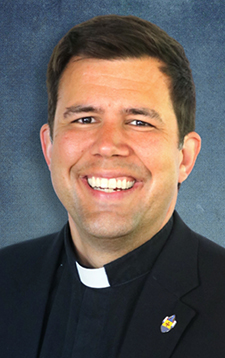
Fr. Nick Adam
Currently, we have three men applying for the seminary for next August. We would love to hit $200,000 – our goal heading into the night – so if you haven’t given and would like to, please contact Rebecca Harris in the diocesan Development Office at (601) 969-1880. Thanks to everyone who worked so hard to make this night a huge success.
One of the greatest gifts of the evening was seeing our seminarian parents having such a great time and working together in support of their sons. We have a diverse group of young men, and their parents have really grown together in the past several months as they walk with them on this journey.
The silent auction included 12 baskets put together by each seminarian’s family. The baskets were filled with items that each seminarian enjoys. For instance, Eli McFadden’s basket was full of St. Louis Cardinals items because his grandparents are from St. Louis, and he loves the team. Our parents are also considering starting a prayer group among themselves to pray for their sons, for more seminarians and for me – which I greatly appreciate.
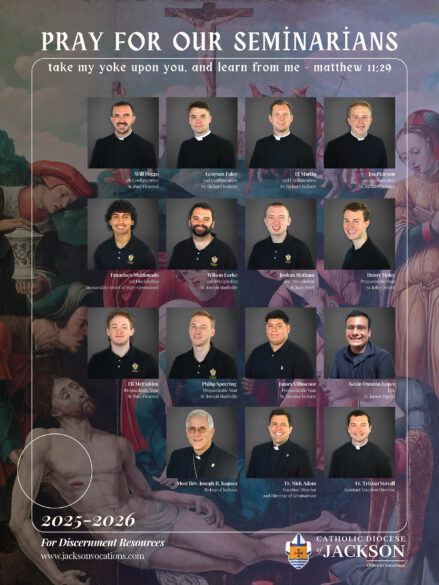
This year’s 2025–2026 Seminarian Poster highlights the 12 men currently preparing for the priesthood in the Diocese of Jackson. Please keep them in your prayers as we continue to encourage more young men to discern their vocation. Join us in prayer that more will answer God’s call to serve.
It is also a joy to see more supporters feeling called to join our cause. We’ve had several families supporting seminarians for many years, and now we are seeing an increase in that support, which is a great blessing. Our new poster will be delivered in the next couple of weeks with all of our guys’ smiling faces, and I think that will be another witness to our diocese of the good work being done and the Lord’s blessings being bestowed on us.
The work of calling forth more young men to consider the priesthood is continuing. Our discernment groups are ongoing, and I was blessed to take three young men down to St. Joseph Seminary College right after Homegrown Harvest. The guys had a great time and, as usual, were amazed by how “normal” all the seminarians were. I think they saw themselves in those seminarians – which is exactly why we take those trips.
Thank you for your prayers and support. God bless our diocese.
(For more information on vocations, visit jacksonvocations.com or contact Father Nick at nick.adam@jacksondiocese.org.)
IN EXILE By Father Ron Rolheiser, OMI In the movie “The English Patient” there’s a very heartwarming scene. A number of people from various countries are thrown together by circumstance in an abandoned villa in post-war Italy. Among them are a young nurse, attending to an English pilot who’s been badly burned in an air crash, and a young Asian man whose job is to find and defuse landmines. The young man and the nurse become friends and, one day, he announces he has a special surprise for her.
He takes her to an abandoned church in which he has set up a series of ropes and pulleys that will lift her to the ceiling where, hidden in darkness, are beautiful mosaics and wonderful works of art that cannot be seen from the floor. He gives her a torch as a light and pulls her up through a series of ropes so that she swings like an angel with wings, high above the floor and is able with the help of her torch to see beautiful masterpieces hidden in the dark.
For her, the experience is one of exhilaration; she has the sensation of flying and of seeing wonderful beauty all at the same time. When she’s finally lowered back to the floor she’s flushed with excitement and gratitude and covers the young man’s face with kisses, saying over and over again: “Thank you, thank you, thank you for showing this to me!”
And from her expression, you see too that she is expressing a double thanks: “Thank you for showing me something that I could never have come to on my own and thank you for trusting me enough to think that I would understand this, for trusting that I would get it!”
There’s a lesson here?
The church needs to do for the world exactly what this young man did for his nurse friend; it needs to show the world where to look for a beauty it would not find on its own, a beauty that is hidden in darkness. And it needs to trust that people will “get it,” will appreciate the richness of what they are being shown.
Where might the church find such hidden beauty? In the deep rich wells of its own history, and in nature, in art, in science, in children, in the energy of the young, and in the wisdom of the old. There are treasures of beauty hidden everywhere. The church’s task is to point these out to the world. Why?
Because beauty has the power to touch and transform the soul, to instill wonder and gratitude in a way that few things have. Confucius understood this. That’s why he suggested that beauty is the greatest of all teachers and why he based his philosophy of education on beauty. People can doubt almost anything, except beauty.
Why can’t beauty be doubted? Because beauty is an attribute of God. Classical Christian philosophy and theology tell us that God has four transcendental properties, namely, God is “One, True, Good and Beautiful.” If this is true, then to be touched by beauty is to be touched by God; to admire beauty is to admire God; to be shown beauty in hidden places is to be shown God in hidden places; to be in awe of beauty is to be in awe of God; and to feel that awe is to feel a homesickness for heaven.
The renowned theologian Hans Urs Von Baltasar highlighted how beauty is a key component in how God speaks to us and how that should color how we speak about God to the world.
However, we shouldn’t be naïve in our understanding of this. Beauty isn’t always pretty in the way that popular culture perceives it. Granted, beauty can be seen in the spectacular colors of a sunset, or in the smile and innocence of a child, or in the perfection of a Michelangelo sculpture, but it can also be seen in the wrinkles of an old woman and in the toothless smile of an old man.
God speaks through beauty and so must we. Moreover, we must believe enough in people’s sensitivity and intelligence to trust that they, like the nurse in “The English Patient,” will appreciate what they are being shown.
In a famous line (often quoted by Dorothy Day) Russian novelist Fyodor Dostoevsky writes: The world will be saved by beauty.
What’s the logic here? How might beauty cure the many ills which beset us?
Here’s Dostoevsky’s algebra: In the face of brutality, what’s needed is tenderness; in the face of hype and ideology, what’s needed is truth; in the face of bitterness and curses, what’s needed are graciousness and blessing; in the face of hatred and murder, what’s needed are love and forgiveness; in the face of the kind of familiarity that breeds contempt, what’s needed are awe and wonder; and in the face the ugliness and vulgarity that pervades our world and our evening news, what’s needed is beauty.
(Oblate Father Ron Rolheiser is a professor of spirituality at Oblate School of Theology and award-winning author. He can be contacted through his website www.ronrolheiser.com.)
By Carol Glatz VATICAN CITY (CNS) – Christians must avoid using their faith to label those who are different – often the poor – as enemies to be avoided and rejected, Pope Leo XIV said.
“Some forms of worship do not foster communion with others and can numb our hearts,” he said in his homily during Mass in St. Peter’s Square Oct. 12 for the Jubilee of Marian Spirituality.
“Mary’s path follows that of Jesus, which leads us to encounter every human being, especially the poor, the wounded and sinners,” Pope Leo said in his homily. “Because of this, authentic Marian spirituality brings God’s tenderness, his way of ‘being a mother,’ to light in the church.”
Members of movements, confraternities and various Marian prayer groups were invited to Rome for their Oct. 11-12 Jubilee, which included an evening prayer service in the square Oct. 11 with Pope Leo in the presence of the original statue of Our Lady of Fatima.
The statue, brought from the Shrine of Our Lady of Fatima in Portugal, also was on display during the Oct. 12 Mass.
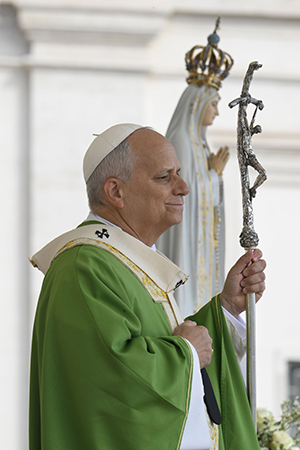
Pope Leo XIV stands with his crosier while in the background can be seen the original statue of Our Lady of Fatima during Mass as part of the Jubilee of Marian Spirituality in St. Peter’s Square at the Vatican Oct. 12, 2025. (CNS photo/Vatican Media)
Marian spirituality, “which nourishes our faith, has Jesus as its center,” Pope Leo said in his homily. Remembering Jesus Christ is what matters.
“The celebration of Sunday, therefore, should make us Christians,” he said. “It should fill our thoughts and feelings with the burning memory of Jesus and change the way we live together and the way we inhabit the earth.”
When some forms of worship fail to foster communion with others, he said, “we fail to encounter the people God has placed in our lives. We fail to contribute, as Mary did, to changing the world, and to share in the joy of the Magnificat.”
“Let us take care to avoid any exploitation of the faith that could lead to labelling those who are different – often the poor – as enemies, ‘lepers’ to be avoided and rejected,” he said.
“Marian spirituality is at the service of the Gospel” because “it reveals its simplicity,” he said.
“Our affection for Mary of Nazareth leads us to join her in becoming disciples of Jesus,” he said, and “it teaches us to return to him and to meditate and ponder the events of our lives in which the Risen One still comes to us and calls us.”
Marian spirituality “helps us to see the proud being scattered in their conceit, the mighty being cast down from their thrones and the rich being sent away empty-handed,” he said, referring to the Canticle of Mary (Lk 1:51-54). “It impels us to fill the hungry with good things, to lift up the lowly, to remember God’s mercy and to trust in the power of his arm.”
Just as God asked Mary for her “yes,” he said, “Jesus invites us to be part of his kingdom.”
“Dear friends, in a world seeking justice and peace, let us revive Christian spirituality and popular devotion to the events and places blessed by God that have changed the face of the earth forever,” he said.