Unity in teaching, mission, and concern for immigrants resounds at bishops’ fall assembly

By Peter Jesserer Smith
(OSV News) – From the start of the U.S. Catholic bishops’ fall plenary assembly to its end, a resounding concern for the God-given dignity of immigrants, and for unity in teaching the faith clearly and renewing the country spiritually, dominated the days’ proceedings.

The first order of business for the bishops, at the start of the Nov. 10-13 gathering was to invoke the intercession of the Holy Spirit. More than 320 active and retired bishops joined the opening Mass at the Basilica of the National Shrine of the Assumption of the Blessed Virgin Mary in Baltimore Nov. 10.
Archbishop Timothy P. Broglio, president of the USCCB and archbishop of the Archdiocese for the Military Services, reminded bishops in his opening homily of “their duty to be servants of truth,” and shared the story of a young airman who asked him “how to be a saint.”

The fall meeting was also Archbishop Broglio’s farewell as USCCB president after leading the bishops for the past three years through a National Eucharistic Revival, its first National Eucharistic Congress in more than eight decades, the recently concluded Synod on Synodality, and the election of the first American pope.
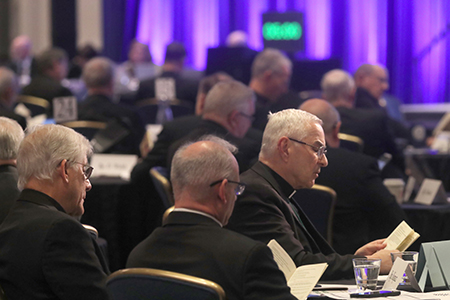
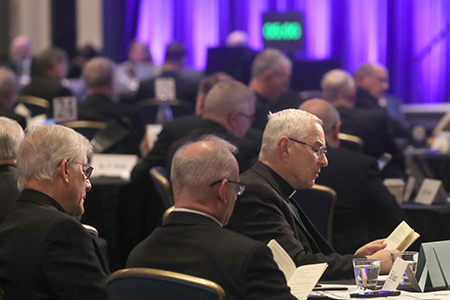
Bishops pray during a Nov. 12, 2025, session of the fall general assembly of the U.S. Conference of Catholic Bishops in Baltimore. (OSV News photo/Bob Roller)

In his final presidential address, he emphasized the need for the bishops to model unity and help “convince people to listen to each other” amid polarization.

“We have to draw on our unity to illustrate that civil discourse is not only possible, but the most authentically human way forward,” he said.

For Cardinal Christophe Pierre, the papal ambassador, it was his first opportunity to address the bishops as Pope Leo XIV’s representative to the U.S. since the pope’s election in May. On the theme of unity, he emphasized continuity between the late Pope Francis and Pope Leo’s pontificates, while encourging them to look to the Second Vatican Council as their guide. As he has for the past several years, he encouraged them to develop a synodal culture that could help them unify the church at a time when many Catholics “identify more with tribes and ideologies than with the body of Christ.”

He said, “The synodal path invites us to a different way: a style of being church that makes communion concrete, allows dialogue to become discernment, and catholicity to become shared mission.”

The cardinal’s remarks about synodality, as a means to help the bishops bring about unity, were underscored by a Leadership Roundtable survey from the prior week. It showed that Catholics tend to give their parish pastors and parish high marks, yet a consistent “trust deficit” pattern prevails at the diocesan and national level.

The bishops elected new leadership for the next three years on Nov. 11, the first day of public meetings, choosing the conference’s secretary, Archbishop Paul S. Coakley of Oklahoma City, as their next president out of 10 possible candidates. Archbishop Coakley won on the third ballot in a close run-off with Bishop Daniel E. Flores of Brownsville, Texas. The bishops then decisively chose Bishop Flores, the conference’s former doctrine committee chair and its point man on implementing synodality in the U.S., as vice president, succeeding Baltimore Archbishop William E. Lori.

The following day, the bishops elected Bishop Kevin C. Rhoades of Fort Wayne-South Bend, Indiana, as their next secretary. Archbishop Alexander K. Sample of Portland, Oregon, was selected to succeed Bishop Rhoades as chair of the Committee on Religious Liberty. The bishops then elected five other committee chairs: Archbishop Jeffrey S. Grob of Milwaukee, for Canonical Affairs and Church Governance; Auxiliary Bishop Peter L. Smith of Portland, Oregon, for Ecumenical and Interreligious Affairs; Bishop William A. Wack of Pensacola-Tallahassee, Florida, for Evangelization and Catechesis; Ukrainian Catholic Metropolitan Archbishop Borys A. Gudziak of Philadelphia, for International Justice and Peace; and Bishop Mark W. O’Connell, newly named bishop of Albany, New York, for Protection of Children and Young People.

While many of the elections were close contests, the bishops’ voice on major issues – from teaching on immigration and gender ideology to public manifestations of Catholic witness and devotion – was overwhelmingly united in every vote.

On Nov. 12, the second public session of the gathering, the prelates approved a special pastoral message on immigration “to raise our voices in defense of God-given human dignity.” They amended the message on the floor to clearly condemn “indiscriminate mass deportation” alongside their call to end “dehumanizing rhetoric and violence, whether directed at immigrants or at law enforcement.”
The bishops applauded and many got to their feet after it passed with a resounding 216 votes in favor, five votes against, and three abstentions.

The bishops’ plenary assembly heard a report on the immigration situation in the U.S. under the Trump administration, as well as a new initiative of solidarity with migrants called “You Are Not Alone.” In a press conference, Bishop Rhoades also revealed that the issue of the ability of Catholic immigrants in ICE detention to receive sacraments “is now at the top of our concerns.”

“Obviously, the beliefs of the church have political consequences, but they’re not political in the usual sense of the word,” Archbishop Richard G. Henning of Boston told OSV News, explaining the bishops’ special message was “a pastoral address to our people rather than an attempt to lobby.”

The bishops also heard about promising signs of progress in their ongoing efforts to resolve backlogs for religious worker visas with the Trump administration. Close to 90% of the nation’s Catholic dioceses rely on foreign-born clergy and religious.

The bishops also heard a presentation on revisions to their “Ethical and Religious Directives for Catholic Health Care Services,” which they approved the following day. They approved the new ERDs – 206 bishops voted yes, with eight abstaining and seven opposing – with substantial revisions from the previous version. They incorporate guidance issued in 2023 by the USCCB’s Committee on Doctrine, which prohibited surgical or chemical interventions seeking to exchange or simulate the sex characteristics of a patient’s body for those of the opposite sex.

The bishops also learned that a new English version of the Bible will be called The Catholic American Bible, which aims to unify American Catholics’ reading of Scripture from the Bible they use in the home to the readings they pray with in the liturgy. They also learned that the Vatican approved the new English edition of the Liturgy of the Hours – concluding a 13-year process of revision – and it would be available for everyone by Easter 2027.

As the U.S. marks its 250th anniversary next year, the bishops voted to consecrate the nation to the Sacred Heart of Jesus in 2026, during their spring assembly in June, which concludes on the solemnity of the Most Sacred Heart of Jesus.

Before the bishops concluded the second and final day of public proceedings – the last day, Nov. 13, was spent in executive session – they approved holding an 11th National Eucharistic Congress in the summer of 2029 following a presentation by Bishop Andrew H. Cozzens of Crookston, Minnesota. Bishop Cozzens, chairman of the National Eucharistic Congress Inc., which will organize the event, said Nov. 12 that a “Revival Impact Study,” which will be made public in December, has shown that a great deal of fruit resulted from the National Eucharistic Revival effort, which included the 2024 National Eucharistic Congress in Indianapolis.

Bishop Cozzens said one of the gifts of the National Eucharistic Congress is the unity it brings to the whole church – something he saw at the 2024 event.

“I think we’ll experience that again in 2029,” he told OSV News. He said a theme is in development and the 2029 National Eucharistic Congress itself will be “a beautiful experience of the power of the Holy Spirit.”

(Peter Jesserer Smith is the national news editor for OSV News. OSV News’ Gretchen R. Crowe, Gina Christian, Kate Scanlon, Lauretta Brown and Julie Asher contributed to this report.)
Laughter

FROM THE HERMITAGE
By sister alies therese

A driver appeared in court charged with parking his car in a restricted area.

“Defense?” asked the judge.

“Yes, there shouldn’t be such misleading signs around … the sign clearly said, Fine for Parking Here.”
Oops – how things can get easily misunderstood! Still, it is a bit funny, isn’t it? What makes you laugh? What makes you hee hee hee or haw haw haw until your sides wiggle?

You know what I mean. What do you consider hilarious? Michael Dorris, the Native American author of Guests, once wrote, “I got dizzy from laughing, lost my breath from laughing. My stomach hurt from laughing. Tears ran from my eyes, everything was funny.”

Quite possibly, on the other hand, you do not laugh but a little he he hey … almost like a tiny sneeze? Or are you a giggler, one who guffaws, or one who hides behind your hands and lets no one know you found something amusing? Maybe laughter is not your thing – or so you say – and yet you laugh and laugh when hidden in the bathroom or away from people.

Henry Ward Beecher once said, “A person without a sense of humor is like a wagon without springs – jolted by every pebble in the road.” I have to say, I think a sense of humor is critical to the spiritual life. Where do we begin?

A good laugh at ourselves usually works. Not taking myself too seriously helps me get things into perspective. As Proverbs 17:22 reminds us, “A cheerful heart is good medicine, but a crushed spirit dries up the bones.”

Yes, go to the Scriptures and discover laughter mentioned more than once: “He will fill your mouth with laughter and your lips with shouts of joy.” (Job 8:21) Check out the Psalms: “Our mouths were filled with laughter, our tongues with songs of joy” (Psalm 126:2), and “The Lord is my strength and my shield; my heart trusts in him, and he helps me. My heart leaps for joy.” (Psalm 28:7)

As with our driver who got it wrong, we can as well – by laughing at others. Not recommended. Nothing is more painful than being laughed at. Yes, we are called to laugh, but how about laughing with?
I marvel at those who have been badly treated, who teach me so much about laughter. W.E.B. Du Bois, the African American educator, once wrote in “My Soul Looks Back, ’Less I Forget”: “I am especially glad of the divine gift of laughter; it has made the world human and lovable, despite all its pain and wrong.”
Can you laugh in November? That’s a good test! Death, purgatory, people dying around us, wars, abortions, hunger, governmental challenges, the death penalty – darkness falling all around us. So what’s so funny?

It is more difficult to laugh or make decisions when the days are rainy, cold and lonely. Yet Norton Juster reminds us in “The Phantom Tollbooth” – “Ordinance 175389: It shall be unlawful, illegal and unethical to think, think of thinking, surmise, presume, reason, meditate or speculate while in the doldrums.”

What comes, however, into our orbit near the end of the month? Thanksgiving, of course – and if you don’t laugh at that dinner table, you will cry! Maybe it will be an old story Uncle George tells, a funny accident by a 3-year-old or even a teenager venturing out to tell a joke. Who knows? It might be the food. It might be just anything.

Go prepared – or you might get caught in a bit of misery. Arguments are ugly. I love this little prayer: “Give me eyes to see what I would miss without you!” (anonymous)

Go to that kitchen to help, that table to eat, and take that opportunity to clear up – having asked the Lord to show you! You just might be the one to prevent a Thanksgiving Day disaster.

T. Hulbert of Rockaway, Oregon, once shared this in Guideposts (1999): “My 1998 resolution: With the help of God, I resolve to be a good witness to those around me by what I say and through what I do.”
David Saltzman wrote in “The Jester Has Lost His Jingle” – “Laughter’s like a seedling, waiting patiently to sprout. All it takes is just a push to make it pop right out.”

Be careful at that table, in that kitchen or dining room. Things often pop out that we had no intention of saying! There is much left to heal.

“Laughter is God’s medicine; the most beautiful therapy God ever gave humanity,” says an anonymous author. Why in the world would laughter be medicine? What needs healing? We often don’t find out until someone pushes that little button we thought we had hidden so artfully away.

There is hope for most of us if we have learned anything this past year. When we join others at the table, watch the person you trust the most before you speak. He or she will give you the go-ahead or hold up a hand – like any good base coach.

I have that super picture of Jesus laughing in my prayer corner. He had to laugh now and then – look who he surrounded himself with!

“Rejoice in the Lord always. I will say it again: Rejoice!” (Philippians 4:4)

Your laughter does not need to be outrageous or loudly offensive – just a good deep chuckle will get those endorphins working. It might even be as simple as a sweet smile to dispel the gloom.

As Sister Monique of Owatonna once said, “May this Thanksgiving help you give thanks for all the turkeys in your life.”

Blessings.

(sister alies therese is a canonical hermit who prays and writes.)

Briefs

NATION
NEW ORLEANS (OSV News) – The Archdiocese of New Orleans has edged one step closer to finalizing its long-running – and costly – bankruptcy proceedings to resolve hundreds of clerical abuse claims. A committee of survivors and additional creditors overwhelmingly voted to accept the plan for a $230 million settlement, which would include tailored payment amounts factoring in the scope of the alleged abuse and its impact on claimants. The plan would also permit the release of files on abusive clergy. However, one group of bond investors filed an Oct. 28 request calling for further discussion of the archdiocese’s Chapter 11 reorganization plan, now in its fifth version. In response, the official committee of unsecured creditors in the case filed a response with the court, accusing the bondholder of “delay and subterfuge tactics” in “an attempt to fruitlessly delay confirmation and thwart justice for the more than 99% of abuse survivor creditors who voted in favor of the Plan.” A confirmation hearing is set to begin on Nov. 17, with testimony scheduled through Dec. 4. The Dec. 2 session will see survivors take the stand to share their personal experiences. OSV News has confirmed with the archdiocese that its legal fees to date in the case have so far totaled approximately $50 million.

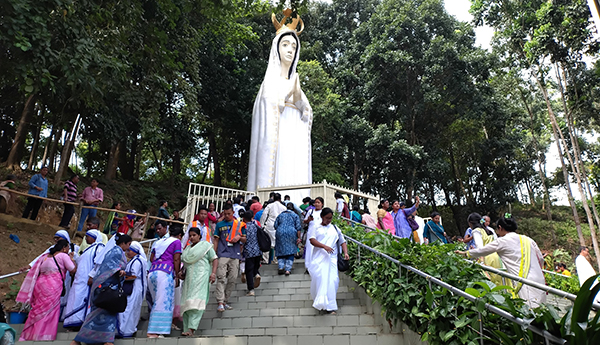
People gather for an annual pilgrimage to the shrine of Fatima Rani – or Mary, Queen of Fatima – at St. Leo’s Church in the Baromari hills in the Sherpur district of the Mymensingh Diocese in Bangladesh Oct. 31, 2025. The pilgrimage attracts tens of thousands of pilgrims from different parts of the country, including Muslims and Hindus, who come seeking spiritual connection and possible miracles. (OSV News photo/Stephan Uttom Rozari)

WASHINGTON (OSV News) – Amid concern about the ability of those detained by immigration enforcement authorities to receive Catholic sacraments, a key U.S. bishop said Trump administration officials have “assured” him the matter is “under careful review.” Bishop Robert E. Barron of Winona-Rochester, Minnesota, who was appointed by President Donald Trump to the Department of Justice’s Religious Liberty Commission, said in a Nov. 3 social media post that he and Father Alexei Woltornist, a Melkite Catholic priest and a member of the Department of Homeland Security’s Homeland Security Advisory Council “have been in touch with senior officials in both the State Department and the Department of Homeland Security and have brought forward the concerns of the church regarding detainees’ access to Sacraments.” Bishop Barron’s post included an OSV News article about a delegation of clergy, religious sisters and laity, and a Chicago auxiliary bishop who were barred for the second time in three weeks from bringing the Eucharist to those being held at an immigration detention center just west of Chicago on the feast of All Saints Nov. 1. Spokespersons for the Department of Homeland Security and ICE did not immediately respond to requests for comment from OSV News.

VATICAN
VATICAN CITY (OSV News) – Pope Leo XIV offered words of joy to Catholics in India’s Kerala state after the Nov. 8 beatification of Mother Eliswa Vakayil, founder of the Teresian Carmelite congregation. Speaking at his Nov. 12 general audience, the pope praised the 19th-century nun as “a source of inspiration” who championed the dignity of women and the education of poor girls. Mother Eliswa, born in 1831 and widowed at 20, became Kerala’s first Indigenous nun in 1866, establishing what is now the Congregation of Teresian Carmelites – and was then Third Order of the Discalced Carmelites – with her sister and daughter. Today the community includes more than 1,500 sisters in over 200 convents worldwide. Over 20,000 faithful filled the Basilica of Our Lady of Ransom in Kochi for the beatification Mass celebrated by Cardinal Sebastian Francis, the pope’s delegate. Church leaders hailed Blessed Eliswa as a pioneer of women’s empowerment in a deeply patriarchal era. Her congregation is now praying for a second miracle “to pave the way for the canonization of our founder,” said Sister Sucy Kinattingal, who has been vice postulator for Mother Eliswa’s cause since 2012.

WORLD
AUCHI, Nigeria (OSV News) – The Diocese of Auchi in Nigeria is mourning the death of teenage seminarian Emmanuel Alabi, who died after being kidnapped with two classmates in July. Diocesan officials confirmed Nov. 4 that while seminarians Japhet Jesse and Joshua Aleobua were freed, Alabi “died in the course of the ordeal.” Bishop Gabriel Dunia expressed deep sorrow and urged Nigerian authorities to prioritize citizens’ safety amid worsening insecurity. The seminarians were abducted July 10 when gunmen attacked Immaculate Conception Minor Seminary, killing a security guard. It was the seminary’s second kidnapping in less than a year. In 2024, its rector, Father Thomas Oyode, was abducted after offering himself in place of students. A Catholic Secretariat of Nigeria report said 145 priests have been kidnapped in Nigeria since 2015, 11 of whom were killed. With the rise of extremist Islamic ideology, Nigeria has become “the most violent place in the world for followers of Jesus,” according to Open Doors International, an organization that supports persecuted Christians around the world. While the conflict is also driven by other factors, including extremist groups’ desire for power and control, more Christians are killed by the extremists than Muslims, Open Doors said.

DHAKA, Bangladesh (OSV News) – In northern Bangladesh, thousands of Catholics have gathered at St. Leo’s Church in the Diocese of Mymensingh to celebrate the 25th anniversary of the Mary, Queen of Fatima shrine, known as Fatima Rani. Nearly 40,000 pilgrims joined the two-day celebration in late October, marked by rosary prayers, candlelight processions, and the Stations of the Cross. Bishop Paul Ponen Kubi of Mymensingh led the closing Mass, joined by Vatican nuncio Archbishop Kevin Randall and local clergy. Parish pastor Father Torun Bonwary said the anniversary, which falls during the Catholic Church’s Jubilee Year, brought “a different level of spirituality” to local Catholics – many of them Indigenous. Pilgrims climbed a 1.2-mile mountain path lit by thousands of candles, praying for forgiveness and peace. Despite limited resources, organizers said the shrine remains a symbol of faith and hope for Bangladesh’s small but vibrant Catholic community of about 400,000 faithful in the Muslim-majority nation. “The sight of thousands of devotees walking on the hilly path with candlelight in their hands proves that no matter what obstacles we face, we will move forward on the path of light with the grace of Mother Mary,” one pilgrim said.

Pope assures the poor they are loved by God, calls on governments to act

By Cindy Wooden
VATICAN CITY (CNS) – Before joining hundreds of people for lunch, Pope Leo XIV celebrated Mass for the Jubilee of the Poor and prayed that all Christians would share “the love of God, which welcomes, binds up wounds, forgives, consoles and heals.”

With thousands of migrants, refugees, unhoused people, the unemployed and members of the trans community present in St. Peter’s Basilica or watching from St. Peter’s Square, Pope Leo assured them, “In the midst of persecution, suffering, struggles and oppression in our personal lives and in society, God does not abandon us.”

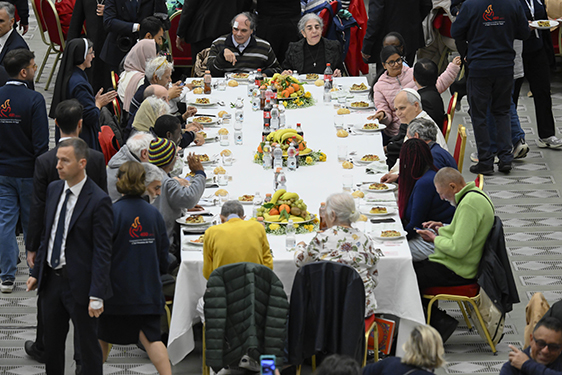
Pope Leo XIV and his guests enjoy their first course, a vegetable lasagna, at a luncheon marking the Jubilee of the Poor Nov. 16, 2025, in the Vatican audience hall. (CNS photo/Vatican Media)

Rather, “he reveals himself as the one who takes our side,” the pope said in his homily Nov. 16, the church’s celebration of the World Day of the Poor.

Volunteers with Vatican, diocesan and Rome-based Catholic charities joined the people they assist for the Mass. The French charity Fratello organized an international pilgrimage, bringing hundreds of people to Rome for the Mass, visits to the major basilicas of Rome and prayer services.
The Vatican said 6,000 people were at Mass in the basilica and another 20,000 people watched on screens from St. Peter’s Square. By the time Pope Leo led the recitation of the Angelus prayer, some 40,000 people were in the square.

After the Angelus, as part of the celebration of the 400th anniversary of their foundation, the Vincentian Fathers sponsored and served lunch for the pope and his guests. Members of the Daughters of Charity and volunteers from Vincentian organizations helped serve the meal and handed out 1,500 backpacks filled with food and hygiene products.

The luncheon featured a first course of vegetable lasagna, followed by chicken cutlets and vegetables and ending with baba, a small Neapolitan cake soaked in syrup. Rolls, fruit, water and soft drinks also were on offer.

Before the Mass, Father Tomaž Mavric, superior general of the Vincentians, symbolically gave Pope Leo house keys from the Vincentians’ “13 Houses Campaign.” The name of the project, which has constructed homes for the poor around the world, is an homage to St. Vincent de Paul and his decision in 1643 to use an endowment from French King Louis XIII to build 13 small houses near the Vincentian headquarters in Paris to care for abandoned children.

In his homily at the Mass, Pope Leo noted how the Bible is “woven with this golden thread that recounts the story of God, who is always on the side of the little ones, orphans, strangers and widows.”

In Jesus’ life, death and resurrection, “God’s closeness reaches the summit of love,” he said. “For this reason, the presence and word of Christ become gladness and jubilee for the poorest, since he came to proclaim the good news to the poor and to preach the year of the Lord’s favor.”

While the pope thanked Catholics who assist the poor, he said he wanted the poor themselves to hear “the irrevocable words of the Lord Jesus himself: ‘Dilexi te,’ I have loved you.”

“Yes, before our smallness and poverty, God looks at us like no one else and loves us with eternal love,” the pope said, “And his church, even today, perhaps especially in our time, still wounded by old and new forms of poverty, hopes to be ‘mother of the poor, a place of welcome and justice,’” he said, quoting his exhortation on love for the poor.

While there are many forms of poverty – material, moral and spiritual – the thing that cuts across all of them and particularly impacts young people is loneliness, he said.

“It challenges us to look at poverty in an integral way, because while it is certainly necessary at times to respond to urgent needs, we also must develop a culture of attention, precisely in order to break down the walls of loneliness,” the pope said. “Let us, then, be attentive to others, to each person, wherever we are, wherever we live.”

Poverty is a challenge not only for those who believe in God, he said, calling on “heads of state and the leaders of nations to listen to the cry of the poorest.”

“There can be no peace without justice,” Pope Leo said, “and the poor remind us of this in many ways: through migration as well as through their cries, which are often stifled by the myth of well-being and progress that does not take everyone into account, and indeed forgets many individuals, leaving them to their fate.”

FEATURE PHOTO: … A New Tool for Life …

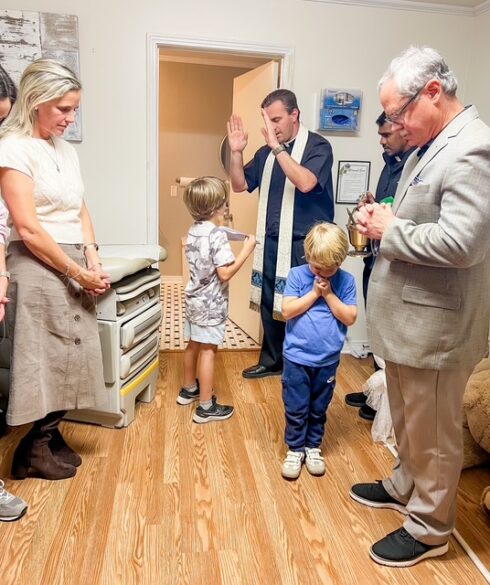
OXFORD – St. John the Evangelist Knights of Columbus Council 10901 recently donated a new ultrasound machine to the Pregnancy Center of Oxford. On Nov. 13, Father Mark Shoffner blessed the machine during a small gathering. Pictured from left are Danielle Lewis, Theodore Cutcliffe, Father Mark Shoffner, Father Robert Antony, Louis Cutcliffe and Grand Knight Jim Herzog. (Photo by Jennifer Newsom)

Calendar of Events

SPIRITUAL ENRICHMENT
GLUCKSTADT – St. Joseph, Millions of Monicas – Praying with confidence for our children, each Tuesday from 6:30-7:30 p.m. in the church. Join with other mothers and grandmothers as we pray for our children’s faithful return to the church. Details: email millionsofmonicas@stjosephgluckstadt.com.

CANTON – Sacred Heart, Advent Penance Service, Monday, Dec. 15 at 6 p.m. Details: church office (601) 859-3749.

PEARL – St. Jude, Advent Penance Service, Wednesday, Dec. 10 at 6 p.m. Details: church office (601) 939-3181.

PARISH & YOUTH EVENTS
FLOWOOD – St. Paul, Rededication Mass, Sunday, Nov. 23 at 3 p.m. Details: church office (601) 992-9547.

HERNANDO – Holy Spirit, Advent/Christmas Concert, on Sunday, Nov. 30 at 4 p.m. Details: church office (662) 429-7851.

MADISON – St. Anthony School, Starry Night Gala, Friday, Dec. 12 at 7 p.m. at the Bill Waller Craft Center. Details: school office at (601) 607-7054.

MADISON – St. Joseph School, Annual Draw Down, Saturday, Jan. 24, 2026, at Reunion Country Club. Details: school office (601) 898-4800.

PEARL – St. Jude, Feast of Our Lady of Guadalupe, Thursday Dec. 11 after 6:30 p.m. Mass the parish will have a special rosary and serenade. On Friday Dec. 12 at 6 p.m. join us for a procession and Mass, plus a potluck after mass.

St. Jude, Posadas, Wednesday Dec. 17 at 6:30 pm. Details: church office (601) 939-3181.

EMPLOYMENT
JACKSON – Diocese of Jackson seeks a Facilities Manager to support parishes and schools. Oversees contract review, construction, and diocesan property/life-health-safety policies; manages maintenance and repairs for the Chancery and diocesan sites. Bachelor’s/associate degree in facilities or construction preferred; CFM preferred; 5+ years facilities/construction management required. Email résumé and cover letter to Cathy Pendleton at cathy.pendleton@jacksondiocese.org.

CATHOLIC SCHOOL ADMINISTRATOR POSITIONS – The Diocese of Jackson seeks qualified, faith-filled leaders to serve as administrators in our Catholic schools. Positions available at St. Joseph School, Madison (Grades 7–12), St. Joseph School, Greenville (Grades PK3–12), and St. Elizabeth School, Clarksdale (Grades PK3–6). Applicants should be practicing Catholics with leadership experience, strong communication skills, and a commitment to Catholic education. For details and applications, visit jacksondiocese.org/administrator-employment.

JACKSON PARENTS SHARE YOUR VOICE IN THE METRO SCHOOL SURVEY
JACKSON – Families with children from early childhood through 12th grade are invited to take part in the Jackson Catholic Schools Family Survey on Education.

Whether your children attend Catholic schools or not, your feedback will help us better serve families across our Catholic community. The short survey asks about your experiences and how you make schooling decisions. Take the survey today at https://tinyurl.com/JacksonCatholicEd.

IN MEMORIAM – DEACON MARK WHITE
OLIVE BRANCH – Please pray for the repose of the soul of Deacon Emeritus Mark White, who died on Nov. 17, 2025. A Mass of Christian Burial will be held at 10 a.m. on Monday, Dec. 1, at Queen of Peace, 8455 Germantown Rd., Olive Branch, MS 38651. Visitation will be held one hour before the Mass. Bishop Joseph Kopacz will be the principal celebrant, with Father Hendrik “Ardi” Ardianto, SCJ and Father David Szatkowski, SCJ concelebrating and Deacon Ted Schreck preaching the Gospel. Eternal rest grant upton him, O Lord.

Obispos de EEUU emiten un mensaje pastoral sobre la inmigración, eligen a un nuevo secretario de la USCCB y aprueban las ‘ERDs’

BALTIMORE (OSV News) – La inmigración volvió a ser el tema central de la asamblea plenaria de otoño de la conferencia episcopal estadounidense en Baltimore.

El 12 de noviembre, durante la segunda sesión pública de la reunión de obispos, que duró medio día, los prelados aprobaron un “mensaje pastoral especial sobre la inmigración”, en el que expresaban “nuestra preocupación por los inmigrantes” en su asamblea plenaria anual de otoño en Baltimore.

La declaración se produjo cuando un número cada vez mayor de obispos ha reconocido que algunas de las políticas migratorias de la administración Trump pueden plantear a la Iglesia retos prácticos en la administración del apoyo pastoral y las iniciativas caritativas, así como retos en materia de libertad religiosa.

En otra acción, los obispos eligieron un nuevo secretario para su conferencia: el obispo Kevin C. Rhoades, de Fort Wayne-South Bend, Indiana. También eligieron un sucesor para el obispo Rhoades como presidente del Comité para la Libertad Religiosa y seleccionaron a los presidentes electos de cinco comités permanentes.

Los obispos rezan durante una sesión de la asamblea general de otoño de la Conferencia de Obispos Católicos de Estados Unidos, celebrada el 12 de noviembre de 2025 en Baltimore. (Foto de OSV News/Bob Roller)

Los obispos aprobaron por abrumadora mayoría una versión actualizada de su documento rector sobre la asistencia médica católica, con revisiones sustanciales que incluyen prohibiciones explícitas contra la denominada asistencia “de afirmación de género”. También aprobaron la celebración del XI Congreso Eucarístico Nacional en el verano de 2029.

Los obispos también escucharon un informe del presidente del comité presupuestario de la conferencia, el arzobispo James F. Checchio, presidente saliente del Comité de Presupuesto y Finanzas. Afirmó que la Conferencia de Obispos Católicos de Estados Unidos (USCCB por sus siglas en inglés) se encuentra en una situación financiera sólida por el momento, tras haber reestructurado algunas operaciones y haber superado el fin de los contratos federales clave para el reasentamiento de refugiados, pero añadió que podrían producirse cambios en la asignación de recursos en un futuro próximo.

En cuanto al “mensaje especial” sobre la inmigración, el arzobispo Richard G. Henning, de Boston, dijo a OSV News en una entrevista que la sensación de “tenemos que decir algo y mostrar solidaridad con los inmigrantes “ha ido brotando entre los obispos”.

“Somos pastores”, dijo. “Nos preocupamos por las personas a las que servimos, y lo que escuchamos de ellas es miedo y sufrimiento. Por lo tanto, es difícil no querer responder a eso”.

Al publicar el texto de la declaración a última hora de la tarde, un comunicado de prensa de la USCCB dijo que era “la primera vez en doce años” que la conferencia episcopal “recurrió a esta forma particularmente urgente de expresarse como cuerpo episcopal. La última vez que lo hizo fue en 2013, en respuesta al mandato federal sobre anticonceptivos”.

“Como pastores, los obispos de los Estados Unidos, estamos unidos a nuestro pueblo en nuestro Señor Jesucristo, por lazos de comunión y compasión”, decía la declaración, que fue aprobada por la gran mayoría de los obispos votantes y recibida con aplausos.

“La preocupación de la Iglesia por el prójimo y nuestra preocupación aquí por los inmigrantes son una respuesta al mandato del Señor de amar como Él nos ha amado”, decía el documento, que fue publicado en inglés después de ser aprobado por los obispos y cuya traducción al español se publicó el mismo día.
Antes de la sesión pública de la tarde, el arzobispo Nelson J. Pérez, de Filadelfia, y Montse Alvarado, presidenta y directora de operaciones de EWTN News, encabezaron una rueda de prensa sobre el Papa León XIV y la próxima National Catholic Youth Conference (la conferencia nacional católica de la juventud conocida como NCYC) en Indianápolis. El Papa va a participar en un encuentro digital único el 21 de noviembre con los jóvenes que asisten a la conferencia. EWTN News es el proveedor exclusivo de multicast del evento.

El arzobispo Pérez dijo a los periodistas que el encuentro “refleja el deseo del Santo Padre de conectar con los jóvenes” y “representa una visita virtual del Santo Padre a ellos”. Durante el encuentro, el Papa se dirigirá a una multitud prevista de unos 15.000 jóvenes de entre 14 y 18 años.

Durante la sesión pública de la tarde, los obispos aprobaron la celebración del XI Congreso Eucarístico Nacional en el verano de 2029, tras la presentación del obispo Andrew H. Cozzens, de Crookston, Minnesota, quien es también presidente de la National Eucharistic Congress Inc., la organización que organizará el evento.

La ubicación del congreso aún no se ha hecho pública. Sin embargo, según el obispo Cozzens, la lista de posibilidades se ha reducido a tres ciudades. El congreso de 2029 sigue al exitoso X Congreso Eucarístico Nacional que tuvo lugar en julio de 2024 en Indianápolis, como parte del gran Avivamiento Eucarístico Nacional de tres años.

La votación de los obispos para aprobar las actualizaciones de las “Directivas éticas y religiosas para organizaciones católicas de servicios médicos y de cuidado de salud” (ERDs, por sus siglas en inglés) se produjo un día después de la presentación preliminar de los cambios por parte del obispo auxiliar James Massa, de Brooklyn, Nueva York, presidente del Comité de Doctrina de la USCCB.

Las ERDs, elaboradas en consulta con profesionales médicos y teólogos, y revisadas periódicamente por la Conferencia de los Obispos Católicos de Estados Unidos, articulan las normas éticas para la atención de salud a la luz de la doctrina de la Iglesia y proporcionan una orientación autorizada sobre las cuestiones morales que se plantean en la atención médica católica.

Ahora, la séptima edición de las ERDs incorpora la orientación emitida en 2023 por el Comité de Doctrina de la USCCB, que prohibía las intervenciones quirúrgicas o químicas destinadas a cambiar o simular las características sexuales del cuerpo de un paciente por las del sexo opuesto.

Además, los fieles también pueden esperar una nueva edición de la Liturgia de las Horas para la Pascua de 2027, según el obispo Steven J. Lopes, presidente del Comité de Culto Divino de la Conferencia de Obispos Católicos de Estados Unidos.

(Kate Scanlon, Gina Christian y Lauretta Brown, miembros del equipo de OSV News, han colaborado con este artículo.)

Obispos de Texas: La orden judicial sobre el DACA ‘socava’ el derecho al trabajo y a mantener a una familia

Por Junno Arocho Esteves
AUSTIN, Texas (OSV News) – Los obispos católicos de Texas emitieron una advertencia sobre los efectos de la próxima aplicación de una orden de un tribunal federal de apelaciones que supondrá la pérdida de las protecciones del programa de Acción Diferida para los Llegados en la Infancia (conocido como DACA) para alrededor de 86.000 inmigrantes en el estado.

“Se espera de manera inminente una decisión de un tribunal federal que cambiará” la situación de los beneficiarios del DACA en Texas “cuya presencia … pasará de ser legal a ilegal”, afirmaron en un comunicado emitido el 4 de noviembre por la Conferencia Católica de Obispos de Texas, con sede en Austin, el brazo de la Iglesia encargado de las políticas públicas en el estado.

“Nosotros, los obispos católicos de Texas, nos comprometemos firmemente a responder con compasión y a exigir justicia para aquellos que, sin culpa alguna, se ven ahora obligados a abandonar sus hogares, sus medios de subsistencia y sus comunidades”, se lee en el comunicado.

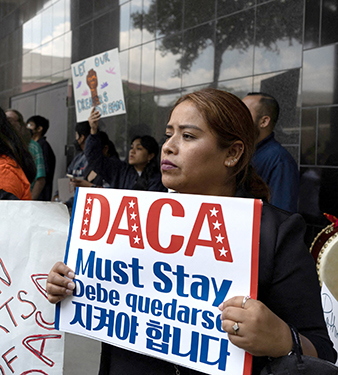
Beatrice Cruz, de Arizona, sostiene un cartel en apoyo a la política de Acción Diferida para los Llegados en la Infancia (DACA) tras una audiencia sobre el programa DACA, frente al juzgado federal de Houston, el 1 de junio de 2023. (Foto de OSV News/Adrees Latif, Reuters)

Conocido comúnmente como DACA, el programa ha sido objeto de una batalla legal de siete años en los tribunales federales desde 2018, con numerosas sentencias, apelaciones y modificaciones de su estatus.

El último avance se produjo el 17 de enero de este año, cuando la Corte de Apelaciones del Quinto Circuito de los Estados Unidos emitió una orden tras revisar una sentencia de la Corte de Distrito de los Estados Unidos para el Distrito Sur de Texas que declaraba ilegal el programa DACA.

“Aunque confirmó en gran parte el fallo del tribunal de primera instancia, el Quinto Circuito redujo el fallo para que se aplicara solo a Texas”, según un memorándum del 30 de octubre emitido por la Conferencia de Obispos Católicos de los Estados Unidos (USCCB por sus siglas en inglés). “También separó los temas de protección contra la deportación y autorización de empleo. El caso fue devuelto al tribunal de primera instancia para la implementación de la orden del Quinto Circuito, y se espera pronto más orientación del tribunal de distrito”.

El caso se encuentra ahora ante el juez de la Corte de Distrito de los Estados Unidos Andrew Hanen, en Brownsville, Texas, quien determinará cómo aplicar la sentencia del tribunal de apelación.

El 1 de mayo de 2018, Texas, junto con Alabama, Arkansas, Louisiana, Nebraska, Carolina del Sur y West Virginia, presentó una demanda ante el tribunal de distrito cuestionando la legalidad del programa. La demanda, Texas contra Estados Unidos, acusaba al entonces presidente Barack Obama y a su administración de conceder ilegal y unilateralmente lo que equivale a la “ciudadanía” a “extranjeros que, de otro modo, se encontrarían en situación irregular” cuando aprobaron el programa DACA en 2012.

Los demandantes argumentaron que los beneficiarios del DACA aumentan los costos estatales en materia de educación, salud y aplicación de la ley; el tribunal de distrito dictaminó que Texas tenía legitimidad para impugnar el programa y que este era ilegal. El Quinto Circuito confirmó que Texas tenía legitimidad para impugnar el programa DACA “basándose en la carga financiera que supone la presencia de los beneficiarios del DACA” y también consideró que el rograma era “sustantivamente ilegal”.

Puesto en marcha por una orden ejecutiva de Obama, el programa permite la autorización de empleo y la protección temporal contra la deportación a los inmigrantes (comúnmente llamados “soñadores” o “dreamers”) traídos a los Estados Unidos por sus padres cuando eran menores de edad sin autorización legal. Las personas que pueden acogerse al programa deben haber llegado antes de los 16 años, haber residido de forma continuada en los Estados Unidos desde el 15 de junio de 2007 y ser menores de 31 años a fecha de 15 de junio de 2012.

Según la KFF (antes Kaiser Family Foundation), a 30 de septiembre de 2024 había en Estados Unidos unos 538.000 beneficiarios del DACA procedentes de casi 200 países de origen.

Los funcionarios federales propusieron un plan de implementación de la orden del Quinto Circuito el 29 de septiembre, según el memorándum de la USCCB. Las partes tienen previsto celebrar una reunión informativa el 24 de noviembre, y se espera que el tribunal de distrito presente su plan detallado poco después.

Pero más claridad es necesaria, ya que diferentes reportes describen diferentes efectos que podrían llevarse a cabo. Por ejemplo, según The Texas Tribune, los beneficiarios del DACA podrían seguir siendo capaces de encontrar empleo en otros estados. Además, el medio de comunicación también informó de que el juez Hanen revisará un plan del Departamento de Justicia “que permitiría al Gobierno empezar a aceptar nuevas solicitudes del DACA por primera vez en cuatro años”, aunque estos solicitantes no podrían solicitar permisos de trabajo en Texas.

Pero, según el plan del gobierno, los beneficiarios del DACA que vivan en Texas y tengan un permiso de trabajo renovable de dos años recibirían un aviso con 15 días de antelación de que se les revoque su permiso de trabajo.

En su comunicado en respuesta al plan de implementación de la orden del Quinto Circuito, los obispos de Texas afirmaron que esta orden “socava aún más el derecho humano fundamental de estas personas a buscar trabajo y mantener a una familia”.

“Es contrario a la realidad afirmar que nuestro estado se ve perjudicado por los beneficiarios de DACA que trabajan aquí de manera legal. En cambio, este tipo de acción disruptiva y sin precedentes por parte de nuestro gobierno, perjudicará a nuestras comunidades al fomentar el miedo, romper relaciones, interrumpir la actividad económica y expulsar a algunas de las personas más respetables de nuestra comunidad”, dijeron los obispos.

“Esta decisión afectará prácticamente a todas las comunidades de Texas al eliminar la legalidad de la presencia de los beneficiarios de DACA que viven en Texas”, afirmaron.

“Los desafíos actuales en nuestro país en materia migratoria son el resultado de décadas de renuencia por parte de todos a implementar una reforma migratoria razonable y significativa, que respete tanto las necesidades de seguridad nacional como el derecho humano de toda persona a trabajar y formar una familia en paz”, afirmaron los obispos.

La aplicación de la orden del Quinto Circuito, continuaron, “perjudicará a nuestras comunidades al fomentar el miedo, romper relaciones, interrumpir la actividad económica y expulsar a algunas de las personas más respetables de nuestra comunidad”.

Los métodos de aplicación de la ley por parte del ICE se han convertido en un importante punto de fricción con la Iglesia Católica alrededor del país, ya que varios grupos han denunciado que el trato que el ICE da a los migrantes detenidos viola su dignidad humana y que no se respetan los derechos de los católicos detenidos a recibir la Eucaristía.

En todo Estados Unidos, los cristianos representan aproximadamente el 80% de todas las personas en riesgo de ser deportadas por la campaña de deportación masiva de Trump, siendo los católicos el grupo más numeroso de cristianos afectados, según un informe católico-evangélico publicado por World Relief. El informe reveló que uno de cada seis católicos (18%) es vulnerable a la deportación o vive con alguien que lo es.

En su comunicado sobre el caso referente a la situación de DACA en el estado, los obispos de Texas recordaron a las autoridades federales y estatales “la importancia de la capacitación y supervisión adecuadas para los agentes de ICE”.

“Jamás debe ser considerado ni justificado acto de violencia alguno en daño de los agentes del orden”, afirmaron los obispos. “La dignidad humana de los propios agentes del orden se ve violada cuando se espera que consideren métodos brutales e inhumanos para hacer cumplir estas decisiones”.

“Somos pastores de agentes de ICE y de beneficiarios de DACA, de personas indocumentadas y de familias cuya seguridad se ve amenazada”, afirmaron. “Esta decisión solo exacerbará el temor y la desconfianza, enfrentará a los miembros de la comunidad entre sí y causará una importante perturbación económica en muchas comunidades”.

Los obispos añadieron: “Queremos decirles inequívocamente a todos nuestros hermanos y hermanas inmigrantes, y de manera especial a quienes llegaron siendo niños: Hemos escuchado sus súplicas. Estamos con ustedes en estos tiempos difíciles”.

Los pobres permanecen en el corazón del Evangelio

Por Obispo Joseph R. Kopacz, D.D.
Durante su homilía el pasado domingo, en conmemoración del Día Mundial de Oración por los Pobres, el Papa León XIV pidió a los líderes mundiales a escuchar el clamor de los más pobres, que desafío a los que tienen tienen responsabilidad política. “No puede haber paz sin justicia”, dijo, “y los pobres nos lo recuerdan de muchas maneras – tanto a través de la migración como desde sus llantos, que a menudo se ven agobiados por el cuento del bienestar y el progreso que no tiene en cuenta a todos, y de hecho olvida a muchos individuos, dejándolos a su suerte.”

El papa también respaldó los esfuerzos de los trabajadores y voluntarios de caridad e invitó a todos los cristianos a buscar el Reino de Dios trabajando para transformar la convivencia humana en un “espacio de fraternidad y dignidad para todos, sin excepción.”

Obispo Joseph R. Kopacz

Este es un momento desafiante en todo el mundo donde corrientes de nacionalismo y aislacionismo están fracturando la solidaridad global, principalmente de un compromiso llevadero en favor de la justicia y la paz. La Iglesia Católica, por otro lado, ha sido firme en palabras y acciones durante 2.000 años y, de forma notable, en la era moderna desde la época del Papa León XIII, en favor de la dignidad humana y la solidaridad internacional. Es inconfundible que ha sido una prenda sin costuras de las Enseñanzas Sociales Católicas desde el corazón de la iglesia que ha sido cuidadosamente articulado en documentos papales.

En la historia reciente existen las cartas y testimonios de los papas Francisco y Benedicto, San Juan Pablo II, San Pablo VI y San Juan XXIII. Cada Santo Padre de su generación a hablado apasionadamente a los líderes mundiales para que se alejen de la guerra y del nacionalismo desenfrenado para fomentar una fraternidad de naciones más pacífica e interdependiente. Durante la pandemia, el Papa Francisco se sentó solo en la Plaza de San Pedro ante el Santísimo Sacramento y encomendó a la Divina Providencia el bienestar de todas las naciones y pueblos. Desde el aislamiento impuesto y la soledad orante en el 2020, el Papa Francisco escribió su tercera encíclica Fratelli Tutti (Hermanos Todos) sobre la amistad social fraternal y la solidaridad global que surge de la humanidad que compartimos.

El Papa Juan XXIII liberó a Pacem in Terris en medio del Concilio Vaticano II, una profunda oración y un llamamiento por la paz y la solidaridad en nuestro mundo. Unos años después, Pablo VI escribió Populorum Progressio sobre el desarrollo de los pueblos y enseñó proféticamente que el Desarrollo Humano Integral contiene el imperativo del Crecimiento Moral, Espiritual y Social, no solo el bienestar material. San Juan Pablo II en Sollicitudo Rei Socialis en el 20º Aniversario de Populorum Progressio en 1987 enseñó sin reservas que la Doctrina Social de la Iglesia es parte integral de su misión evangelizadora. El Papa Benedicto, en su documento del 2005 Deus Caritas Est, escribió que “la naturaleza más profunda de la Iglesia se expresa así en su triple deber: proclamando la Palabra de Dios, celebrando los sacramentos y ejerciendo el ministerio de caridad. Estos deberes son inseparables y se reconocen mutuamente.”

La Iglesia Católica en Estados Unidos abraza plenamente las enseñanzas de nuestros Santos Padres como valores fundamentales y una visión evangélica para nuestro mundo. Con motivo de la conmemoración del Día Mundial de Oración por los Pobres, nos enorgullece que, como iglesia global, tengamos una amplia experiencia en el racionamiento a la ayuda humanitaria y asistencia al impulso a través de agencias internacionales como Catholic Relief Services, en colaboración con ONG y gobiernos por igual.
“La Iglesia Católica ha reconocido durante mucho tiempo que ayudar a quienes lo necesitan, independientemente de su nacionalidad o fe, es un deber moral. La ayuda humanitaria y el desarrollo es una parte integral del compromiso de la iglesia con la vida y la dignidad humana. Mientras la iglesia busca un mundo más pacífico mediante el diálogo y la diplomacia, la asistencia que salva vidas y afirma la vida actúan como complementos necesarios que permiten que radiquen soluciones sostenibles.

“Una visión integra y provida católica para la asistencia humanitaria y de desarrollo de EE. UU. reconoce que el gobierno de EE. UU., junto con la Iglesia, comparten la responsabilidad de promover el bien común. Dado que las instituciones gubernamentales y la iglesia están llamadas conjuntamente a crear un mundo más justo, un enfoque católico hacia la ayuda internacional de EE. UU. invoca a ambas partes como socios esenciales en la promoción de un cambio sostenible que aborde eficazmente las necesidades globales.” (Visión Católica para la Asistencia Humanitaria y al Desarrollo de EE. UU. USCCB)

El Papa León XIV nos ha recordado en Dilexi Te, su primera Exhortación Apostólica: “que el corazón ardiente de la misión de la Iglesia me convenza de la necesidad de volver a leer el Evangelio, no sea que corramos el riesgo de reemplazarlo por la sabiduría de este mundo. No se puede descuidar a los pobres si queremos permanecer dentro del reglamento de la de la vida en la iglesia, que tiene su origen en el Evangelio y da fruto en cualquier tiempo y lugar. Esto también es esencial para el camino hacia la santidad.”

Profundizar y trabajar con paciencia para mantener a laIglesia sobre cimientos sólidos, dice el papa

By Carol Glatz
ROMA (CNS) – En muchos sentidos, la Iglesia católica es siempre una “obra en construcción” en la que Dios moldea constantemente a sus miembros, que deben esforzarse y trabajar con diligencia, pero también con paciencia, afirmó el papa León XIV.

La obra en construcción es “una hermosa imagen que habla de actividad, creatividad y dedicación, así como de trabajo duro y, a veces, de problemas complejos que hay que resolver”, dijo el papa mientras celebraba la misa en la Basílica de San Juan de Letrán en Roma el 9 de noviembre, fiesta de la dedicación de la basílica en el siglo IV.

De pie ante la “cathedra” o silla del obispo, el papa León predicó sobre la basílica como “un signo de la Iglesia viva, construida con piedras escogidas y preciosas sobre Cristo Jesús, la piedra angular”.

También habló sobre la festividad cuando regresó al Vaticano para la recitación del Ángelus al mediodía.
“Somos la Iglesia de Cristo, su cuerpo, sus miembros llamados a difundir su Evangelio de misericordia, consuelo y paz por todo el mundo, a través de ese culto espiritual que debe brillar sobre todo en nuestro testimonio de vida”, dijo a las personas reunidas para rezar con él en la Plaza de San Pedro.
“A menudo, las debilidades y los errores de los cristianos, junto con muchos clichés y prejuicios, nos impiden comprender la riqueza del misterio de la Iglesia”, afirmó.

El papa León XIV se sienta en la «cathedra» o silla episcopal de la basílica de San Juan de Letrán, en Roma, mientras celebra la misa el 9 de noviembre de 2025, festividad de la dedicación de la basílica. (Foto CNS/Pablo Esparza)

Sin embargo, la santidad de la Iglesia “no depende de nuestros méritos, sino del “don del Señor, que nunca se retira”, que sigue eligiendo “como instrumento de su presencia, con un amor paradójico, las manos sucias de los hombres””, dijo el Papa, citando el libro de Benedicto XVI de 1968, Introducción al cristianismo.

En su homilía en la basílica, el papa León pidió a los fieles que reflexionaran sobre los cimientos de la iglesia en la que se encontraban.

“Si los constructores no hubieran excavado lo suficiente como para encontrar una base sólida sobre la que construir el resto, todo el edificio se habría derrumbado hace mucho tiempo o correría el riesgo de hacerlo en cualquier momento”, dijo. “Afortunadamente, sin embargo, quienes nos precedieron sentaron unas bases sólidas para nuestra catedral, excavando profundamente con gran esfuerzo antes de levantar los muros que nos acogen, y esto nos hace sentir mucho más tranquilos”.

Como miembros y trabajadores de la Iglesia, dijo, los católicos de hoy también “debemos primero excavar profundamente dentro de nosotros mismos y a nuestro alrededor antes de poder construir estructuras impresionantes. Debemos eliminar cualquier material inestable que nos impida llegar a la roca sólida de Cristo”.

La Iglesia y sus miembros deben volver constantemente a Cristo y a su Evangelio, dijo el Papa, “de lo contrario corremos el riesgo de sobrecargar un edificio con estructuras pesadas cuyos cimientos son demasiado débiles para sostenerlo”.

Construir la Iglesia de Cristo es una labor que requiere mucho tiempo, esfuerzo y paciencia, afirmó.
Parte de esa labor, dijo el Papa, consiste en ser lo suficientemente humildes como para permitir que Dios actúe sobre cada uno de los miembros, las “piedras vivas” que conforman la Iglesia.

“Cuando Jesús nos llama a participar en el gran proyecto de Dios, nos transforma moldeándonos hábilmente según sus planes de salvación”, dijo el papa León. “Esto implica un camino cuesta arriba, pero no debemos desanimarnos. Al contrario, debemos continuar con confianza en nuestros esfuerzos por crecer juntos”.

El papa León concluyó su homilía con una petición especial a la comunidad que celebra misa allí habitualmente, pero también a todas las iglesias y parroquias.

“El cuidado de la liturgia, especialmente aquí, en la Sede de Pedro, debe ser tal que sirva de ejemplo para todo el pueblo de Dios. Debe cumplir con las normas establecidas, estar atento a las diferentes sensibilidades de los participantes y ajustarse al principio de la sabia inculturación”.

Pidió a los fieles que “permanezcan fieles a la solemne sobriedad típica de la tradición romana, que puede hacer tanto bien a las almas de quienes participan activamente en ella”.