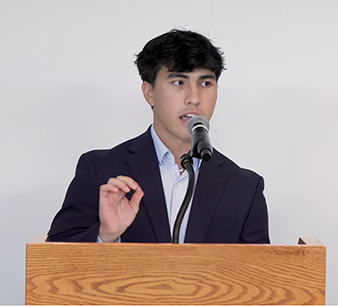
Meet our new permanent deacons – Enrique Amador

JACKSON – Bishop Joseph Kopacz ordained seven men to the permanent diaconate for the Diocese of Jackson on July 18, 2026 at the Cathedral of St. Peter the Apostle in Jackson. In the following profiles, the new deacons share their vocation stories, the people and experiences that shaped their faith, and their hopes for serving the people of the diocese.

DEACON ENRIQUE AMADOR
Assigned: St. James, Corinth
Spouse: Carolina Fierro-Amador
Hometown: Veracruz, Mexico / Tupelo, Mississippi
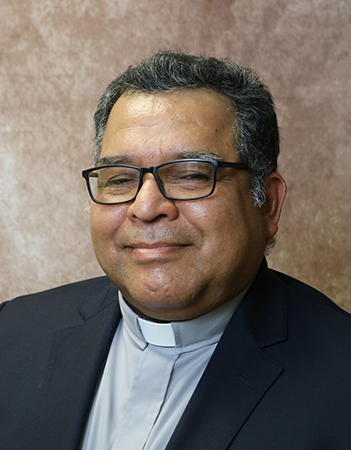
Were you raised Catholic, or did you convert to the faith? I was raised Catholic.

Can you share a moment or journey that deepened your faith or drew you closer to the Church? Although I was raised Catholic, my religious life consisted of social events. When I met my high school sweetheart (my now wife), and wanted to ask her out for a date, she asked me to meet her in the 8am Mass at the Cathedral of our hometown. Since then, God used her to bring me closer to him and to grow in my Catholic faith.

Would you share your vocation story – how did you get called to the diaconate? Many years ago, while I was studying an evangelization course program with the SouthEast Pastoral Institute (SEPI), one of the professors was a Deacon. I liked the way he taught us. He was smiling all the time; He was joyous not only about being a professor, but about living his faith, and most specifically about being a deacon. This was my first contact with the ministry of the diaconate. Years later, while studying practical theology with Loyola University New Orleans, and serving in my parish at Tupelo, one priest asked me if I had considered to be a deacon; my answer was: I have not. However, the question remained in my mind, and I started praying about it, above all, before the Blessed Sacrament. Later, I was still serving in different ministries at my parish, and I asked another priest about how to become a permanent deacon. He explained to me about the diaconate ministry and recommended to ask God before the Blessed Sacrament, if He wanted me to become one. I prayed about it for some more months until I felt what I thought was God’s call to do it. I talked about it with my pastor; he agreed with me and supported me to start the process. Since I met the SEPI’s professor to the moment I submitted my application to be considered for the diaconate program, about ten years had passed.

Where do you feel most called to serve as a deacon? (For example: charity, preaching, family ministry, etc.). I feel most called to serve as a deacon in preaching, family ministry, couples, youth, confirmation class.

How has your parish community supported you on this journey? My community has been very supporting through prayers, loving encouraging expressions, some guidance and heartily acceptance. After I was instituted as a Lector and as Minister of Holy Communion, they let me serve in those ministries. Also, they outspokenly cheer me up with prayers and encouraging words.  

What has been most challenging or surprising during this journey? The most challenging part during this journey has been the formation studies with their heavy workload of assignments, because sometimes we had two or even three courses at the same time. The most surprising thing during this journey has been the outstanding assistance of the Holy Spirit to finish my studies, the profound knowledge I have acquired, and most especially, the way God has been molding me to be his servant. I feel more at peace and sure about myself than before.

What would you say to someone who might be feeling called to the diaconate? I would tell him that the diaconate is a great journey with hard but worthy formation. Also, I would say to him that he will learn and understand more about his faith for sure, and that it is a great blessing to be a servant of God. I would suggest to him to keep praying and asking God before the Blessed Sacrament if this call is for him. Finally, I would assure him that he will not be alone on this journey. I will affirm to him that many people will show him love, support and guidance for him to become a deacon; that his parish community, the professors, the other deacons, the priests and our Bishop will be praying and accompanying him along the way because we all are one same community of family and friends.

Do you have a favorite Scripture passage and why? My favorite Scripture passage is Rom 8:28, because it reminds me that everything that happens to me will be for my own good, if I love God. This biblical passage gives me peace and trust in God.  

Who is your favorite saint and why? Saint Theresa of Lisieux, the Little Flower. She is the patron saint of Missions. Eight years after a vasectomy, my wife and I got three miscarriages. We prayed to the Little Flower to intercede for us in having a baby, now that we discovered the vasectomy had naturally reverted, and she did! We had two more babies. The first one of those has her name: Teresita de Jesus.

Do you have a favorite religious image or devotion and why? One of my favorite devotions is praying the rosary. This prayer helps me to be at peace and to keep me accountable of my actions. Also, I know for a fact that it is a powerful prayer for difficult cases.

What is your favorite liturgy of the year and why? My favorite liturgy of the year is the Easter Vigil celebration, because it is beautiful and deeply symbolic of our daily spiritual life with the candles in darkness, the blessing of the fire, and the welcoming to new Catholics to our Church.

What is something people might be surprised to learn about you? People might be surprised to discover that I am a very reserved person. I get nervous when I need to talk in front of many people, even if I have done it before. I used to, generally, force myself to do it.  

Any children? (if you want it printed).

Yarah, José Enrique, Teresita de Jesús and Juan Francisco, Amador-Fierro.

In heaven: Dulce Maria, Carolina Isabel, Guillermo, Rogelio.

Deacon’s wives questions:

Name (as you want it printed): Carolina Fierro-Amador

What did you think when your husband first began to consider ordination? I thought it was a privilege and felt happy and blessed.

How has this journey shaped your marriage and your family life? Wow, what can I say? This journey has been transformational for my husband and I right from the beginning. It has given us resilience, clarity, and courage to make changes that we had thought of making but never did before. It also prepared us to face extremely difficult family situations that shook us and could potentially break us. Most especially, it has made us humbler to recognize our dependence on God, our limitations, and our fragilities.  

How has your parish supported your family during this time? The parish has been very generous and open to giving my husband plenty of opportunities to strengthen his formation. The parish community, the people of the pews, have been amazingly encouraging and loving towards all of us.

What has been most challenging or surprising during this journey? The most surprising thing has been my direct witnessing of the hard and complex formation that the diaconate life implicates. At the same time, it has been one of the most challenging things as well, because of the time, money and effort invested in the process by both my husband and me.

Do you have a favorite Scripture passage and why? Deuteronomy 6:4-9 because it grounds me on the most important and basic things in life. It gives me direction, peace, and encouragement to continue being loyal to God regardless of the difficulties I face.

Who is your favorite saint and why? Saint Jean-Marie Vianney because he showed me with his life what to do fighting for the people around me, even if they do not want to get closer to God.

Do you have a favorite religious image or devotion and why? Praying the Prayer of the Hours is one of my favorite devotions because it is a powerful experience to know that the universal Church is praying together in the silence and intimacy of ordinary life. Most especially, it has had a mysterious unifying effect in my marriage since my husband and I pray it together. There are two prayers within the breviary that I hold close to my heart and constantly pray them: 1) “Protect us, Lord, as we stay awake; watch over us as we sleep, that awake, we may keep watch with Christ, and sleep, rest in his peace.” 2) “Father, creator of unfailing light, give that same light to those who call to you. May our lips praise you; our lives proclaim your goodness; our works give you honor, and our voices celebrate you forever.”

What is your favorite liturgy of the year and why? Easter Vigil Mass is my favorite liturgy of the year because the remembrance of God’s love for us through the readings fills me with joy and hope. The symbolism and beauty throughout the celebration leave me in awe, reverence, and gratitude for being part of such a perfect Church regardless.
In Assisi, Pope Leo urges young people to become ‘new saints’

06-08-2026 Visita Pastorale ad Assisi – Basilica di Santa Maria degli Angeli: Celebrazione della Santa Messa

By Courtney Mares
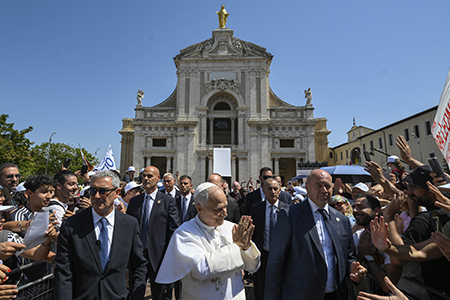
ASSISI, Italy (OSV News) – Pope Leo XIV traveled to Assisi Aug. 6 to celebrate the Jubilee Year of St. Francis with 2,500 young people, urging them to become the “new saints” the world needs today.

The pope celebrated Mass at the Basilica of St. Mary of the Angels on the feast of the Transfiguration of the Lord for participants in the “Go! Franciscan Youth Meeting,” a four-day gathering of young people ages 18 to 33 from across Europe. The basilica was built on the site where St. Francis founded the Franciscan order.

“Dear young people, today Europe and the whole world are looking to you to be new saints. Dare to believe in the word of the Gospel; become fully human with the freedom of Jesus Christ,” Pope Leo said in his homily in the basilica that encompasses the small chapel where St. Francis founded the Franciscan order.

“Unite the best energies of your magnificent humanity: your studies, skills, work, friendships, love and prayer, so that you can bring Saint Francis’ vision to life in many different ways,” he added.

The pope’s visit is part of the Church’s celebration of the 800th anniversary of St. Francis’ death and coincides with the annual August celebration in which pilgrims flock to the Basilica of St. Mary of the Angels to receive a plenary indulgence linked to a mystical experience of St. Francis.

The pope flew from Vatican City to Assisi by helicopter in the morning. Before Mass, he met young people gathered in the piazza in front of the basilica and answered some of their questions, offering advice about vocations and discernment.

He told them that “the deepest vocation, written in every human heart, is a call to communion,” a truth he said sin can obscure. Thankfully, he added, every vocation is also a journey toward redemption and healing.

“Jesus’ invitation to follow him reveals our own dignity and teaches us to honor the dignity of others by placing our trust in them and proving ourselves worthy of their trust,” Pope Leo said. “This dynamic is so liberating that it deserves the wholehearted commitment of our lives.”

The pope also greeted representatives of the Franciscan orders in the basilica’s cloister before celebrating Mass. The opening procession began outside, where the pope blessed young people who followed the Mass from the piazza under the summer sun.
The Basilica of St. Mary of the Angels, built in the 16th century, encloses the Porziuncola, a small chapel considered the birthplace of the Franciscan order, which St. Francis founded in 1209.

Each year during the first week of August, pilgrims can receive a plenary indulgence under the usual conditions linked to a mystical experience St. Francis reported there in 1216, when he asked Christ to grant full remission of sins to those who repented, confessed and prayed in the church.

(Courtney Mares is Vatican editor for OSV News.)

St. Paul Knights support Birthright of Jackson

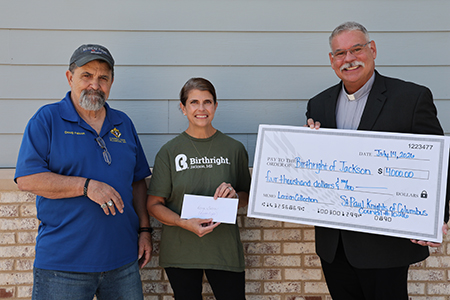
FLOWOOD – Doug Falcon, grand knight of the Knights of Columbus Council at St. Paul Parish, presents a donation to Karen Giordano of Birthright of Jackson alongside Deacon Tony Schmidt. Birthright provides free pregnancy tests, confidential support and connections to resources for women and families facing an unexpected pregnancy. Giordano said the organization accompanies mothers, babies and fathers throughout pregnancy and after a child’s birth, helping families access services such as employment and child care assistance. The non-denominational organization has received support from the St. Paul Knights of Columbus for more than a decade as part of the council’s commitment to protecting and supporting human life. (Photo by Tereza Ma)

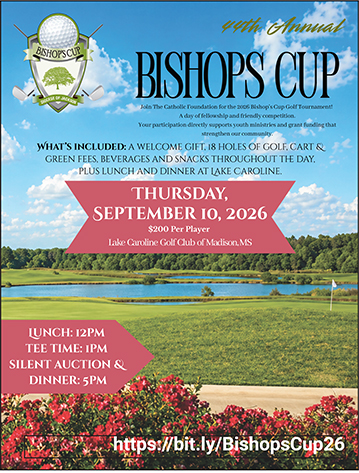
Golfers, sponsors invited to tee-off at 44th annual Bishop’s Cup tournament

By Staff Reports
JACKSON – Golfers, sponsors and supporters from across the Diocese of Jackson are invited to participate in the 44th annual Bishop’s Cup Golf Tournament on Thursday, Sept. 10, at Lake Caroline Golf Club in Madison. Hosted by the Catholic Foundation, the annual event brings together clergy, parishioners, businesses and friends for a day of fellowship, friendly competition and support for diocesan ministries.

Proceeds from the tournament benefit youth ministries throughout the Diocese of Jackson and provide grant funding to strengthen parish and diocesan ministries. The event has become one of the Catholic Foundation’s signature fundraisers, helping invest in the faith formation of future generations and the work of the Church across the diocese.

“This tournament is about much more than golf,” said Rebecca Harris, executive director of the Catholic Foundation. “Each year, the generosity of our golfers, sponsors and volunteers helps us provide meaningful support for youth ministry and grant programs that strengthen our parishes and communities. We invite everyone to join us for a wonderful day of fellowship while making a lasting difference in the lives of young people across our diocese.”

Registration is $200 per golfer and includes a welcome gift, 18 holes of golf with a cart and greens fees, beverages and snacks throughout the day, plus lunch and dinner. Lunch begins at noon, followed by a shotgun start at 1 p.m. The day concludes with a silent auction and dinner beginning at 5 p.m.

Businesses and individuals also are invited to support the tournament through sponsorships ranging from hole sponsorships to presenting-level opportunities. Sponsors receive recognition throughout the event while helping make a lasting impact on the ministries supported by the Catholic Foundation.

Registration and sponsorship forms must be received by Sept. 4. Those unable to play in the tournament are invited to attend the dinner or participate in the silent auction.

For more information or to register, visit https://bit.ly/BishopsCup26.

Pope Leo XIV to visit 10 cities in South America in November

By Courtney Mares
ROME (OSV News) – Pope Leo XIV will make the first apostolic journey to South America of his pontificate Nov. 6-17, visiting 10 cities in Uruguay, Argentina and Peru, the Vatican has announced.
The trip will take him from one of Latin America’s least religious countries to the homeland of the late Pope Francis before culminating in Pope Leo’s return to Peru, where he served as an Augustinian missionary and later bishop of Chiclayo. It will be his first return to the continent since his election as pope.

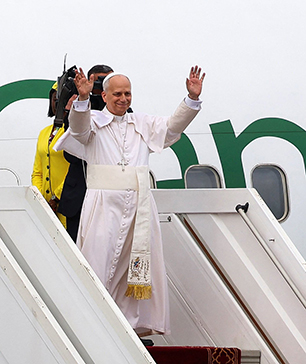
Pope Leo XIV waves to the crowd as he boards the papal plane at Bamenda International Airport in Cameroon April 16, 2026, en route to in Yaoundé, Cameroon. The Vatican announced Aug. 5 that Pope Leo will visit 10 cities in South America during his apostolic journey to Uruguay, Argentina and Peru Nov. 6-17. (OSV News photo/Guglielmo Mangiapane, Reuters)

Here is a look at the cities that Pope Leo will visit:

Uruguay (Nov. 6-8)
The pope’s first stop will be Uruguay, where Christians only make up 44% of the population, the lowest percentage in Latin America, according to the Pew Research Center.

Montevideo
Montevideo is Uruguay’s capital and largest city. It is home to the National Shrine of the Sacred Heart of Jesus and the historic Montevideo Metropolitan Cathedral.

Paysandú
Paysandú, a cultural and economic hub on Uruguay’s western border with Argentina, was founded in 1772 by a priest, Policarpo Sandú, and Christianized Indigenous families. The city is home to the Basilica of Our Lady of the Rosary, known for its large pipe organ.

Florida
The Uruguay visit will likely conclude in Florida, home to the National Sanctuary of Our Lady of the Thirty-Three, the patroness of Uruguay. A yearly pilgrimage is held every second Sunday of November, which falls this year on Nov. 8. The basilica preserves an 18th-century Guaraní image of the Virgin Mary before which 33 of Uruguayans prayed before fighting for independence.

St. John Paul II consecrated the shrine during his 1988 visit, the last papal trip to Uruguay. “Almost 40 years ago, we experienced the unforgettable visit of St. John Paul II. Now we welcome Pope Leo with enormous anticipation. It is a joy for the Church, but also for all of Uruguay,” Cardinal Daniel Sturla of Montevideo said.

Argentina (Nov. 8-11)
The second leg of the trip will be Argentina, the homeland of Pope Francis, who served as archbishop of Buenos Aires before becoming pope, but never returned during his pontificate. About 58% of adults in Argentina identify as Catholic, according to Pew.

Buenos Aires
In Buenos Aires, the pope will likely meet President Javier Milei, who welcomed the announced visit as “an event of enormous spiritual and institutional significance for our country and for all Argentines.”

The capital is also home to the Basilica of Our Lady of Mercy, where the tomb of Argentina’s first female saint, known as Mama Antula, is located.

Córdoba
Córdoba, Argentina’s second-largest city, is known for its Spanish colonial architecture. Its historic Manzana Jesuítica, “Jesuit Block,” includes one of South America’s oldest universities and is a UNESCO World Heritage site.

Luján
Luján is home to the Shrine of Our Lady of Luján, patroness of Argentina and one of the country’s leading pilgrimage sites. As archbishop of Buenos Aires, Pope Francis led pilgrimages there, while St. John Paul celebrated Mass at the shrine during his 1982 visit and consecrated Argentina to Our Lady of Luján.

Peru (Nov. 11-17)
The final and longest portion of the trip will bring Pope Leo back to Peru, where he first arrived as an Augustinian missionary in 1985. He was appointed apostolic administrator of the Diocese of Chiclayo in 2014 before becoming its bishop. He obtained Peruvian citizenship in 2015 before being transferred to the Vatican in 2023.

Lima
Lima is Peru’s capital and largest city. The city is home to the Basilica and Convent of Our Lady of the Rosary, also known as the Convent of Santo Domingo, where St. Rose of Lima and St. Martin de Porres are buried. Keiko Fujimori, whose victory in Peru’s presidential election was declared July 4, is expected to welcome the pope to the country.

Chiclayo
Chiclayo is expected to be one of the most closely watched stops of the trip because of the pope’s ties to the local church. Pope Leo served as bishop of the diocese from 2015 to 2023.

Cusco
Pope Leo will also visit Cusco, the former capital of the Inca Empire. One of the oldest continuously inhabited cities in the Western Hemisphere, Cusco remains one of Peru’s foremost cultural centers in the Andes with an average elevation of 11,150 feet.

Pucallpa
The pope will not leave Peru without stopping in Pucallpa, a city on the Ucayali River in the Amazonian rainforest that has long served as a center for Catholic missionary outreach in Peru’s rainforest.

The Diocese of Chiclayo celebrated the Vatican’s announcement saying that the pope’s visit will bring “a message of faith, hope, and closeness to millions of Peruvians.”

“It will be a historic visit that will unite us as a people and as a Church,” the diocese said in a social media post.

In France, pope to highlight life, unity; Vatican confirms he’ll meet with abuse victims

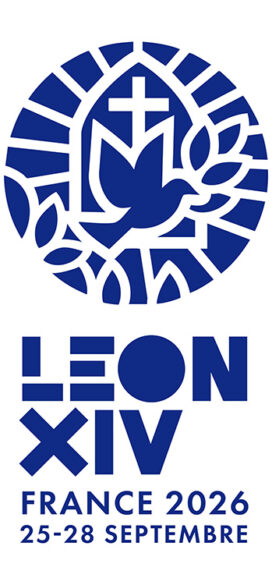
This is the logo for Pope Leo XIV’s Sept. 25-28, 2026, apostolic journey to France. With the motto “That the world may have life,” the pope’s first visit to France will include stops in Paris, Lourdes and Metz and a private meeting with victims of abuse in the Church. The logo features a stained-glass window, a cross and a dove carrying an olive branch, symbolizing the Church’s unity, the apostolic and liturgical dimensions of the visit, and peace. (OSV News photo/courtesy Pope in France)

By Paulina Guzik
PARIS (OSV News) – Pope Leo XIV will make a four-day apostolic journey to France Sept. 25-28, with a program that stretches from the Élysée Palace and UNESCO in Paris to the Marian shrine of Lourdes and a final stop in Metz, and it will include a private meeting with victims of abuse in the Church, the Vatican has confirmed.

The Holy See Press Office released the detailed schedule Aug. 7, along with a statement to journalists saying, “During his upcoming Apostolic Journey to France, Pope Leo XIV will meet privately with several victims of abuse in the Church. The victims themselves will be involved in preparing for this event. Further details may be provided later.”

The motto of the trip, “That the world may have life,” can be clearly read through the prism of a recent vote made by French lawmakers to legalize “assisted dying,” a move that French bishops called a “radical choice.”

He will also meet catechumens and newly baptized Catholics and celebrate Mass at Place de la Concorde. In Lourdes, Pope Leo will pray at the Marian shrine, meet bishops, the sick and religious sisters, and celebrate Sunday Mass. The final stop in Metz will focus on peace, European unity and the legacy of Catholic statesman Robert Schuman.

The French bishops’ conference and the Vatican also unveiled the official logo and motto for the visit: “That the world may have life” (John 6:51), a theme that will most likely frame the pope’s message amid debates on assisted dying in the country.

As France prepares to welcome Pope Leo for the first papal visit in 18 years, Church leaders asked for prayers as amid “logistical challenges and financial considerations, the visit of Pope Leo is “first and foremost a spiritual event,” the bishops said on the official website of the apostolic journey.

“The bishops of France invite all the faithful to pray for the arrival of Pope Leo XIV on the Feast of the Assumption,” on Aug. 15. “Let us entrust to the Lord this apostolic journey and the fruits it will bear for the Church and our country.”

(Paulina Guzik is international editor for OSV News. Follow her on X @Guzik_Paulina)

Acutis AI co-founder explores ‘Magnifica Humanitas’ and pope’s call for digital disciples

By Kimberley Heatherington
WASHINGTON (OSV News) – Artificial intelligence is quickly bringing about the end of the world as people know it – but Pope Leo XIV has an urgent message for everyone: Don’t run from the change AI brings; instead, engage it.

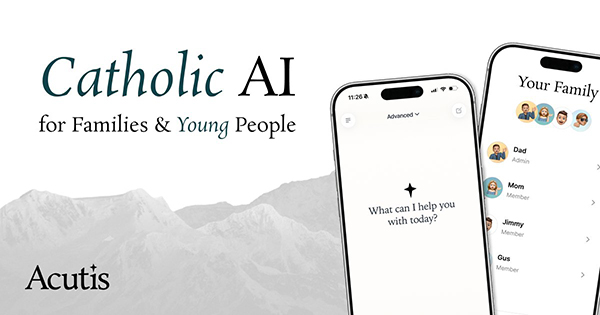
Screenshot of the website platform Acutis AI, which is named in honor of St. Carlo Acutis and designed as a Catholic alternative to mainstream AI systems by offering responses rooted in Church teaching. (OSV News photo/courtesy of AcutisAI)

That was just one of the take-aways from an Aug. 1 conference at the St. John Paul II National Shrine in Washington exploring the pope’s recent encyclical “Magnifica Humanitas: On Safeguarding the Human Person in the Time of Artificial Intelligence.”

Peter Cooney, co-founder of the website platform Acutis AI – named in honor of St. Carlo Acutis and designed as a Catholic alternative to mainstream AI systems by offering responses rooted in Church teaching – walked attendees through Pope Leo’s lengthy document.

“He opens up on a strong note: Humanity is facing a pivotal choice. He gets straight to it. If you look at other encyclicals, they usually open on a much softer note,” said Cooney, 21, an incoming senior and Economics major at the University of Dallas. “So I think what Pope Leo is telling us is: This is important – listen up; pay attention.”

And there’s good reason to – given the speed with which AI is spreading into all corners of everyday life.

Cooney noted that on Nov. 30, 2022, the launch of ChatGPT, a generative AI chatbot, was announced on the social media platform Twitter, now known as X. Within five days, it had over a million users – now, less than four years later, there are over a billion monthly active users.

“This is the fastest growing technology we’ve ever seen in the world,” Cooney said. “And I think there are a few things to note about this technology that makes it different than in the past.”

Among those differences, he said, is the diversity of AI users (everyone from kids to the military); concentrated AI ownership (Cooney estimated less than 10 companies own 95% of the current market); and the competitive AI race between the U.S. and China (with the goal of weaponizing the powerful technology).

“So what you have is a few companies in two of the most powerful nations of the world competing to create the smartest AI models; to have a military advantage,” Cooney emphasized. “And that same technology is on kids’ Chromebooks in their classrooms. This is the world that the Holy Father is addressing.”

Still, the Catholic Church is not without answers.

With this encyclical, Pope Leo has “established the Church as a moral authority on this topic,” Cooney said. “Which gives tech leaders good reason to read the rest of what he has to say.”

The pontiff, Cooney said, notes three particular AI dangers: the ease of obtaining results; its impression of objectivity where it doesn’t actually exist; and its ability to simulate human communication.

While AI can be genuinely helpful, “If we’re never thinking through things anymore and just outsourcing all of that to AI, then we’ll lose the ability to think,” suggested Cooney, “which is a huge part of what makes us human.”

He also confirmed that for AI, “every answer is based on probability. It’s basically doing math and finding the highest probability of the next word being correct,” Cooney said. “AI is not neutral.”

As to human communication, Cooney added, “If we’re not careful, we can allow AI to slowly take away our human relationships … it can deteriorate human relationships.”

Cooney observed that Pope Leo says these threats place truth, work and freedom in jeopardy.

Truth, because AI amplifies the problem of misinformation through the ability to manipulate images or videos; work, because using AI to replace employees compromises their human dignity; and freedom, because it’s easy to feel like you’re choosing while your choices are actually heavily influenced by AI.

And yet, Cooney confirmed, Pope Leo is ultimately hopeful.

Peter Cooney, co-founder of the website platform Acutis AI, speaks during an Aug. 1, 2026, conference at the St. John Paul II National Shrine in Washington exploring the pope’s recent encyclical “Magnifica Humanitas: On Safeguarding the Human Person in the Time of Artificial Intelligence.” (OSV News photo/courtesy of St. John Paul II National Shrine)

“He doesn’t say to hide from AI or run away from it. He acknowledges all the dangers and the confused and afraid state of the world,” Cooney said. “But he calls us to build. He says, despite this downward spiral, we can also glimpse a great part of humanity that is striving … to build the holy city.”

Pope Leo’s “Magnifica Humanitas” commissioning of people to take up their role as disciples of Jesus Christ in an “era of digital transformation” is indeed evocative.

“Let us not be afraid to get our hands dirty on the ‘construction site’ of our time,” Pope Leo writes in the encyclical. He urged people “not to be passive spectators of social and cultural fractures, nor mere commentators on what is crumbling, but men and women prepared to enter the construction sites of history – research laboratories, technology companies, schools, the media, institutions and local communities – in order to rebuild what has collapsed and protect what is threatened.”

Pope Leo’s call to men and women today, Cooney said, “is to build without fear, to protect our children, and to trust everything to Mary.”

In order to live out Pope Leo’s summons, Cooney noted three personal suggestions.

“We can’t be afraid of AI. We have to learn how to use it – and learn how to use it well,” he said.

He also urged parents “to have conversations with kids – and have a conversation with their schools, to find out how is AI being used. Because it’s being used in pretty much every school … it’s important that they have an understanding of how it works, and how it has problems sometimes.”

And finally, Cooney advised prayer.

“I would say try to pray a few Hail Marys every day for world peace,” he said, “and that the world can figure this out together.”

(OSV News correspondent Kimberley Heatherington reported from Washington.)

School Sister of St. Francis celebrates 70th jubilee

By Michael O’Loughlin
MILWAUKEE, Wisconsin – Twenty-three School Sisters of St. Francis of the United States Province celebrated milestone anniversaries of service as women religious on June 20, 2026 with a Jubilee Mass celebrated in St. Joseph Chapel at the sisters’ motherhouse in Milwaukee.

In addition, nine lay women and men in Associate Relationship with the community celebrated their 25, 40, and 50-year Jubilees of partnership with the community.

One sister, who is celebrating seven decades of consecrated life, has significant service in the Diocese of Jackson.

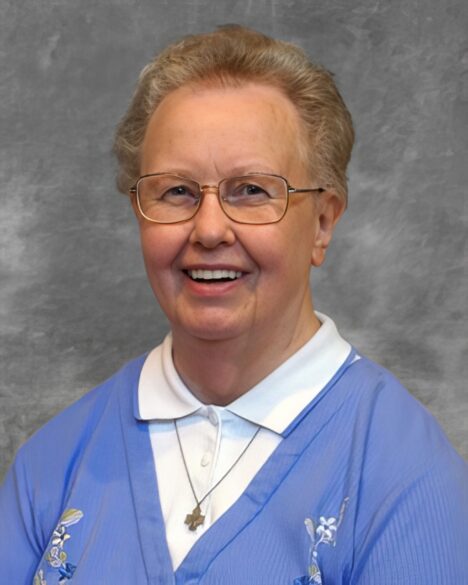
Sister Kathleen Kunze (70 years) was born in Milwaukee. In the Diocese of Jackson, she was a teacher at St. Francis School in Yazoo City (1962-1970), Holy Family School in Jackson (1977-1978), and Christ the King School in Jackson (1970-1973), where she also served as principal (1974-1977). She served as a religious education consultant from 1973-1974 at St. Francis Parish, Yazoo City; Holy Savior Parish, Raymond; and Immaculate Conception Parish, Clinton.

Cards and donations in honor of sister’s years of service may be mailed to her attention, c/o Jubilee Committee, School Sisters of St. Francis, 1545 S. Layton Blvd., Milwaukee, WI 53215.

Briefs

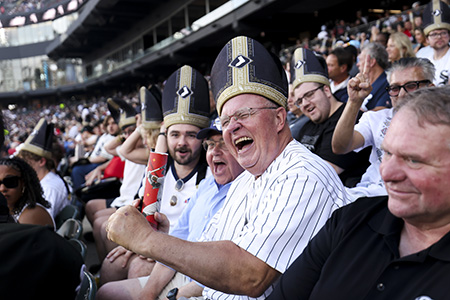
White Sox fans smile while wearing “pope hats” at an Aug. 11, 2026, baseball game at Rate Field in Chicago. The White Sox game paid tribute to Pope Leo XIV, a native of Dolton, Ill., with a first pitch thrown by a nun, a performance by the ChiTown Popes, and a fifth inning “sign of peace” while taking on the Cincinnati Reds. (OSV News photo/courtesy of the Chicago White Sox)

NATION
CHICAGO (OSV News) – White Sox baseball fans sporting custom-designed black and gold mitre-style hats celebrated Pope Leo XIV, a fellow Sox fan, at a pope-themed game in Chicago Aug. 11. Dominican Sister Mary Jo Sobieck of Springfield, Illinois, threw the first pitch, and fans shook hands with the “sign of peace,” led by the Chicago Archdiocese’s Father Tom Hurley, during the fifth inning at Rate Field, home of Pope Leo’s favorite baseball team. White Sox management handed out “pope hats” to over 38,000 fans who showed up at the third game in a series against the Cincinnati Reds. The promo project started out as a fan giveaway for the first 2,500 tickets, which sold quickly and it added another fast-selling 500. Management expanded the promo to the full stadium capacity and the tickets flew. “The place was capacity,” Richard King, a diehard Sox fan and Knight of Columbus who watched the game on TV, told OSV News, adding he thought having Catholicism so openly on display was “great” and would raise more interest in the Catholic faith. The game also featured its own familiar penitential rite for Sox fans, as the Reds rallied in the 10th inning to beat the White Sox 5-4, giving Cincinnati a lead in the three-game series that concludes Aug. 13. Pope Leo, a Chicago native who grew up in Dolton, Illinois, a south suburb, has been pictured sporting a White Sox baseball cap at the Vatican, and has received multiple Sox-themed presents since his election as pontiff in May 2025.

CANTON, Ohio (OSV News) – Rhoda Wise, an Ohio laywoman, wife, adoptive mother, Catholic convert and mystic, has taken a step closer to possible sainthood. The Diocese of Youngstown announced July 7 that the official “positio” on Wise has been submitted to the Vatican’s Dicastery for the Causes of Saints. The comprehensive document examines her life of virtue and alleged miracles. The dicastery’s theological and historical commissions will investigate her heroic virtues and could recommend that the pope declare her venerable. Wise was born into a Protestant family in 1888 and endured significant hardships, including infertility, the death of one of her adopted daughters and a husband struggling with alcoholism and unemployment. She later experienced visions of Jesus and St. Thérèse of Lisieux, known as the “Little Flower,” and was associated with the stigmata and hundreds of reported healings. Among those who attributed a healing to Wise was Mother Angelica, founder of EWTN. She said Wise prayed with her during a novena to St. Thérèse, after which a painful stomach condition was healed. As Wise’s reputation for holiness spread, many visitors came to speak with her and pray outside of her house. She died in 1948, and her former home in Canton continues to be a place of pilgrimage.

VATICAN
VATICAN CITY (CNS) – Pope Leo XIV urged Catholics to gather in person for Sunday Mass and called for working conditions that allow people to attend, saying Sunday is “the foundation and kernel of the whole liturgical year.” “To sanctify Sunday, it is essential to celebrate the Eucharist,” the pope said at his Aug. 12 general audience in St. Peter’s Basilica. “In this regard, I urge everyone to seek the best possible conditions so that even those who are unable to take time off work on Sundays may take part in Holy Mass.” Continuing his series on the documents of the Second Vatican Council, Pope Leo reflected on ‘Sacrosanctum Concilium,’ the Constitution on the Sacred Liturgy. The liturgical year is not a static representation of past events, but an ongoing encounter with Christ, he said. At its core is Easter, when Christ rose from the dead, and for that reason, the pope said, it is “essential for the faithful to sanctify the Lord’s Day by gathering to celebrate the Eucharist.”

VATICAN CITY (OSV News) – The Vatican announced Aug. 11 that Pope Leo XIV’s message for the 2027 World Day of Peace will focus on “disarming technology” and the moral responsibility of political leaders. The theme will be “Disarming Technology, Serving Peace. Politics as Preventive Responsibility,” according to the Vatican Dicastery for Promoting Integral Human Development. “His Holiness wishes to draw attention to the moral responsibility of those called to serve in the public sphere, and he urges all people to uphold the dignity of the human person and to contribute to the building of peace, beginning by ‘disarming technology,’” the dicastery said. The message will draw on Pope Leo’s encyclical “Magnifica Humanitas” and warn about risks of entrusting military decisions to artificial intelligence. The announcement comes after Nobel laureates, inspired by the pope’s encyclical, gathered in Rome July 16 to sign a declaration urging a global treaty banning artificial intelligence from nuclear launch systems. The Jan. 1 observance, which is the solemnity of Mary, Mother of God, will be the 60th World Day of Peace, a tradition begun by Pope Paul VI.

WORLD
AMMAN, Jordan (OSV News) – Jordan is officially preparing for a major milestone in Christian history: the 2,000th anniversary of the Baptism of Jesus Christ at Bethany Beyond the Jordan, also known as Al-Maghtas. A $120 million development project is underway adjacent to the UNESCO World Heritage site along the Jordan River. The initiative features a new Baptism museum, a dedicated pilgrim and visitor village, and ecological walking trails designed to support environmental conservation. The sacred site marks the beginning of Christ’s public ministry and holds a unique place in modern Church history as the only location visited by four popes: St. Paul VI, St. John Paul II, Pope Benedict XVI, and Pope Francis. Millions of Christian pilgrims are expected to journey to Jordan by 2030 for this historic commemoration of faith, unity, and Christian heritage.

PELPLIN, Poland (OSV News) – Two previously unknown sermons by St. Augustine have been identified in a 12th-century manuscript preserved at the diocesan library in Pelplin, Poland, after nearly two years of research by scholars from Germany and Austria. The sermons, which address Saul’s encounter with the Medium of Endor in the Book of Samuel, will be published in a critical edition by the end of 2026. Researchers authenticated the texts through extensive philological, linguistic, liturgical and theological analysis. The manuscript, copied at the Cistercian abbey of Bad Doberan, reached Pelplin in the Middle Ages through monastic connections. Scholars say the sermons provide fresh insight into St. Augustine’s preaching and his willingness to consider multiple faithful interpretations of difficult biblical passages rather than insisting on a single explanation. “He presents several possible interpretations, refrains from making a final judgment, and allows his listeners to draw their own conclusions,” said Paul Nebauer, a member of the Bad Doberan Monastery Association, who has spent years tracing medieval manuscripts from the former Cistercian abbey. The sermons also highlight Augustine’s emphasis on God’s mercy, suggesting Saul may have repented after hearing Samuel’s prophecy. The discovery underscores the importance of preserving historic Church libraries and manuscript collections.