
By Joanna Puddister King
JACKSON – A comprehensive assessment of Catholic education in the Jackson metropolitan area recommends bringing four Catholic schools under a unified governance and administrative structure designed to strengthen their shared mission and ensure their long-term sustainability.
The assessment encompasses St. Joseph Catholic School in Madison, serving grades seven through 12, along with St. Anthony Catholic School in Madison, St. Richard Catholic School in Jackson and Sister Thea Bowman Catholic School in Jackson, each serving prekindergarten through sixth grade.
The proposed system would provide students with a more seamless path from early childhood through high school while allowing the schools to coordinate resources, leadership, enrollment, advancement, communications and academic planning. The area’s three early learning centers are expected to join the organization after the new structure is fully operational.
Bishop Joseph R. Kopacz authorized the assessment in April 2025 with the unanimous approval of the 10 pastors serving on the Canonical Board of Pastors. A 23-member committee of clergy, educators, school leaders and lay representatives from Metro Jackson parishes guided the process.
In his letter authorizing the study, Bishop Kopacz described Catholic education as a responsibility shared by the entire Catholic community.
“While each parish has traditionally supported its own school, it is worth noting that Catholic education is a significant ministry of the entire Church,” he wrote. “It is the responsibility of every Catholic parish in the metro area to ensure the vitality of our Catholic schools.”
The committee selected Partners in Mission to conduct the assessment. Its work included 395 surveys completed by Catholic school and non-Catholic school families, 50 confidential narratives, interviews with stakeholders, meetings with school principals and on-site visits conducted in October and November 2025.
The assessment identified Catholic identity, dedicated and caring faculty and staff, academic quality and strong school communities among the schools’ greatest strengths. It also examined enrollment, finances, governance, facilities, demographic changes and competition within the Jackson-area education market.
The report’s central recommendation is the creation of a unified Catholic school system governed by a board of directors composed of clergy and lay members. The board would provide strategic direction, oversee governance and fundraising, and ensure the schools’ financial sustainability and fidelity to their Catholic mission.
A founding president would lead the system and oversee a central administrative office. The schools would also work toward greater alignment in areas including admissions, curriculum, staffing, marketing, communications, advancement and alumni engagement.
In a June 23 letter included with the full assessment, Bishop Kopacz accepted the committee’s recommendations and authorized the formation of the new entity. Legal and canonical work has begun, while the committee continues its work on the organization’s structure, formation of its board and the search for a president.
“We will move forward thoughtfully and faithfully, with both urgency and prudence, trusting always in the Lord’s guidance,” Bishop Kopacz wrote.
The assessment does not call for the four schools to surrender their individual histories or communities. Rather, it presents a structure through which the schools can build upon their existing strengths while working together more effectively.
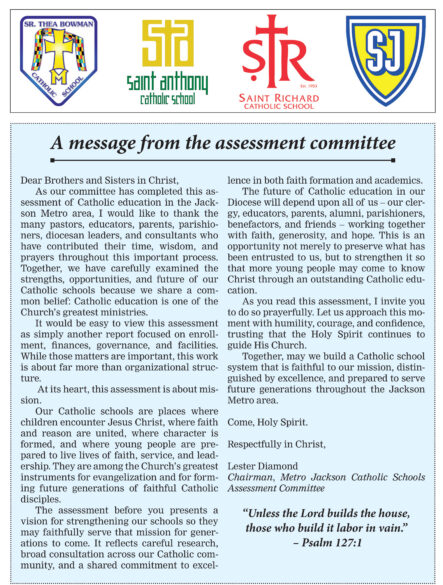
Lester Diamond, chairman of the Metro Jackson Catholic Schools Assessment Committee, said the work should not be understood solely as an examination of organizational and financial matters.
“It would be easy to view this assessment as simply another report focused on enrollment, finances, governance and facilities,” Diamond wrote in a message to the Catholic community. “While those matters are important, this work is about far more than organizational structure.
“At its heart, this assessment is about mission.”
Diamond described Catholic schools as places where children encounter Jesus Christ, faith and reason are united, character is formed and young people are prepared for lives of faith, service and leadership.
“The assessment before you presents a vision for strengthening our schools so they may faithfully serve that mission for generations to come,” he wrote. “It reflects careful research, broad consultation across our Catholic community, and a shared commitment to excellence in both faith formation and academics.”
The report outlines five strategic priorities for the proposed system: Catholic identity, price transparency, diverse excellence, career exposure and facility modernization. It also identifies opportunities to reach families seeking a smaller, faith-based alternative to large public schools and a more affordable option than other private schools in the area.
The transition will include the establishment of the board of directors and selection of a founding president, followed by a three- to five-year strategic planning process involving additional community participation and professional guidance.
Bishop Kopacz said the work remains rooted in the Church’s mission of forming young people in the light of Jesus Christ and nurturing the whole person.
“I am confident that these efforts will strengthen our schools and serve our families well for many years to come,” he wrote. “Above all, it is my hope that our students will come to know, love and follow Jesus Christ, living lives of faithful intentional discipleship.”