CSA feature: Catholic Charities – Diocese of Jackson

Catholic Charities continues its mission to serve the poor and vulnerable across all 65 counties. Interim executive director Christina Bach said the agency remains grounded in the national theme: “Love Your Neighbor.”

“Our work is rooted in this call,” Bach said. “We live it out through programs such as adoption and maternity services, counseling and wraparound support, substance-abuse treatment for pregnant and parenting women, foster care for unaccompanied refugee minors, domestic violence and rape crisis services, immigration legal assistance, disaster response and parish-based ministry.”
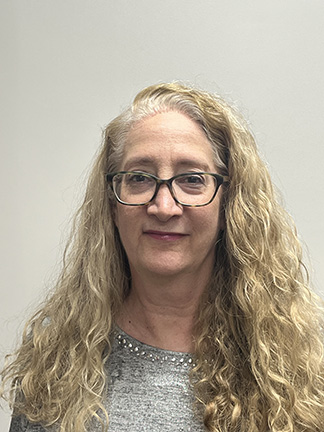
Christina Bach, interim executive director of Catholic Charities, Inc. of the Diocese of Jackson.

Bach shared a recent example from the Kinship Navigator program, which helps relatives caring for children when parents cannot. The program supported a caregiver who had taken in her sister’s two children while the family was facing homelessness. “When we first met them, they needed housing, move-in assistance, birth certificates, clothing and other essentials,” Bach said. “Kinship was able to pay the deposit and rent so they could secure a place to live.”

The caregiver later told staff, “I appreciate y’all going to bat for me and the kids. I’ve been getting the runaround from others. This is a huge help.” Bach said responses like this show how vital the program is in keeping children connected with relatives instead of entering foster care.

Bach said that poverty and unaddressed trauma continue to be the biggest challenges for many families. “Trauma also has a high cost to individuals and to the community. We work to break those cycles by giving a hand-up, building family capacity, and teaching people to advocate for themselves.”

She emphasized that Catholic Charities aims not only to meet immediate needs but also to help families move toward long-term stability. “We want everyone we meet to be in a better situation than when we met them,” she said.

Bach believes the organization’s long history of responding to underserved needs distinguishes it from others. “We’ve often been approached by community leaders to provide programs no one else is offering,” she said. “We take seriously the call to assist the ‘least of these,’ and we believe all of God’s children deserve love and care.”

Looking ahead, Bach said she finds hope in the new strategic direction emerging nationally. “The message for 2026–2030 is simple: ‘Love Your Neighbor,’” she said. “It is timeless, and I have hope because our community is choosing to move forward with this as our guide.”

She said the Catholic Service Appeal is essential. “The CSA allows us to put funds where they’re most needed,” Bach said. “It helps us sustain the programs doing the most good.”

Bach added one final message: “Catholic Charities is a way for the local community to have a statewide impact.”

Click here to DONATE to the CSA in support of Catholic Charities of Jackson
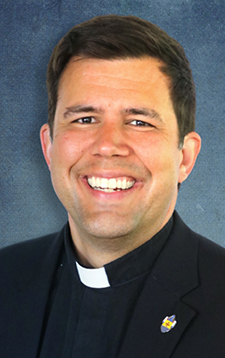
Homegrown seminarian, Foggo ordained transitional deacon for the diocese

By Joanna Puddister King
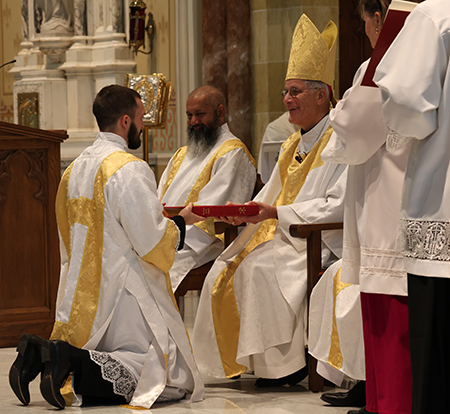
JACKSON – Surrounded by family, friends, priests, deacons, and fellow seminarians, Will Foggo was ordained to the transitional diaconate on Saturday, Nov. 29, at the Cathedral of St. Peter the Apostle. Bishop Joseph R. Kopacz ordained Foggo, marking the final stage of formation before his anticipated priestly ordination on May 16, 2026.

Foggo, a lifelong member of the Diocese of Jackson, grew up at St. Paul Catholic Church in Flowood and attended St. Richard School in Jackson and St. Joseph School in Madison. He later became deeply involved in Catholic Campus Ministry during his years at Mississippi State University, where he first began to sense a persistent call to priesthood.

JACKSON – Bishop Joseph R. Kopacz hands the Book of the Gospels to newly ordained Deacon Will Foggo during his Nov. 29 diaconate ordination at the Cathedral of St. Peter the Apostle, entrusting him with the ministry of preaching and service. (Photos by Joanna Puddister King)

“I never had one specific moment,” Foggo said. “It was a series of events and the work of prayer and reflection over the course of a few years that led me to enter seminary.”

During the Rite of Ordination, Father Nick Adam, Director of Vocations, presented Foggo to Bishop Kopacz and testified that he had been found worthy after inquiry among the faithful and those overseeing his formation. The bishop then formally chose Foggo for the Order of the Diaconate.

In his homily, Bishop Kopacz reflected on the foundations of faith laid by Foggo’s family, parish community, and those who walked with him in discernment. He emphasized the distinct call of the diaconate as a ministry “set apart to serve – not above, but at the heart of the church – in service to God’s Kingdom.” He also highlighted Pope Leo XIV’s teaching that charity is the “burning heart” of the church’s mission, noting that the diaconate embodies this spirit in a particular way.

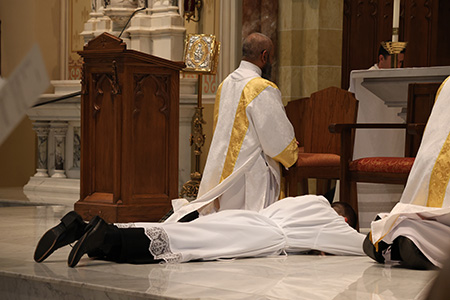
Foggo said the Litany of Saints, during which the ordinand lies prostrate before the altar, was especially profound for him. “The Litany has always been my favorite part of any ordination,” he said. “The entire church is praying for the ordinand that he may fully give of himself to the Lord and the church.”

His devotion to prayer has long been central to his discernment. He often turns to the rosary and Eucharistic adoration, describing them as powerful moments of encountering Christ. He also carries a deep affection for St. Joseph – his confirmation saint – drawn to the saint’s humility and quiet strength. Fittingly, Foggo will now return to St. Joseph parish in Starkville, where he was active during his MSU years, to serve as deacon up until his ordination to the priesthood.

During the Litany of Saints, Will Foggo lies prostrate before the altar at his diaconate ordination on Nov. 29 at the Cathedral of St. Peter the Apostle. Foggo said this moment was especially profound for him, as the whole church prays for the ordinand to give himself fully to the Lord. (Photo by Joanna King) View more photos at jacksondiocese.zenfolio.com.

“It is an honor and an act of divine providence that I am able to serve one of the communities that helped to form me,” Foggo said. “I am excited to begin preaching and the sacraments and to get to better know the people I will be serving.”

At the close of Mass, Father Nick expressed gratitude to all who supported Foggo throughout his formation. He noted the joyful presence of Foggo’s family – including his parents, John and Sheila Foggo – and shared a memory of the day Chris Diaz, who proclaimed the first reading at the ordination, brought Will to his office to receive his seminary application.

As Foggo begins his ministry as a transitional deacon, his prayer is simple: “That the Lord will give me the necessary graces to serve His people the best I can and do His will.”

Foggo will serve at St. Joseph Catholic Church in Starkville until his priestly ordination on May 16, 2026, when he will return to the cathedral to be ordained to the priesthood for the Diocese of Jackson.

Youth

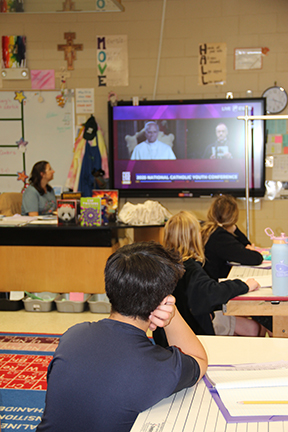
Diocesan Catholic Schools witness historic digital encounter with Pope Leo XIV

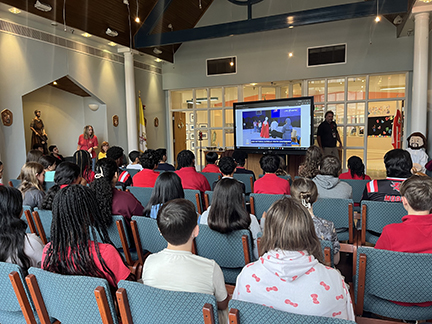
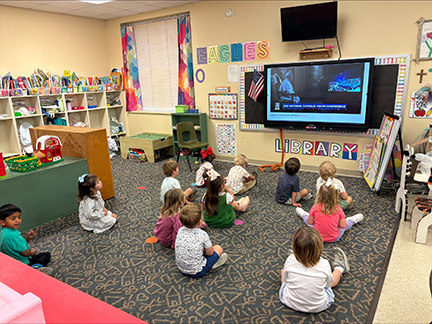
SOUTHAVEN – Students at Sacred Heart School watch a livestream of the National Catholic Youth Conference, using guided questions to follow along and discuss afterward. Younger students enthusiastically called out answers during the presentation. (Photo by Bridget Martin)

MADISON – Sixth graders at St. Anthony School watch as Pope Leo XIV engages with young people during a historic live digital encounter at NCYC. (Photo by Kati Loyacono)

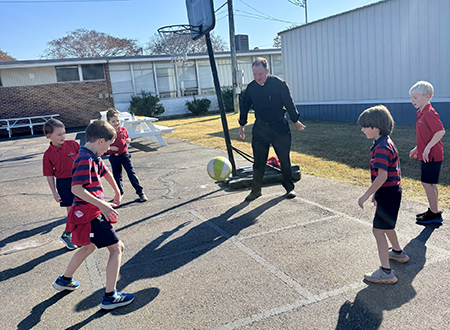
COLUMBUS – After school Mass, Father Jeffrey Waldrep joined first graders Colin Baucom, Jason Hood, Harrison Barranco, Huff Morgan and Luke Thomas for a game of four square at Annunciation Catholic School. (Photo by Jacque Hince)
VICKSBURG – On Nov. 6, 2025, joined by Father PJ Curley, Father Mario Solórzano and Father Rusty Vincent celebrated a Spanish Mass at St. Francis Xavier Chapel for the St. Aloysius Spanish II class. Students read, responded and participated in Spanish, with several Spanish I students also taking part. (Photo by Vivian L. Velazquez)
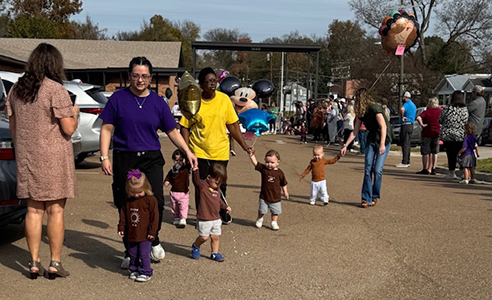
VICKSBURG – At the Sisters of Mercy Early Learning Center’s annual Balloon Parade, teachers Alexa Eb and Marisha Davis walk with one-year-old students Millie Moody, Beau Brock, Anderson Parker and Ryland Miller. James Hyland is pictured at right with his mother, Liz Hyland. (Photo by Shannon Bell)
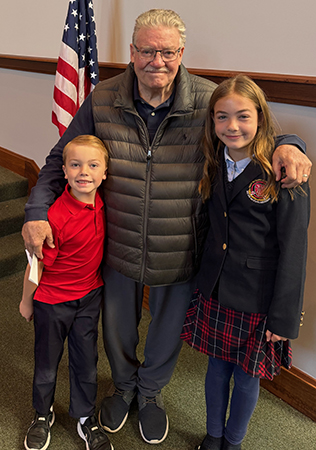
JACKSON – During the St. Richard School Veterans Day program, veteran Bob Metzger is pictured with his grandchildren, Oliver and Hadley Metzger, who attend the school. (Photo by Gina Metzger)

The Lord is near: Advent’s call to hope and conversion

By Bishop Joseph R. Kopacz, D.D.
“Deliver us, Lord, from every evil, grant us peace in our days that with the help of your mercy we may be free from sin and safe from all distress as we await the blessed hope and the coming of our Savior, Jesus Christ.”

This is the magnificent intercessory prayer that the priest pronounces during the Communion Rite of each Mass throughout the year after the Lord’s Prayer and prior to the sign of peace on behalf of all the faithful, a proclamation of the fullness of faith and hope in the Lord’s promises. This is the spirituality of Advent that looks to the second coming of our Lord Jesus Christ, all the while knowing in our hearts that he is Emmanuel, God with us already. This is the mystery of our faith that celebrates his first coming in the Incarnation, the majestic Christmas story, and looks beyond – awake and alert – to the end of time for his second coming. This is also our hope for all who have died in the Lord and gone before us. “Arise, O sleeper, rise from the dead, and Christ will give you light.” (Eph. 5:14)

Meanwhile, we rejoice with Christians knowing that he is always near in the fullness of Jubilee faith “through the Holy Spirit who has been poured into our hearts,” celebrated sacramentally and recognized wherever two or three are gathered in his name in prayer and loving service.

An Advent wreath is depicted in a stained-glass window at Christ the King Church in Commack, N.Y. (CNS photo/Gregory A. Shemitz)

Although Advent has a different aura than Lent, the call to conversion is just as real. The voice of John the Baptist crying out in the wilderness to prepare the way of the Lord is not merely a suggestion among different options. This is our faith that is proclaimed above, “that with the help of your mercy we may be free from sin.” The Sacrament of Reconciliation is always the gold standard to know the Lord’s mercy and peace, and during the culmination of the Jubilee Year of Hope in the heart of Advent it really shines.

We also pray “to be free of all distress” because anxiety over many of life’s uncertainties casts a long shadow over the love of God and the light of the Gospel, eclipsing the virtues of faith, hope and love. Persistent distress and anxiety are in opposition to the hope that does not disappoint. We do believe, and we ask the Lord to increase our faith to know the fullness of God’s peace during this season of joyful expectation as we await the “blessed hope and the coming of our Lord, Jesus Christ.”

The Blessed Mother as the Immaculate Conception and Nuestra Señora de Guadalupe is the paradigm presence during our Advent longing. God prepared her from the first moment of her conception to be the mother of the Savior, and with a pure heart and a willing spirit open to divine providence, she fulfills the yearning of her people for the Messiah. “The dawn from on high broke upon the world to shine on those who dwelled in darkness and the shadow of death and to guide our feet on the way to peace.” (Luke 1:77-79)

Her apparitions to Juan Diego nearly 500 years ago brought a people back from the brink of annihilation to the light of a new day. Yes, she is the great mother who reveals the tender compassion of our God. With the Blessed Mother and all the saints, the church in every age fulfills the Lord’s commission to work for the salvation of all as a beacon of hope.

Let us rejoice because the Gospel is preached, the sacraments are celebrated, and works of charity, justice and peace abound. May we inspire one another as Advent advances to believe, hope and love. Indeed, the Lord is near! Come, Lord Jesus!

How do we know God exists?

IN EXILE
By Father Ron Rolheiser, OMI
Recently I was listening to a religious talk show on the radio when a caller asked: How do we know that God exists? A good question.

The radio host answered by saying that we know it through faith. That’s not a bad answer, except what needs to be teased out is how we know this through faith.

First, what does it mean to know something? If we believe that to know something means to be able to somehow picture it, understand it, and imagine its existence, then this side of eternity, we can never know God. Why?

Because God is ineffable. That’s the first and non-negotiable truth we need to accept about God and it means that God, by definition, is beyond our imagination. God is infinite and the infinite can never be circumscribed or captured in a concept. Try imagining the highest number to which it is possible to count. God’s nature and existence can never be conceptualized or imagined. But it can be known.

Knowing isn’t always in the head, something we can explicate, own in a picture, and give words to. Sometimes, particularly with things touching the deepest mysteries in life, we know beyond our head and our heart. This knowing is in our gut, something felt as a moral imperative, a nudge, a call, an obligation, a voice which tells us what we must do to stay true. It’s there we know God, beyond any imaginative, intellectual, or even affective grasp.
The revealed truths about God in scripture, in Christian tradition, and in the witness of the lives of martyrs and saints, simply give expression to something we already know, as the mystics put it, in a dark way.
So, how might we prove the existence of God?

I wrote my doctoral thesis on exactly that question. In that thesis, I take up the classical proofs for the existence of God as we see these articulated in Western philosophy. For example, Thomas Aquinas tried to prove God’s existence in five separate arguments.

Here’s one of those arguments: Imagine walking down a road and seeing a stone and asking yourself, how did it get there? Given the brute reality of a stone, you can simply answer, it’s always been there. However, imagine walking down a road and seeing a clock still keeping time. Can you still say, it’s always been there? No, it can’t always have been there because it has an intelligent design that someone must have built into it and it is ticking away the hours, which means it cannot have been there forever.
Aquinas then asks us to apply this to our own existence and to the universe. Creation has an incredibly intelligent design and, as we know from contemporary physics, has not always existed. Something or someone with intelligence has given us and the universe a historical beginning and an intelligent design. Who?

How much weight does an argument like this carry? There was once a famous debate on BBC radio in England between Frederick Copleston, a renowned Christian philosopher, and Bertrand Russell, a brilliant agnostic thinker. After all the give and take in their debate, they agreed, as atheist and believer, on this one thing: If the world makes sense then God exists. As an atheist, Russell agreed to that, but then went on to say that ultimately the world doesn’t make sense.

Most thinking atheists accept that the world doesn’t’ make sense; but then, like Albert Camus, struggle with the question, how can it not make sense? If there isn’t a God then how can we say that is better to help a child than to abuse a child? If there isn’t a God, how can we ground rationality and morality?

At the end of my thesis, I concluded that existence of God cannot be proven through a rational argument, a logical syllogism, or a mathematical equation, albeit all of those can give some compelling hints regarding God’s existence.

However, God is not found at the end of an argument, a syllogism, or an equation. God’s existence, life, and love are known (they are experienced) inside a certain way of living.

Simply put, if we live in a certain way, in the way all religions worthy of the name (not least Christianity) invite us to live, namely, with compassion, selflessness, forgiveness, generosity, patience, long-suffering, fidelity, and gratitude, then we will know God’s existence by participation in God’s very life – and whether or not we have an imaginative sense of God’s existence is of no importance.

Why do I believe in God? Not because I’m particularly persuaded by proofs from great philosophical minds like Aquinas, Anselm, Descartes, Leibnitz or Hartshorne. I find their proofs intellectually intriguing but existentially less persuasive.

I believe in God because I sense God’s presence at a gut level, as a silent voice, as a call, an invitation, a moral imperative which, whenever listened to and obeyed, brings community, love, peace and purpose.

That’s the real proof for the existence of God.

(Oblate Father Ron Rolheiser is a professor of spirituality at Oblate School of Theology and award-winning author.)

Lebanese have what is needed to build a future of peace, pope says

By Cindy Wooden
BEIRUT (CNS) – Even in the face of difficulties and the constant threat of war, the young people of Lebanon and the country’s religious leaders have enormous resources that can build a better future for all people, Pope Leo XIV said.

“The true opposition to evil is not evil, but love, a love capable of healing one’s own wounds while also caring for the wounds of others,” he said Dec. 1 as he met thousands of young people outside the headquarters of the Maronite Patriarchate of Antioch in Bkerké, overlooking Beirut.

Pope Leo met the 15,000 young people after meeting their elders – representatives of the country’s Christian, Muslim, Druze and Alawite communities – in Beirut’s Martyrs’ Square, which honors those who fought for Lebanon’s independence and were executed there in 1916. The martyrs came from every religious community.

At their meeting, the young people posed two questions to the pope: How to preserve one’s inner peace and hope “in a country deprived of stability, whether in terms of security or economy”; and how can people keep their families, marriages and friendships solid in a world dominated by the digital and ephemeral.

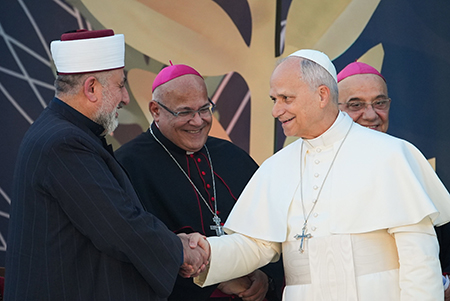
Pope Leo XIV shakes hands with Sheikh Ali Kaddour, head of the Alawi Islamic Council in Lebanon during an ecumenical and interreligious meeting in Martyrs’ Square in Beirut, Lebanon, Dec. 1, 2025. (CNS photo/Lola Gomez)

Pope Leo told them to look for good examples around them.

“Draw from the good roots of those dedicated to serving society without using it for their own interests,” he said. “Be the source of hope that the country is waiting for!”

For Christians, the pope said, Jesus is the first person to look to for help both with peace and with relationships because both require love.

“If our ego is at the center of a friendship or loving relationship, it cannot bear fruit,” he said. “Similarly, it is not true love if we only love temporarily, as long as the feeling lasts: if love has a time limit, it is not truly love.”

Love and charity express God’s presence in the world “more than anything else,” the pope told them. “Charity speaks a universal language, because it speaks to every heart.”

Pope Leo encouraged them to look at the example of their peers who have not been discouraged “by injustices and negative examples, even those found within the church. Instead, they have tried to forge new paths in search of the kingdom of God and its justice.”

“Drawing on the strength you receive from Christ, build a better world than the one you inherited,” he told them, and make friends with people from different cultures and religions.

In a tent in the shadow of the Mohammad Al Amin Mosque in Beirut, Pope Leo told the leaders that the central role of faith in the life of Lebanon is obvious.

The pope prayed that every toll of the bell and every call to prayer would “blend into a single, soaring hymn … to lift a heartfelt prayer for the divine gift of peace.”

Too often, he said, when people think of the Middle East, they think of ongoing conflict.

“Yet,” Pope Leo said, “in the midst of these struggles, a sense of hopefulness and encouragement can be found when we focus on what unites us: our common humanity, and our belief in a God of love and mercy.”

“In an age when coexistence can seem like a distant dream,” he said, “the people of Lebanon, while embracing different religions, stand as a powerful reminder that fear, distrust and prejudice do not have the final word, and that unity, reconciliation, and peace are possible.”

Fruitful rest

FROM THE HERMITAGE
By sister alies therese

“When the soul is willingly emptied for love in order to have Him who is all. Then it is able to receive spiritual rest.” –Julian of Norwich, d. 1416

I had finished my prayer time … in silence, surrounded by my icons … and I gazed out the window to an overcast and cold morning … trying to allow Jesus to give me rest amidst recent anxiety and concern. It was not going to happen, and I was sure of that. I could not make it happen myself, and Jesus seemed far, far away. The middle of Advent and on into the “Os” is a fragile time. The fullness of Christmas had filled everyone else, and many had a lack of peaceful rest.

A few days later, I ran into Cardinal Zen’s “Advent Reflections” while tidying up a bookshelf. Perhaps you have read it or used it for your own reflection?

First, “Who likes darkness? Isn’t the light sure to prevail? Unfortunately, it is not necessarily so. Darkness often tempts us. In the dark, we can do shoddy things.” (p. 23) In so many of our places, the sun sets early. Darkness might be experienced, as Cardinal Zen says, “For Christians, ‘despairing of hope’ for salvation and thinking that God could not save us is indeed a sin … But what is it exactly that you doubt? … the power of God or His mercy? … He is always with us, so His plan must succeed.” (p. 19)

Another: “Because of His excessive love for us, God sent us His Son in the likeness of our sinful bodies – a fragile infant laid in a manger; only with the help of an angel, He could escape the attempt on His life. He wanted to experience all the hardships of human existence, hoping that we might trust Him and recognize Him as one of us.” (p. 74) This reminded me of my favorite saint, Julian of Norwich … who reminds us of the extraordinary love God has for us.

Off I went exploring the nearly end of her “Revelations of Divine Love” … and I read some paragraphs as if I’d never seen them before. I lived for 20 years not some 26 miles from her cell in Norwich (England) and frequently went there to pray.

How could she experience this silence and rest when “surrounded by the Black Death, parts of the Hundred Years War, the peasants’ revolt, Edward III and Richard II, and Henry IV taking the throne”? Does any of that sound in the least like what surrounds you? Pandemics, natural disasters, crime, political intrigue, extreme consumerism … ? How could one be expected to pray in that environment? How can there be spiritual rest?

Today we expect everyone to comment on most things – politics, family, religion. What is our business? What is none of our business? In the day, Julian commented on none of it. “Instead of pointing to men’s failures to be human and Christian, Juliana focuses on the love of a living, loving, personal God, His sufferings, and her response to them. The anchorhold at Norwich might as well have been in China for all the notice she takes of current sins and scandals, local persons and events, or the … immoralities of the failed shepherds of a spiritually starving, helpless flock … she is to observe God alone, to listen to Him and to make her response, and to transmit the experience to her fellow Christians.” (Introduction)

Cardinal Zen’s reflections kept me considering this notion of “excessive love.” Fit right in with Julian. He points to the reality that God wanted from all eternity to be our God, and that we become His people. How do we come to understand this? How do we know we are loved by God?

Julian explained that dread is caused by fright, pain, doubt and reverent dread. Curiously, she says, “Love and dread are brothers. They are rooted in us by the goodness of our Maker and can never be taken from us. We have the power to love from nature and from grace. We have the power to dread from nature and from grace … it is proper for us to love Him for His goodness.” (p. 217)

In considering how we learn to trust, she reminds us that love and dread take on different aspects: “In love we shall be friendly and near to God, and in dread we shall be gentle and courteous.” Advent brings us near to God either through love or dread.

Advent can be a time of renewal or discovery. Cardinal Zen poses this: “How many still do not know Jesus Christ? … How many who know Him are yet unwilling to obey? … But it is undeniable that ‘the light shines in the darkness, and the darkness has not overcome it.’” (p. 144)

The darkness will not prevail. Julian tells us: “All shall be well … not only the noble and great things but also the little and small, lowly and simple things … not one of the smallest things will be forgotten … He wants us to be more at ease in soul and more peaceful in love and to stop looking at all the tempests that could keep us from rejoicing in Him!” (p. 132) That is fruitful spiritual rest.

Blessings.

(sister alies therese is a canonical hermit who prays and writes.)

Anticipation in extra-ordinary time

ORDINARY TIMES
By Lucia A. Silecchia
If there is ever a time when the difference in perspective between children and adults is stunningly clear, it is during the four weeks of Advent.

As Advent begins, children will say, with a sigh of impatience, “Four whole weeks to Christmas.” My younger self did too.

Adults, looking at the exact same calendar, are more likely to say, with a much deeper sigh, “Only four weeks to Christmas.” My older self does too.

Through the eyes of a child, the days of December drag on, with a slow march toward the glory of Christmas – a march filled with excitement and joyful expectation. Through the eyes of adults, however, Christmas arrives in a flash and flurry of activity, and the fleeting days of Advent can go unnoticed because they pass so quickly.

Cynics will say that the excited joy of children comes more from the coming of Santa than of Savior. Maybe that is true. Indeed, my younger self would acknowledge mixed motives.

Yet, there is more. There is something to be learned from the joyful, unencumbered anticipation that children have as they wait, wonder and hope.

They seem, simply, to be more ready than adults. Certainly, some of that is because life’s responsibilities have not yet taken a toll. They have less to do to prepare for Christmas in a season when much adult labor is spent preparing Christmas celebrations for them. They seem less distracted and freer to anticipate all that is to come.

A child counts the days. A child notices when decorations first come out. A child notices when a crèche goes up and rejoices when the figures in the nativity scene move closer to the manger. A child notices when the Jesse trees in their churches start to fill up. A child counts the number of candles that are lit on the Advent wreath – not with fear that the number of days to Christmas is dwindling but with anticipation that what is to come is closer. With special joy, a child notices that on Gaudete Sunday the rose candles offer hope that the wait is almost over.

A child anticipating Christmas seems to understand, more than I do, what it means to wait. Yes, they enjoy the festivities leading up to Christmas. But they also have a single-minded focus on Christmas itself. To adults, so often, it can seem as though Advent is a season of events that can exhaust us before Christmas arrives, leaving us with the feeling that Christmas is over before the Christmas season has even begun.

A child longing for Christmas will never say, as I do, that last Christmas seems like it was yesterday. A child is unlikely to wonder how the year went by so fast because, in the temporal economy of childhood, time moves more slowly, and last Christmas seems like an eternity ago. Perhaps that is why each Christmas seems so special.

The children in my life teach me much about what it means to wait with joy and wait with readiness. They are not distracted by all that they think needs to be done before Christmas. Instead, they are ready to welcome the birthday of Christ with simple joy, uncomplicated excitement and the knowledge that something special and awesome – in all senses of that word – is about to happen.

I cherish the events leading up to Christmas. The traditions, celebrations, time with loved ones and special occasions fill my calendar and my heart. Yes, they also keep me busy.

But this season, I hope to wait for Christmas a little bit more like my younger sisters and brothers in faith. I hope that the distractions and busyness of December do not make my heart hope that Christmas can wait until I am ready for it.

My ancestors in faith spent millennia eagerly awaiting the birth of Christ. The ancients who came before me, and the young who come after me, did not and do not spend their days hoping for delay and more time until that silent, holy night. They want no unnecessary distance between themselves and the night that brings the “thrill of hope” when “a weary world rejoices.” They know how to anticipate that extraordinary time.

(Lucia A. Silecchia is Professor of Law at the Catholic University of America’s Columbus School of Law. Email her at silecchia@cua.edu.)

Called by Name

By Father Nick Adam
I’m still reflecting with joy on the ordination of Deacon Will Foggo, and I await with great hope his priestly ordination on May 16. This ordination was especially meaningful to me as vocation director because Will is the first seminarian I’ve had the privilege to see all the way through. Reaching this moment with him has prompted me to consider what has changed – and what has remained steady – since he began seminary in August 2020 and I began my role the month before.

One major difference, of course, is that we are no longer in the midst of a global pandemic. I called Will and Grayson Foley the “Bubble Boys” because they arrived at St. Joseph Seminary College at the height of COVID, when campus was closed to all nonessential personnel. The seminary was able to operate fairly normally, and infections stayed low, but the isolation and uncertainty of that “bubble” created real challenges. I remain proud of how they both handled those early years with faith and resilience.

Beyond that, the biggest shift in our vocation program has been the intentional expansion of ways we accompany young men discerning God’s call. We’ve strengthened our diocesan discernment groups, increased the number of seminary visits we offer each year, and become more present in schools and parishes. The addition of Father Tristan Stovall as assistant vocation director has been a tremendous blessing, and Bishop Kopacz’s steady support has helped build a culture where vocations are encouraged and nurtured throughout the diocese.

When men have a place to talk openly about their experiences of God’s call, they are far more likely to reach the point of “taking the leap” and applying to seminary. Will experienced that kind of accompaniment through Father Jason Johnston, who served as his chaplain at St. Joseph Catholic School in Madison and later as his campus minister at Mississippi State. That steady, personal support helped him discern with confidence. Over the past six years, more of our priests have embraced that same approach – walking with young men in their parishes, campuses and schools so they can explore God’s call in a healthy way.

I’m excited to have Will serving in Starkville as a deacon. He relates naturally to young people, and I know he will accompany anyone who approaches him with interest in the priesthood. I’m grateful for all those who walked with him to bring him to this moment, and I look forward with hope to the day he is ordained a priest for our diocese.

(For more information on vocations, visit jacksonvocations.com or contact Father Nick at nick.adam@jacksondiocese.org.)

Oxford Knights of Columbus support life through ultrasound program

By Jacob Eftink
OXFORD – For many years, Knights of Columbus Council 10901 has faithfully supported the Oxford Pregnancy Center, a local resource that offers compassionate, confidential and high-quality care to women and families. The center provides free services, including pregnancy testing, ultrasound imaging and counseling – all made possible through the generosity of community donors.

Located in an area of visible need and serving a major university community, the center reaches many women in vulnerable situations. The nearest abortion facility is more than 75 miles away in Memphis, making the Oxford Pregnancy Center’s presence all the more essential.

Recognizing the importance of life-affirming care, the Oxford council partnered with the Knights of Columbus Supreme Council Ultrasound Program, which helps pregnancy centers obtain state-of-the-art ultrasound equipment. In 2018, after a survey conducted by the Diocese of Jackson, the Oxford Pregnancy Center qualified for the program and dedicated its first ultrasound machine that December.

By 2024, the center’s leadership identified the need for an upgraded machine to continue providing the highest level of care. Once again, Council 10901 stepped forward. Through its major fundraiser – the St. John’s Knights of Columbus Car Parking Event – the council raised about $30,000, covering half the total cost. The Supreme Council’s Ultrasound Program matched the amount, bringing the final purchase price to $59,243.

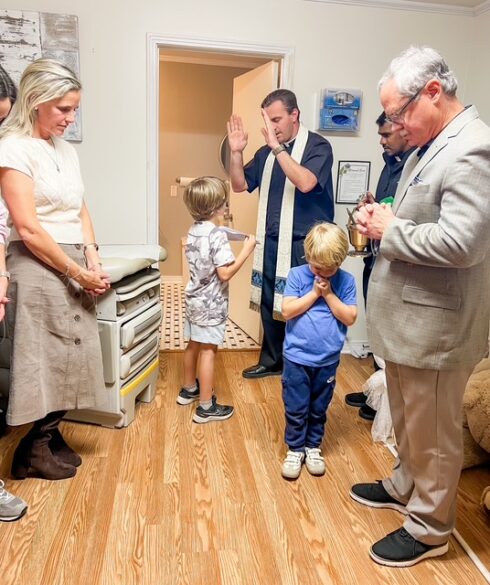
OXFORD – St. John the Evangelist Knights of Columbus Council 10901 recently donated a new ultrasound machine to the Pregnancy Center of Oxford. On Nov. 13, Father Mark Shoffner blessed the machine during a small gathering. Pictured from left are Danielle Lewis, Theodore Cutcliffe, Father Mark Shoffner, Father Robert Antony, Louis Cutcliffe and Grand Knight Jim Herzog. (Photo courtesy of Jennifer Newsom)

The collaboration among the Oxford Pregnancy Center, the Diocese of Jackson, the local council and the Supreme Council was a testament to faith in action and a shared commitment to the sanctity of life.
The new ultrasound machine was dedicated Nov. 13, 2025, at a ceremony held at the Oxford Pregnancy Center. Father Mark Shoffner offered a blessing over the machine, and attendees included staff, board members, parishioners from St. John’s Catholic Church, and members of Council 10901.

A highlight of the celebration came when the center’s sonographer demonstrated the clarity of the new equipment, showing guests the vivid images it produces. She noted that the difference in image quality was dramatic – and potentially life-changing.

As one Knight observed, “The ultrasound room is truly sacred space – where decisions for life are made every day.”

Through their faith, generosity and unity, the Oxford Knights of Columbus and their partners have once again brought hope, compassion and life-affirming care to their community.