By Katarzyna Szalajko OBERNDORF, Austria (OSV News) – As Christmas nears and “Silent Night” echoes through churches worldwide, its origins point to hardship rather than holiday calm.
The world’s most famous Christmas carol – “Stille Nacht” in German – was not born in a peaceful, picture-book setting. There was no postcard village, no soft snowfall, no glowing atmosphere.
The beloved carol was first sung on Christmas Eve 1818 in Oberndorf, Austria – a town battered by war, famine and political upheaval after the Napoleonic Wars and a global climate crisis triggered by a volcanic eruption.
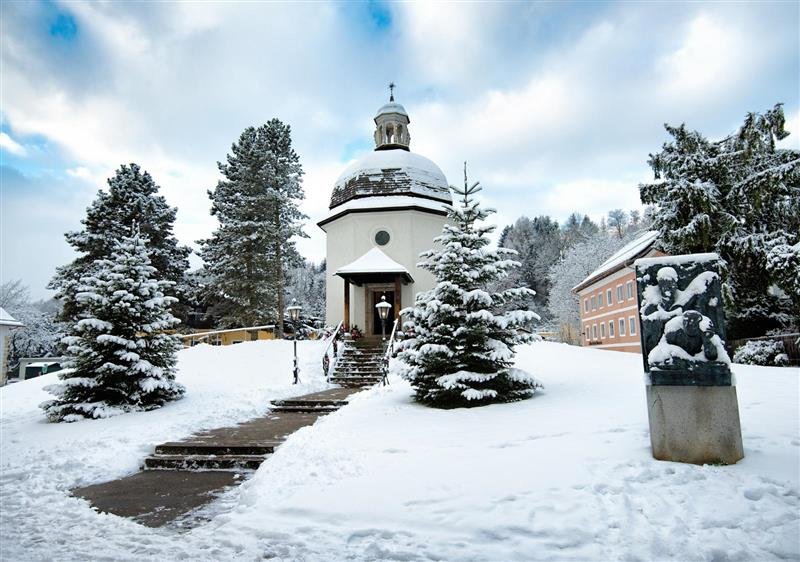
Silent Night Chapel, where the famed “Stille Nacht” Christmas carol was born is seen on an 2024 photograph in Oberndorf, Austria. The beloved carol was first sung there on Christmas Eve 1818. Oberndorf was not a fairy-tale place back then – it was battered by war, famine and political upheaval after the Napoleonic Wars and a global climate crisis triggered by a volcanic eruption. (OSV News photo/courtesy Stille Nacht Museum)
Museum officials say the song emerged from poverty and uncertainty. Its creators, Father Joseph Mohr and schoolteacher Franz Xaver Gruber, both rose from humble beginnings thanks to mentors who recognized their musical gifts.
Mohr’s lyrics speak of God entering a troubled world in quiet humility, while Gruber’s simple melody conveys warmth and hope. “The melody is simple but creates a feeling of warmth and safety,” Martina Knall, a representative of the Stille-Nacht-Museum, said.
“The text speaks of rescue from distress, hope and love – themes that speak to everyone.”
For Father Thomas Kunnappallil, pastor of Oberndorf’s parish since September, said that for him as a priest, “Silent Night” is more than a Christmas song, leading back “to the deep mystery that God does not appear in the splendor and noise of this world, but in the silence of a child who gives peace and hope.”
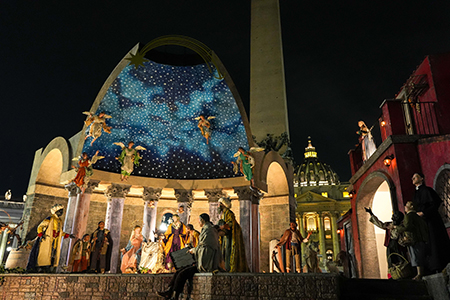
The Nativity scene is unveiled and the Christmas tree is lighted in St. Peter’s Square at the Vatican Dec. 15, 2025. (CNS photo/Lola Gomez)
NATION BURLINGTON, Wash. (OSV News) – Several parishes and schools across Western Washington have shut down operations due to historic flooding in the state. Gov. Bob Ferguson announced Dec. 12 that President Donald Trump signed the state’s request for an emergency declaration, permitting federal funds to be used as aid in 16 counties and several Tribal Nations affected by the floods. The Laudato Si’ Movement-Washington State Chapter released a statement Dec. 11, saying, “We are working together with Archdiocese of Seattle, Catholic Community Services, and additional collaborative agencies to prepare for and provide emergency assistance, as needed.” St. Charles Parish in Burlington, St. Catherine Mission in Concrete, Our Lady of Sorrows Parish in Snoqualmie, St. Joseph School in Issaquah and Immaculate Conception School in Mount Vernon are among the closures. The Tri-Parish Food Bank at St. Charles has also been shut down. In its statement, the Laudato Si’ Movement-Washington State Chapter said it “holds all those affected in prayer” and called the devastation “heartbreaking.” Early on Dec. 15, the National Weather Service said that “a period of very active weather will dominate the week ahead as a series of strong frontal systems produce cascading impacts across Western Washington.”
WASHINGTON (OSV News) – The Washington-based Black and Indian Mission Office is getting a boost from two new half-hour documentaries, “Trailblazers of Faith: The Legacy of African American Catholics” and “Walking the Sacred Path: The Story of the Black and Indian Mission Office.” Father Maurice Henry Sands, a Detroit archdiocesan priest that heads the office, hopes they’ll be an aid with fundraising. Trailers of the films can be viewed on the mission office’s website, https://blackandindianmission.org/films. “Trailblazers of Faith” tells the story of how African Americans have been able to embrace the Catholic faith without abandoning their own culture. A particular focus is on the Baltimore-based Oblate Sisters of Providence, the first Catholic order in the U.S. for Black women, as well as Venerable Mother Henriette Delille of New Orleans, Servant of God Julia Greeley, Venerable Father Augustus Tolton and Servant of God Sister Thea Bowman. They are among seven Black Catholics with active sainthood causes – dubbed the “Saintly Seven.” The Black and Indian Missions Office originated in 1874 as the Bureau of Catholic Missions, with wider goals added in subsequent years. The office is in a brick row house that once belonged to St. Katharine Drexel (1858-1955), the Philadelphia heiress who devoted her life and her wealth to ministering to Native Americans and African Americans.
VATICAN VATICAN CITY (CNS) – The Nativity scene and the Christmas tree are signs of faith and hope, Pope Leo XIV said. “As we contemplate them in our homes, parishes and town squares, let us ask the Lord to renew in us the gift of peace and fraternity,” he said, calling for prayers for all those who suffer because of war and violence. “We must eliminate hatred from our hearts.” The pope was speaking Dec. 15 during a meeting with the government representatives, artisans and donors responsible for providing the Christmas decorations in the Paul VI Audience Hall and in St. Peter’s Square. Pope Leo thanked the Costa Rican artist who created the Nativity scene for the audience hall, titled “Nacimiento Gaudium.” Created by Paula Sáenz Soto, it features a pregnant Virgin Mary and 28,000 colored ribbons, each representing a life saved from abortion thanks to the prayers and support provided to many mothers in difficulty by Catholic organizations, according to a press release by the Vatican City State’s governing office. “I thank the Costa Rican artist who, together with the message of peace at Christmas, also wanted to launch an appeal for the protection of life from the moment of conception,” Pope Leo said. “The Nativity scene and the Christmas tree are signs of faith and hope,” he said to all those present. “Let the tenderness of the child Jesus illuminate our lives. Let God’s love, like the branches of an evergreen tree, remain fervent in us.”
VATICAN CITY (CNS) – Pope Leo XIV has accepted the resignation of Cardinal Timothy Dolan as archbishop of New York and named Archbishop Ronald A. Hicks of Joliet, Illinois, as his successor. The Vatican announced the decision Dec. 18. Cardinal Dolan, who turned 75 in February, submitted his resignation as required by canon law. Appointed archbishop of New York in 2009 by Pope Benedict XVI, he was made a cardinal three years later. Cardinal Dolan previously served as president of the U.S. Conference of Catholic Bishops and held several national leadership roles, including chair of pro-life and religious liberty committees. Archbishop Hicks, 58, has led the Diocese of Joliet since 2020. Born in Chicago and longtime priest of the Archdiocese of Chicago, he has served as vicar general, auxiliary bishop, seminary formator, and regional director of Nuestros Pequeños Hermanos in Central America. He currently serves on several USCCB committees and Catholic boards.
WORLD PARIS (OSV News) – Fifty French Catholics killed under Nazism were beatified Dec. 13, 2025, during a Mass at Notre Dame Cathedral in Paris, recognizing their witness of faith during World War II. Cardinal Jean-Claude Hollerich of Luxembourg presided at the liturgy, as they were declared blessed, with their liturgical memorial on May 5. The martyrs – priests, seminarians and laymen – died in Germany between 1944 and 1945 while serving fellow French workers deported under Nazi forced labor policies. Many belonged to the Young Christian Workers movement, with several also active as Catholic scouts. They volunteered to accompany workers sent to German factories, offering pastoral care through a clandestine mission known as the St. Paul Mission. For French Father Bernard Ardura, former president of the Pontifical Committee for Historical Sciences, and postulator of their causes in Rome since 2018, these men are “martyrs of the apostolate.” “They went to Germany voluntarily, as Christians, and it was as Christians that they were arrested and died,” he told OSV News. They died in concentration camps, death marches or executions, refusing to abandon their faith. In his homily, Cardinal Hollerich praised their courage, calling the witness given by their lives and deaths a faithful following of Christ to the very end.
SYDNEY (OSV News) – After two gunmen targeted Jewish beachgoers at an event celebrating the first day of Hanukkah in terror attack at Sydney’s Bondi Beach, Pope Leo XIV highlighted God’s closeness to humanity and called for prayers for those who suffer on account of war and violence, especially the victims from the Jewish community in Australia. “Enough with these forms of antisemitic violence!” Pope Leo said Dec. 15, speaking with the groups that donated this year’s Vatican Christmas Tree and Nativity Scene. “We must eliminate hatred from our hearts,” he highlighted. In a Dec. 15 statement, Archbishop Anthony Fisher of Sydney called for an end to an “atmosphere of antisemitism” in Australia. He also shared that he personally has Jewish heritage from his great-grandmother, and that as Christians “an attack on the Jews is an attack on all of us.” Just hours after the shooting and an initial report of 12 dead, the death toll rose to 15. The Guardian reported a 10-year-old girl, a rabbi and two Holocaust survivors were among victims. The second gunman, police confirmed, was in custody and in critical condition. According to authorities, over 40 people were wounded and taken to St. Vincent’s Hospital. The attack occurred in the early evening as hundreds were gathered at Archer Park, a grassy area in Bondi Beach.
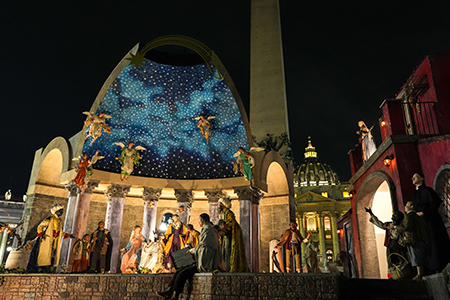
El belén se inaugura y el árbol de Navidad se enciende en la Plaza de San Pedro, en el Vaticano, el 15 de diciembre de 2025. (Foto CNS/Lola Gómez)
NACIÓN BURLINGTON, Washington (OSV News) – Varias parroquias y escuelas del oeste de Washington han cerrado sus puertas debido a las históricas inundaciones que ha sufrido el estado. El gobernador Bob Ferguson anunció el 12 de diciembre que el presidente Donald Trump había firmado la solicitud del estado para declarar el estado de emergencia, lo que permite utilizar fondos federales como ayuda en 16 condados y varias naciones tribales afectadas por las inundaciones. El Movimiento Laudato Si’ del estado de Washington emitió un comunicado el 11 de diciembre en el que decía: “Estamos trabajando junto con la Arquidiócesis de Seattle, los Servicios Comunitarios Católicos y otras agencias colaboradoras para prepararnos y proporcionar ayuda de emergencia, según sea necesario”. Entre los cierres se encuentran la parroquia de San Carlos en Burlington, la misión de Santa Catalina en Concrete, la parroquia de Nuestra Señora de los Dolores en Snoqualmie, la escuela de San José en Issaquah y la escuela de la Inmaculada Concepción en Mount Vernon. También se ha cerrado el banco de alimentos Tri-Parish Food Bank de San Carlos. En su comunicado, el Movimiento Laudato Si’ del estado de Washington afirmó que “mantiene a todos los afectados en sus oraciones” y calificó la devastación de “desgarradora”. A primera hora del 15 de diciembre, el Servicio Meteorológico Nacional afirmó que “un periodo de clima muy activo dominará la semana que viene, ya que una serie de fuertes sistemas frontales producirán impactos en cascada en todo el oeste de Washington”.
WASHINGTON (OSV News) – La Oficina de Misiones Afroamericanas e Indígenas, con sede en Washington, está recibiendo un impulso gracias a dos nuevos documentales de media hora de duración: “Pioneros de la fe: el legado de los católicos afroamericanos” y “Recorriendo el camino sagrado: la historia de la Oficina de Misiones Afroamericanas e Indígenas”. El padre Maurice Henry Sands, sacerdote de la arquidiócesis de Detroit que dirige la oficina, espera que sirvan de ayuda para recaudar fondos. Los tráilers de las películas se pueden ver en el sitio web de la oficina misionera, https://blackandindianmission.org/films. “Pioneros de la fe” cuenta la historia de cómo los afroamericanos han podido abrazar la fe católica sin abandonar su propia cultura. Se presta especial atención a las Hermanas Oblatas de la Providencia, con sede en Baltimore, la primera orden católica de Estados Unidos para mujeres negras, así como a la venerable madre Henriette Delille, de Nueva Orleans, la sierva de Dios Julia Greeley, el venerable padre Augustus Tolton y la sierva de Dios hermana Thea Bowman. Todos ellos forman parte de un grupo de siete católicos negros con causas de canonización en curso, conocidos como los “Siete Santos”. La Oficina de Misiones Negras e Indígenas se creó en 1874 como Oficina de Misiones Católicas, y en los años siguientes se le añadieron objetivos más amplios. La oficina se encuentra en una casa adosada de ladrillo que perteneció a Santa Katharine Drexel (1858-1955), la heredera de Filadelfia que dedicó su vida y su fortuna al servicio de los nativos americanos y los afroamericanos.
VATICANO CIUDAD DEL VATICANO (CNS) – El belén y el árbol de Navidad son signos de fe y esperanza, dijo el papa León XIV. “Mientras los contemplamos en nuestros hogares, parroquias y plazas, pidamos al Señor que renueve en nosotros el don de la paz y la fraternidad”, dijo, pidiendo oraciones por todos aquellos que sufren a causa de la guerra y la violencia. “Debemos eliminar el odio de nuestros corazones”. El Papa habló el 15 de diciembre durante una reunión con los representantes del Gobierno, los artesanos y los donantes responsables de proporcionar los adornos navideños en la Sala de Audiencias Pablo VI y en la Plaza de San Pedro. El Papa León agradeció al artista costarricense que creó el belén para la sala de audiencias, titulado “Nacimiento Gaudium”. Creado por Paula Sáenz Soto, muestra a la Virgen María embarazada y 28 000 cintas de colores, cada una de las cuales representa una vida salvada del aborto gracias a las oraciones y el apoyo prestado a muchas madres en dificultades por organizaciones católicas, según un comunicado de prensa de la oficina de gobierno de la Ciudad del Vaticano. “Agradezco a la artista costarricense que, junto con el mensaje de paz en Navidad, también ha querido lanzar un llamamiento a la protección de la vida desde el momento de la concepción”, dijo el papa León. “El belén y el árbol de Navidad son signos de fe y esperanza”, dijo a todos los presentes. “Que la ternura del niño Jesús ilumine nuestras vidas. Que el amor de Dios, como las ramas de un árbol siempre verde, permanezca ferviente en nosotros”.
CIUDAD DEL VATICANO (CNS) – Incluso en situaciones difíciles y lugares hostiles, como las prisiones, cuando las personas se centran en cuidarse unas a otras, respetarse mutuamente y ofrecer perdón, “florecen hermosas flores del “terreno duro” del pecado y el sufrimiento”, dijo el papa León XIV. Vestido con vestimentas rosas para el Domingo Gaudete, tercer domingo de Adviento, el papa celebró la misa en la basílica de San Pedro el 15 de diciembre con motivo del Jubileo de los Presos. Participaron reclusos y exreclusos, tanto adultos como menores, de Italia, España, Portugal, Malta y Chile, acompañados por guardias y capellanes, así como representantes de otros 85 países. Fue el último de los grandes eventos del Jubileo antes de Navidad y del cierre del Año Santo el 6 de enero. Las hostias consagradas durante la misa fueron elaboradas por reclusos de las prisiones italianas de Opera, San Vittore y Bollate. Forman parte de un proyecto en el que participan más de 300 reclusos de prisiones de toda Italia que elaboran regularmente hostias para 15 000 iglesias y parroquias.
MUNDO SÍDNEY (OSV News) – Después de que dos hombres armados atacaran a bañistas judíos en un evento que celebraba el primer día de Hanukkah en un atentado terrorista en la playa Bondi de Sídney, el papa León XIV destacó la cercanía de Dios a la humanidad y pidió oraciones por aquellos que sufren a causa de la guerra y la violencia, especialmente las víctimas de la comunidad judía en Australia. “¡Basta ya de estas formas de violencia antisemita!”, dijo el papa León el 15 de diciembre, dirigiéndose a los grupos que donaron el árbol de Navidad y el belén del Vaticano de este año. “Debemos eliminar el odio de nuestros corazones”, destacó. En una declaración del 15 de diciembre, el arzobispo Anthony Fisher de Sídney pidió el fin de la “atmósfera de antisemitismo” en Australia. También compartió que él personalmente tiene ascendencia judía por parte de su bisabuela y que, como cristianos, “un ataque contra los judíos es un ataque contra todos nosotros”. Apenas unas horas después del tiroteo y de un informe inicial de 12 muertos, el número de víctimas mortales ascendió a 15. The Guardian informó de que entre las víctimas se encontraban una niña de 10 años, un rabino y dos supervivientes del Holocausto. La policía confirmó que el segundo tirador estaba detenido y en estado crítico. Según las autoridades, más de 40 personas resultaron heridas y fueron trasladadas al Hospital St. Vincent. El ataque se produjo a primera hora de la tarde, cuando cientos de personas se habían reunido en Archer Park, una zona verde en Bondi Beach.
Pope Leo XIV’s childhood home in Dolton, Ill., a suburb of Chicago, is pictured May 9, 2025. Dolton’s board of trustees on Dec. 1 approved a motion to officially declare the house a historic landmark. Shortly after the former Cardinal Robert Prevost was elected pope, the board purchased the residence in July for $375,000. (OSV News photo/Carlos Osorio, Reuters)
NATION DOLTON, Ill. (OSV News) – Pope Leo XIV’s childhood home just outside of Chicago has been declared a historic landmark. The village of Dolton’s board of trustees approved a motion for the designation during a regular meeting Dec. 1 that began with a recitation of the Lord’s Prayer. Mayor Jason House described the property as one of the “most culturally and spiritually significant locations in the United States,” according to ABC-7 Chicago. The modest, one-story brick residence, located at 212 E. 141st Pl., was purchased by the village’s board in July for $375,000, an amount that included all applicable realtor and auction fees. Weeks after the election of the first U.S.-born pope, the board had moved to acquire the 75-year-old home where the former Robert Prevost and his family lived until 1969. The site immediately became a tourist attraction and even a place of pilgrimage after Pope Leo’s papal election. Speaking during the board meeting ahead of the vote, House said the move represented “a very big moment for residents” of the village, noting the “target timeline” for developing the site is spring 2027 – but adding, “Hopefully it’s faster.”
VATICAN VATICAN CITY (OSV News) – A commission set up by Pope Francis to study women deacons has voted against the possibility of ordaining women deacons while also supporting more study on the issue. It also expressed hope that women’s access to other ministries would be expanded. Pope Francis established the “Study Commission on the Female Diaconate” in 2020 as a follow-up to a previous group that studied the history of women deacons in the New Testament and the early Christian communities. The Vatican published the synthesis, including the results of votes the commission members took on eight different statements or “theses.” One proposition that showed members split exactly down the middle was: “The masculinity of Christ, and therefore the masculinity of those who receive Holy Orders, is not accidental but is an integral part of sacramental identity, preserving the divine order of salvation in Christ. To alter this reality would not be a simple adjustment of ministry but a rupture of the nuptial meaning of salvation.” When this statement was put to a vote among 10 members in February, it received five votes in favor, confirming its current form, while the other five members voted to remove it. A statement that received six votes against, two for and two abstaining was: “The undersigned is in favor of the institution in the church of the female diaconate as understood as the third degree of holy orders.”
WORLD ABUJA, Nigeria (OSV News) – Church leaders in West Africa are pleading for the safe return of hundreds of children and teachers kidnapped from a Catholic school in central Nigeria. The Nov. 21 attack on St. Mary’s School in Papiri left the rural community reeling, with Bishop Bulus Dauwa Yohanna of Kontagora describing widespread trauma and confusion. As of Nov. 26, 265 people – including 253 children – remained in captivity, while about 50 students who escaped have been reunited with their families. Local residents say entire families were taken, and at least one parent died from the shock of learning his young children were abducted. Nigeria’s government has launched a military search-and-rescue mission, and Pope Leo XIV used his Nov. 23 Angelus address to call for the hostages’ release – as well as for the release of kidnapped clergy in Cameroon. Church leaders there warn they may shut down parishes and schools if abductions continue. “The frequent kidnapping of our priests and mission personnel has pushed us to the wall and we say that this should stop with immediate effect,” a Nov. 23 press release signed by Archbishop Andrew Nkea Fuanya of Bamenda said. “We think these people need to live in tranquility and peace,” he said.
(OSV News) – We radiate the life of Jesus to the world to the extent that we live with the conviction that we are divinely loved. Advent calls us beyond the false security of the merely virtuous person and into the daring surrender to God’s love of the saint.
But our feelings and the circumstances of our lives and the world around us so often make it difficult for us to be rooted and grounded in the love of God. Thankfully, what the Advent season calls us to, it also makes possible. These weeks are fertile ground for cultivating trust in the truth that no matter how things may seem to us, we are intimately and tenderly loved by God. And in living this conviction, we may ever more radiantly learn to bear Christ to others.
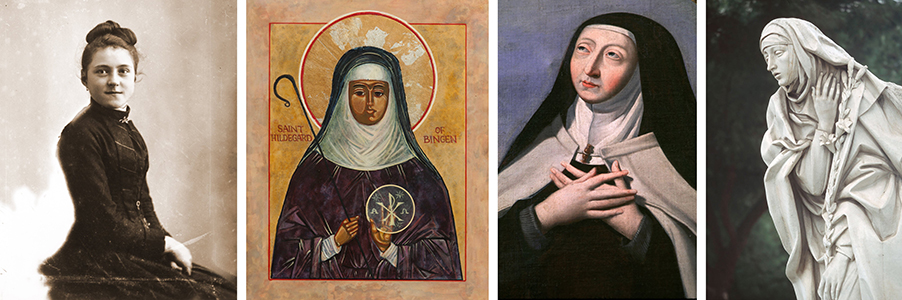
As we contemplate Advent themes in this spirit, we welcome into our company four radiant women, all doctors of the church, who put all their hope in God’s love: Thérèse of Lisieux, Hildegard of Bingen, Teresa of Avila and Catherine of Siena.
– Thérèse of Lisieux on consistency
It is natural for us to live by the changing weather patterns of our emotions. One day, we are anxious about finances or deadlines or the results of health tests, so we withdraw into a cocoon or snap at those around us. The next day, we are feeling in control of life and rather successful at being human, so we beam joviality and peace upon the world.
Advent stirs us from the slumber of following our feelings and urges us to “stay awake” to what faith demands of us (Mk 13:33-37).
As important and compelling as our emotions are, faith calls us not to be absorbed in them or to identify with them. Rather, we are to dive beneath their variability and deliberately to live ever alert to the truth that God’s love is holding us in being, moment by moment. Our fears or moods may remain, but as we consistently choose to live by faith, to live awake to the reality that we are unstintingly and passionately loved, we will be for others the living presence of God.
A particular genius of St. Thérèse of Lisieux was to live in constant trusting vigilance to God’s love for her and thus to be an unwavering beacon of divine goodness. The sweetness of Thérèse’s writing style perhaps makes it easy to miss her tenacious refusal to conform herself to the contours of her changing emotions. However, this consistent decision to be attentive and receptive to the flood of God’s love is unmistakable in Thérèse’s response to the trial of faith that blanketed the last 18 months of her life.
After first describing to her prioress her experience of a relentless “night of nothingness” in which “everything has disappeared,” Thérèse goes on to articulate her stance of steadfast trust. She writes: “My dear Mother, I may perhaps appear to you to be exaggerating my trial. In fact, if you are judging according to the sentiments I express in my little poems composed this year, I must appear to you as a soul filled with consolations and one for whom the veil of faith is almost torn aside; and yet it is no longer a veil for me, it is a wall which reaches right up to the heavens and covers the starry firmament. When I sing of the happiness of heaven and of the eternal possession of God, I feel no joy in this, for I sing simply what I want to believe.”
For at least one day this week, try to live in the spirit of St. Thérèse of Lisieux, acting not according to your changing feelings, but rather according to what you want to believe.
– St. Hildegard of Bingen on transformation
How can we possibly live as Advent stirs us to live? The messiness and anxieties of our everyday lives frequently exert an all-consuming claim over us. Within the grip of life’s contingency, not to mention its banality, how can we live in the security of being divinely loved and so be for others the presence of the living God? Is it simply a matter of dogged spiritual will-power?
John the Baptist promises that Jesus “will baptize you with the Holy Spirit” (Mk 1:1-8). The Holy Spirit enables us to enter into and live by the life of Jesus. This means that every decision we make to live in the truth that we are loved by God, while certainly our own decision, is mysteriously enabled; it is a sharing in Jesus’ trusting “yes” to live as the beloved Son of God.
At every moment, no matter our internal or external circumstances, the Holy Spirit is holding us in the flow of Trinitarian love; we simply have to choose to participate.
The writings of St. Hildegard of Bingen crackle with a living awareness of the transforming power of the Holy Spirit. For Hildegard, the Holy Spirit is the source of “viriditas,” or greenness — that vitality, freshness, dynamism which makes all life, both physical and spiritual, alive.
We glimpse Hildegard’s perception of what it means to be baptized with the Holy Spirit in the closing lines of a letter she wrote to a friend: “May He anoint you with the viridity of the Holy Spirit, and may He work good and holy works in you through that devotion with which true worshipers worship God.” The strength to live confidently as loved sons and daughters of God is not something we muster from our own interior resources. It is what, with our cooperation, the Holy Spirit causes to spring up within us.
We again hear Hildegard portraying the Holy Spirit’s power to make the divine life take root within us in her “Antiphon to the Holy Spirit.” Ringing out across the centuries and greening our Advent journey with healing and hope, she sings:
“The Spirit of God / is a life that bestows life, / root of world-tree / and the wind in its boughs. / Scrubbing out sin, / she rubs oil into wounds. / She is glistening life / alluring all praise, / all-awakening, / all-resurrecting.”
Take some time this week to notice the creation around you. Seek out any surprising signs of life and hopefulness amongst that which seems dormant and barren. Ask the Holy Spirit to stir such surprising vitality in the dormant and barren areas of your interior life, bringing about new vigor, joy and commitment.
– St. Teresa of Avila on encounter
It is perhaps easy for committed Catholics to gloss over the description of Jesus in the first chapter of John as one we “do not recognize.” We know him! We go to Mass every Sunday; we grasp the gist of the Gospels. But Advent challenges us to confront the comfortable presumption that we know the Lord and beckons us to deepen our personal relationship with him.
After all, our decision to cooperate with the divine enablement of the Spirit and to live radiant with the steadfast conviction that we are beloved by God is all about growing in our living union with Jesus. We are invited in the Advent season to expose our minds and hearts anew — or maybe even for the first time — to the ecstasy of self-giving love, the torrent of utterly attentive affection, incarnate and accessible to us in the person of Jesus.
The Christian spiritual tradition teaches that praying with the Gospels is a singularly effective way of coming to know Jesus more intimately. St. Teresa of Avila has precious wisdom to offer us in this regard. For Teresa, the Gospels are a fruitful context for focusing our attention on Jesus and speaking with him in faith.
She gives us a beautiful demonstration of doing just this when she contemplates keeping Jesus company in the Garden of Gethsemane. She had been writing to her sisters about prayer, but she spontaneously bursts into prayer: “O Lord of the world, my true Spouse! … Are You so in need, my Lord and my Love, that You would want to receive such poor company as mine, for I see by your expression that you have been consoled by me?”
Teresa makes the stunning claim here that we can console the Lord in his sufferings. When she teaches us about encountering Jesus in the Gospels, she is not merely suggesting some imaginative exercise or reconstructing in our minds a historical scene. She is talking about encountering a living person.
Teresa is alive to the truth that the Gospel episodes are not over and done with, irretrievably in the past. The Jesus who lived then, lives now and all his earthly life is alive in him; the way he was for the people he encountered in the past is the way he is now for us. So, we can, in fact, be the person touching his cloak, or asking him for mercy, or pleading for living water or consoling him. The episodes of the Gospels truly are pathways to deepening our knowledge of the living Jesus.
– St. Catherine of Siena on Christian identity
Was Mary’s personal identity eradicated at the Annunciation (Lk 1:26-38)? Did her generous, “I am the handmaid of the Lord” signal the end of her own life story as she began her life as the God-bearer? On the contrary, with her “yes” to the unfolding of God’s plan, Mary leaned more fully into her unique selfhood. Her witness prompts us to step back and discern the same flourishing at work in our own lives — or at least potentially so.
Throughout Advent we have prayed that our lives may more and more bear the radiant glory of God to others. We radiate God’s presence inasmuch as we live from the truth that God loves us; this means coming to know more intimately the God revealed in Jesus, cooperating with the transforming power of the Holy Spirit, and surrendering unreservedly to that love which sustains us in being through thick and thin. To be alive with the divine life means the blossoming of our deepest identity. We become light to the world and more fully ourselves as we let ourselves be loved.
St. Catherine of Siena had a vivid insight into the reality that our true self flourishes as we grow in union with God. Her prayer “My Nature is Fire” takes our self-understanding to audacious new depths and profoundly enriches our sense of what our life in Christ offers others.
The prayer reads: “In your nature, eternal Godhead, I shall come to know my nature. And what is my nature, boundless love?
“It is fire, because you are nothing but a fire of love. And you have given humankind a share in this nature, for by the fire of love you created us. And so with all other people and every created thing; you made them out of love. O ungrateful people! What nature has your God given you? His very own nature! Are you not ashamed to cut yourself off from such a noble thing through the guilt of deadly sin? O eternal Trinity, my sweet love! You, light, give us light. You, wisdom, give us wisdom. You, supreme strength, strengthen us. Today, eternal God, let our cloud be dissipated so that we may perfectly know and follow your Truth in truth, with a free and simple heart. God, come to our assistance! Lord, make haste to help us! Amen.”
Advent both reminds us of our transcendent calling and nurtures its fulfillment within us. Throughout this sacred season, we are created into beacons of divine tenderness as the Holy Spirit shapes our lives into Jesus’ “yes” to the Father’s love.
This Advent, guided by the wisdom of the women doctors of the church, let us throw our hearts open to God’s transforming work of love as never before. Our world needs us to do nothing less.
(Michelle Jones writes from Australia.)
A combination photo show images of Sts. Thérèse of Lisieux, Hildegard of Bingen, Teresa of Avila, and Catherine of Siena. (OSV News files)
NATION NEW ORLEANS (OSV News) – The Archdiocese of New Orleans has edged one step closer to finalizing its long-running – and costly – bankruptcy proceedings to resolve hundreds of clerical abuse claims. A committee of survivors and additional creditors overwhelmingly voted to accept the plan for a $230 million settlement, which would include tailored payment amounts factoring in the scope of the alleged abuse and its impact on claimants. The plan would also permit the release of files on abusive clergy. However, one group of bond investors filed an Oct. 28 request calling for further discussion of the archdiocese’s Chapter 11 reorganization plan, now in its fifth version. In response, the official committee of unsecured creditors in the case filed a response with the court, accusing the bondholder of “delay and subterfuge tactics” in “an attempt to fruitlessly delay confirmation and thwart justice for the more than 99% of abuse survivor creditors who voted in favor of the Plan.” A confirmation hearing is set to begin on Nov. 17, with testimony scheduled through Dec. 4. The Dec. 2 session will see survivors take the stand to share their personal experiences. OSV News has confirmed with the archdiocese that its legal fees to date in the case have so far totaled approximately $50 million.
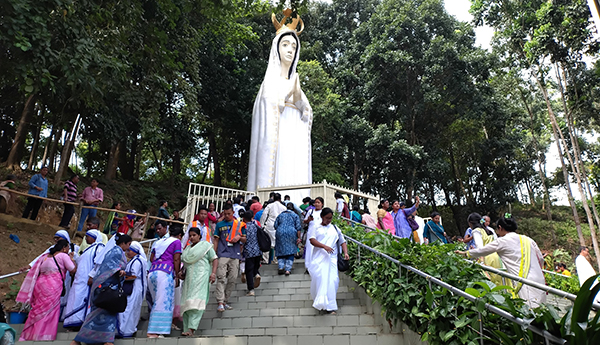
People gather for an annual pilgrimage to the shrine of Fatima Rani – or Mary, Queen of Fatima – at St. Leo’s Church in the Baromari hills in the Sherpur district of the Mymensingh Diocese in Bangladesh Oct. 31, 2025. The pilgrimage attracts tens of thousands of pilgrims from different parts of the country, including Muslims and Hindus, who come seeking spiritual connection and possible miracles. (OSV News photo/Stephan Uttom Rozari)
WASHINGTON (OSV News) – Amid concern about the ability of those detained by immigration enforcement authorities to receive Catholic sacraments, a key U.S. bishop said Trump administration officials have “assured” him the matter is “under careful review.” Bishop Robert E. Barron of Winona-Rochester, Minnesota, who was appointed by President Donald Trump to the Department of Justice’s Religious Liberty Commission, said in a Nov. 3 social media post that he and Father Alexei Woltornist, a Melkite Catholic priest and a member of the Department of Homeland Security’s Homeland Security Advisory Council “have been in touch with senior officials in both the State Department and the Department of Homeland Security and have brought forward the concerns of the church regarding detainees’ access to Sacraments.” Bishop Barron’s post included an OSV News article about a delegation of clergy, religious sisters and laity, and a Chicago auxiliary bishop who were barred for the second time in three weeks from bringing the Eucharist to those being held at an immigration detention center just west of Chicago on the feast of All Saints Nov. 1. Spokespersons for the Department of Homeland Security and ICE did not immediately respond to requests for comment from OSV News.
VATICAN VATICAN CITY (OSV News) – Pope Leo XIV offered words of joy to Catholics in India’s Kerala state after the Nov. 8 beatification of Mother Eliswa Vakayil, founder of the Teresian Carmelite congregation. Speaking at his Nov. 12 general audience, the pope praised the 19th-century nun as “a source of inspiration” who championed the dignity of women and the education of poor girls. Mother Eliswa, born in 1831 and widowed at 20, became Kerala’s first Indigenous nun in 1866, establishing what is now the Congregation of Teresian Carmelites – and was then Third Order of the Discalced Carmelites – with her sister and daughter. Today the community includes more than 1,500 sisters in over 200 convents worldwide. Over 20,000 faithful filled the Basilica of Our Lady of Ransom in Kochi for the beatification Mass celebrated by Cardinal Sebastian Francis, the pope’s delegate. Church leaders hailed Blessed Eliswa as a pioneer of women’s empowerment in a deeply patriarchal era. Her congregation is now praying for a second miracle “to pave the way for the canonization of our founder,” said Sister Sucy Kinattingal, who has been vice postulator for Mother Eliswa’s cause since 2012.
WORLD AUCHI, Nigeria (OSV News) – The Diocese of Auchi in Nigeria is mourning the death of teenage seminarian Emmanuel Alabi, who died after being kidnapped with two classmates in July. Diocesan officials confirmed Nov. 4 that while seminarians Japhet Jesse and Joshua Aleobua were freed, Alabi “died in the course of the ordeal.” Bishop Gabriel Dunia expressed deep sorrow and urged Nigerian authorities to prioritize citizens’ safety amid worsening insecurity. The seminarians were abducted July 10 when gunmen attacked Immaculate Conception Minor Seminary, killing a security guard. It was the seminary’s second kidnapping in less than a year. In 2024, its rector, Father Thomas Oyode, was abducted after offering himself in place of students. A Catholic Secretariat of Nigeria report said 145 priests have been kidnapped in Nigeria since 2015, 11 of whom were killed. With the rise of extremist Islamic ideology, Nigeria has become “the most violent place in the world for followers of Jesus,” according to Open Doors International, an organization that supports persecuted Christians around the world. While the conflict is also driven by other factors, including extremist groups’ desire for power and control, more Christians are killed by the extremists than Muslims, Open Doors said.
DHAKA, Bangladesh (OSV News) – In northern Bangladesh, thousands of Catholics have gathered at St. Leo’s Church in the Diocese of Mymensingh to celebrate the 25th anniversary of the Mary, Queen of Fatima shrine, known as Fatima Rani. Nearly 40,000 pilgrims joined the two-day celebration in late October, marked by rosary prayers, candlelight processions, and the Stations of the Cross. Bishop Paul Ponen Kubi of Mymensingh led the closing Mass, joined by Vatican nuncio Archbishop Kevin Randall and local clergy. Parish pastor Father Torun Bonwary said the anniversary, which falls during the Catholic Church’s Jubilee Year, brought “a different level of spirituality” to local Catholics – many of them Indigenous. Pilgrims climbed a 1.2-mile mountain path lit by thousands of candles, praying for forgiveness and peace. Despite limited resources, organizers said the shrine remains a symbol of faith and hope for Bangladesh’s small but vibrant Catholic community of about 400,000 faithful in the Muslim-majority nation. “The sight of thousands of devotees walking on the hilly path with candlelight in their hands proves that no matter what obstacles we face, we will move forward on the path of light with the grace of Mother Mary,” one pilgrim said.
Por David Agren (OSV News) – La Conferencia del Episcopado Mexicano ha condenado el asesinato de un alcalde, que fue asesinado tras solicitar ayuda federal para combatir a los cárteles de la droga, que extorsionan a los productores de aguacate de su municipio, situado en el estado occidental de Michoacán.
Carlos Manzo, alcalde de Uruapan, fue asesinado a tiros durante una ceremonia con velas por el Día de Muertos el 1 de noviembre. Manzo recibió siete disparos, según el secretario de Seguridad Pública de México, Omar García Harfuch, mientras que las fotos del evento en la plaza del pueblo lo mostraban con su hijo pequeño en brazos. Dos sospechosos fueron detenidos en relación con el caso, añadió García Harfuch.
El asesinato de Manzo “se suma a una serie de asesinatos de personas que se han atrevido a levantar la voz y enfrentar la falta de Estado de Derecho en sus tierras, comercios y otros espacios. Hoy ya no basta aprehender al asesino: hay que combatir con determinación la causa de todos estos asesinatos”, afirmó la conferencia episcopal en un comunicado del 2 de noviembre.
“La presencia ordinaria de grupos armados, que controlan la vida pública de los ciudadanos en varias regiones del país, es el verdadero crimen a enfrentar; los retenes en carreteras, el despojo de tierras, las amenazas constantes a los productores, comerciantes y gobernantes, reflejan un grave debilitamiento del orden constitucional que los gobiernos, a nivel municipal, estatal y federal están obligados a garantizar”.
El asesinato provocó indignación en México, donde la violencia de los cárteles de la droga ha azotado amplias zonas del país durante casi dos décadas. La violencia ha afectado especialmente a Michoacán, que tiene una larga historia de cultivo de marihuana. Pero los analistas afirman que ahora los grupos criminales extorsionan a los cultivadores de aguacates y limas, talan ilegalmente bosques e importan precursores químicos para drogas sintéticas a través del puerto de Lázaro Cárdenas.
Un sacerdote de Michoacán describió la desesperada situación del estado, en el que los grupos criminales se confabulan con los políticos y luchan entre sí por el control de los lucrativos territorios del crimen.
“El pueblo ya está, dicen ellos, ‘hasta la madre, padre’”, declaró a OSV News el sacerdote, que ejerce su ministerio en una zona conflictiva de Michoacán. El sacerdote, que anteriormente prestó apoyo espiritual a los grupos de autodefensa que se formaron para luchar contra los cárteles de la droga en 2013, pidió permanecer en el anonimato para poder hablar con franqueza. “Créemelo, que estamos a un minuto, a un momento de que arda Michoacán”, afirmó el sacerdote.
Manzo se dio a conocer por acompañar a la policía en sus patrullas por Uruapan. Denunció el crimen organizado e instó a la presidenta Claudia Sheinbaum a tomar medidas.
“A la presidenta este país ya se le fue de las manos”, declaró Manzo al medio de comunicación mexicano Latinus. “El país se nos está yendo. El crimen se ha vuelto parte del paisaje. (…) Nosotros enfrentamos solos a la delincuencia. No hay estrategia, no hay Estado”.
Enfrentarse a los grupos criminales puede ser peligroso. Bernardo Bravo, presidente de una asociación de productores de cítricos de la ciudad de Apatzingán, fue encontrado recientemente asesinado tras organizar una protesta de los productores de cítricos, hartos de pagar extorsiones.
“Estos crímenes hieren a la sociedad mexicana y demandan una respuesta inmediata y coordinada por parte de las autoridades para reconstruir la paz en Michoacán.”, afirmó el 2 de noviembre el Diálogo Nacional por la Paz, una iniciativa para pacificar México, patrocinada por la conferencia episcopal, los jesuitas y la Conferencia de Superiores Mayores de Religiosos de México.
Sheinbaum condenó el asesinato de Manzo, que anteriormente había sido diputada por su partido Morena, actualmente en el poder, y ganó la alcaldía como independiente. Sin embargo, el 3 de noviembre suscitó polémica al afirmar en su rueda de prensa matutina que la violencia en Michoacán se originó con el expresidente Felipe Calderón, quien, según ella, robó las elecciones de 2006 y comenzó a tomar medidas enérgicas contra los cárteles de la droga en Michoacán para “legitimar” su victoria.
El asesinato de Manzo captó la atención internacional y se produjo en un momento en que Estados Unidos presionaba a México para que detuviera el flujo de drogas como el fentanilo.
“Estados Unidos está dispuesto a profundizar la cooperación en materia de seguridad con México para erradicar el crimen organizado a ambos lados de la frontera”, declaró Christopher Landau, subsecretario de Estado, en una publicación de X que mostraba una foto de Manzo con su hijo. “Que su alma descanse en paz y que su recuerdo inspire acciones rápidas y eficaces”.
(OSV News) — The Mexican bishops’ conference has condemned the murder of a mayor, who was assassinated after pleading for federal assistance in combating drug cartels — which extort avocado growers in his municipality in western Michoacán state.
Carlos Manzo, the mayor of Uruapan, was shot dead at a candlelighting ceremony for Day of the Dead on Nov. 1. Manzo was shot seven times, according to Mexico’s public security secretary, Omar García Harfuch, while photos from the event in the town square showed him holding his young son in his arms. Two suspects were arrested in the case, García Harfuch added.
Manzo’s slaying “adds to a series of murders of people who have dared to speak out and confront the absence of the rule of law in their communities, businesses and other spaces. Today, it is no longer enough to apprehend the killer: We must resolutely combat the root causes of all these murders,” the bishops’ conference said in a Nov. 2 statement.
“The ordinary presence of armed groups, which control the public life of citizens in various regions of the country, is the real crime to be faced: the roadblocks, the dispossession of lands, the constant threats to producers, merchants and rulers reflect a serious weakening of the constitutional order that the governments at the municipal, state and federal levels, are obligated to guarantee.”
The brazen murder sparked outrage in Mexico, where drug cartel violence has plagued swaths of the country for nearly two decades. The violence has especially plagued Michoacán, which has a long history of marijuana growing. But analysts say that now criminal groups now extort the growers of avocados and limes, illegally log forests and import chemical precursors for synthetic drugs through the port of Lázaro Cárdenas.
A priest in Michoacán described a desperate situation in the state with criminal groups colluding with politicians and fighting each other to control lucrative crime territories.
“The people are saying, ‘Enough, padre,” the priest, who ministers in a conflictive part of Michoacán, told OSV News. The priest, who previously lent spiritual support to self-defense groups that formed to fight drug cartels in 2013, asked for anonymity to speak candidly. “Believe me: We’re just a minute, a moment away from Michoacán burning,” the priest said.
Manzo became known for accompanying police as they patrolled Uruapan. He spoke out against organized crime and urged President Claudia Sheinbaum to take action.
“This country has already slipped out of the president’s control,” Manzo told Mexican media outlet Latinus. “The country is slipping away from us. Crime has become part of the landscape. … We are facing crime alone. There is no strategy, there is no state.”
Confronting criminal groups can be perilous. Bernardo Bravo, head of a citrus growers’ association in the city of Apatzingán, was recently found murdered after he organized a protest by citrus growers tired of paying extortion.
“These crimes wound Mexican society and demand an immediate and coordinated response from the authorities to rebuild peace in Michoacán,” said a Nov. 2 statement from the National Dialogue for Peace, an initiative to pacify Mexico, sponsored by the bishops’ conference, the Jesuits and the Conference of Religious Superiors of Mexico.
Sheinbaum condemned the killing of Manzo, who previously served in Congress as a member of her ruling Morena party and won the mayor’s office as an independent. She drew controversy on Nov. 3, however, for saying at her morning press conference that violence in Michoacán originated with former President Felipe Calderón — who she insisted stole the 2006 election and started cracking down on drug cartels in Michoacán to “legitimize” his win.
“And we have always said it is about addressing the causes and zero impunity, intelligence, investigation and prosecutions,” Sheinbaum said.
Calderón’s crackdown on drug cartels shortly followed his taking office in December 2006. It was preceded by a drug cartel known as La Familia Michoacana bursting into a bar in Uruapan and tossing five human heads onto a dance floor.
Manzo’s murder captured international attention and came as U.S. pressure on Mexico to stop the flow of drugs like fentanyl has mounted.
“The U.S. stands ready to deepen security cooperation with Mexico to wipe out organized crime on both sides of the border,” Christopher Landau, deputy secretary of state, said on X. “May his soul rest in peace and may his memory inspire prompt and effective action.”
(David Agren writes for OSV News from Buenos Aires.)
By Joanna Puddister King SALTILLO, Mexico – Bishop Joseph Kopacz and Bishop Louis Kihneman of Biloxi traveled together to Saltillo, Mexico, October 15–20, continuing a long tradition of friendship and shared faith between Mississippi and the Diocese of Saltillo.
The trip marked Bishop Kopacz’s eleventh visit to the mission founded by Father Patrick Quinn more than 50 years ago. Father Quinn, who served in Mississippi before being assigned to Mexico in 1969, worked tirelessly to build bridges of faith between the people of Saltillo and the faithful of Mississippi. Today, his legacy continues to thrive through the Mission of San Miguel and the many chapels that extend across the desert landscape.
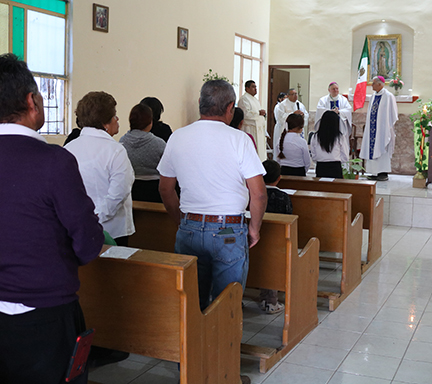
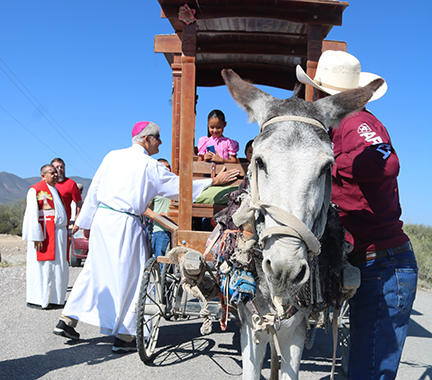
During their five-day pilgrimage, the bishops celebrated the Eucharist in city parishes and rural communities, visited Father Quinn’s tomb at Parroquia del Perpetuo Socorro, and joined local families in joyful processions honoring the Holy Infant of Good Health. At San Miguel, they gathered with parishioners for Mass before walking through the streets in celebration, surrounded by color, song, and faith-filled joy.
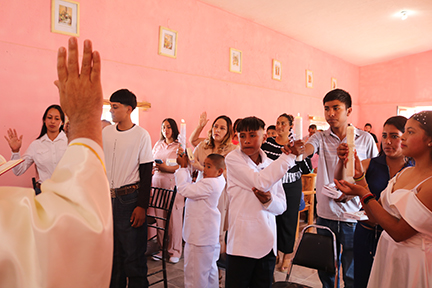
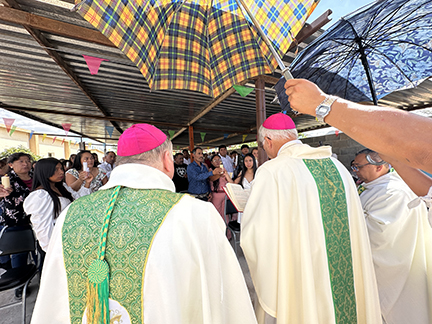
The visit also included confirmation Masses in Garambullo and Tanque del Cerro, meals and fellowship with local priests, and time spent at small desert ranchos where the people welcomed the bishops with open hearts. On the fourth day, rain fell over the desert for the first time in Bishop Kopacz’s eleven years of visits – a moment that filled the communities with thanksgiving and praise.
While in Saltillo, the bishops also visited Father Adolfo Suárez, a diocesan priest from St. Michael Parish in Forest and its missions, who has been serving at the Mission of San Miguel since April. Father Adolfo returned to Mexico earlier this year due to U.S. immigration limits that affect many foreign-born priests and religious serving in dioceses across the country.
Bishop Kopacz continues to raise awareness about the Religious Worker Protection Act (RWPA) – bipartisan legislation that would allow priests, sisters and other ministers like Father Adolfo to remain in the U.S. while awaiting permanent residency. “These faithful men and women serve our parishes and our people with dedication and love,” Bishop Kopacz said. “Their ministry is essential to the life of our church.” “Every visit to Saltillo is a reminder of the universality of our church,” Bishop Kopacz added. “We may live far apart, but we share the same faith, the same hope, and the same joy in Christ.”
The Mission of Saltillo remains a living partnership between the Dioceses of Jackson and Saltillo – a bond strengthened through prayer, presence and a shared mission to serve God’s people.
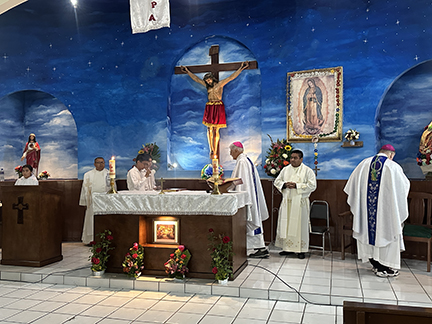
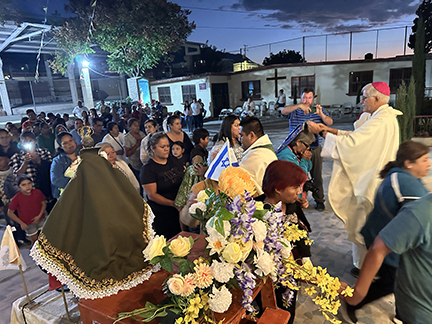
SALTILLO, Mexico – Bishops Joseph Kopacz and Louis Kihneman of Biloxi celebrate the first Mass of their trip at Santos Mártires Parish on Oct. 15 with Father David Martínez Rubio and Father Adolfo Suárez Pasillas.Bishop Joseph Kopacz concelebrates Mass at San Juan Diego Parish on Oct. 16 with Father Adolfo Suárez (right) and visiting clergy from the Diocese of Saltillo.Bishop Joseph Kopacz blesses parishioners with the cape of the Holy Infant of Good Health after a rosary and procession at San Miguel Parish. Earlier, two parishioners changed the infant’s garment, with the previous cape used in the blessing.NUEVO GÓMEZ RANCHO, Mexico –Bishop Joseph Kopacz checks in with his ride before joining the procession to San Francisco del Ejido.NUEVO GÓMEZ RANCHO, Mexico –Students celebrate Confirmation and one First Communion at Santa Teresa Parish.TONQUE DEL CERRO, Mexico – Bishop Louis Kihneman of Biloxi and Bishop Joseph Kopacz of Jackson celebrate an outdoor Mass with confirmations at Sagrado Corazón Parish on Oct. 19. (Photos by Tereza Ma)
(OSV News) — Many parishioners at San Antonio de las Huertas Parish in Mexico City remember their deceased loved ones by building altars in their homes for Day of the Dead.
The altars burst with marigolds, are often adorned with colourful “papel picado,” or decorative cut paper, and usually feature food and drink, including Coca-Cola, tequila and beer. People believe their relatives return the nights of Nov. 1 and Nov. 2 to reunite with family.
Father Pedro Lira, pastor at San Antonio de las Huertas, supports the practice of building altars. But he also encourages his congregation to pray for their deceased loved ones and to remember the promise of eternal life.
A file photo shows workers assembling an altar in Mexico City’s Zocalo Square, which is part of an art installation to celebrate the Day of the Dead. The traditional celebration honors children on All Saints’ Day, Nov. 1, and adults on All Souls’ Day, Nov. 2. (OSV News photo/Tomas Bravo, Reuters)
“Upon lighting the candles many people stop and pray the Our Father without really knowing how to pray at the altar,” Father Lira told OSV News. “It’s the confidence of saying, ‘Even after death, I can do something for you?'”
Day of the Dead — famed Dia de los Muertos — marks one of Mexico’s deepest cultural traditions, dating to pre-Hispanic times, in which people commemorate and commune with their deceased loved ones. Mexicans build altars and visit graveyards for candlelight vigils.
Many Mexicans visit churches, too, where prayers are said for All Saints’ Day on Nov. 1 and All Souls’ Day on Nov. 2.
“The church commemorates, does not celebrate, the faithful who have departed,” Father Lira said. “We entrust them to God’s mercy. We no longer know if they share in his glory, but we do entrust them to God’s providence. And that is why as a church we pray for them.”
Death holds a unique place in Mexican culture. Pre-Hispanic populations celebrated a version of Day of the Dead around harvest time, according to research. Early Catholic evangelists “Christianized” that remembrance of the dead, according to Father Lira, who emphasized, “The Christian message is death as a passage to eternal life. … Mexican culture did not see life after death.”
The tradition has become a spectacle, too — all thanks to the 2015 James Bond movie, “Spectre,” which featured an apocryphal Day of the Dead parade. Mexican tourism officials copied the parade — complete with giant skeleton marionettes — which draws throngs to central Mexico City.
Onlookers paint their faces black and white and dress in La Catrina costumes — elegant skeletons previously used to mock the Mexicans aspiring to be Europeans. Tourists, meanwhile, increasingly make trips to graveyards to witness the festivities, bringing much needed economic activity to downtrodden rural towns, but disrupting commemorations.
“The people of Oaxaca (state) have managed to create a second Day of the Dead that is exclusively meant for tourists and strangers,” Shawn Haley, a Canadian anthropologist studying the holiday, told OSV News. The alternative Day of the Dead “redirects the strangers focus away from the village celebrations that can then remain restricted to the community and family.”
Observers say a renewed sense of pride in Mexican traditions, along with movies such as “Coco,” have hastened the embrace of Day of the Dead. The renewed interest in Day of the Dead, meanwhile, has largely diminished interest in Halloween, which had been brought back by migrants and had been gaining ground until recently. “It is viewed as a quaint American holiday,” Haley said.
Mexican church leaders have long warned of the rise of Halloween. Father Andrés Larios said a group of young people in his parish in Michoacán even tried to turn the parish event hall into a haunted house — something he used as a teaching opportunity.
“The church much prefers promoting that one day we will meet our loved ones who died for this world, but who continue living in the other, rather than getting rid of all these things that come from the United States” such as Halloween, said Andrés Larios, a parish priest in the Diocese of Apatzingán.
Practicing Catholics still refer to Day of the Dead as All Saints, which remembers the saints, and All Souls, which remembers all believers, to “distinguish themselves from nonpracticing Catholics,” according to Haley, though “the actual celebration is exactly the same.”
He added, “In non-Catholic homes, the deceased loved ones are expected to return home where in Catholic homes, the altar becomes more of a memorial to the deceased. Less celebrating and more remembering.”
Priests are emphasizing faith, along with remembrance.
“It’s very important to recall the importance of praying for the saints on Nov. 1 and praying for the dead on Nov. 2,” Father Alan Camargo, spokesman for the Diocese of Matamoros-Reynosa, told OSV News.
“The Catholic faith, at its core, is Christ who dies and conquers death,” he continued, adding that “altars to the dead, skulls, those don’t clash with the Christian faith as long as we discover the importance of respect for life and also respect for death.”
(David Agren writes for OSV News from Buenos Aires.)