By Joanna Puddister King
JACKSON – Beginning Jan. 1, 2027, eligible taxpayers will have a new opportunity to put money they would otherwise pay in federal income taxes toward scholarships supporting Catholic education in the Diocese of Jackson.
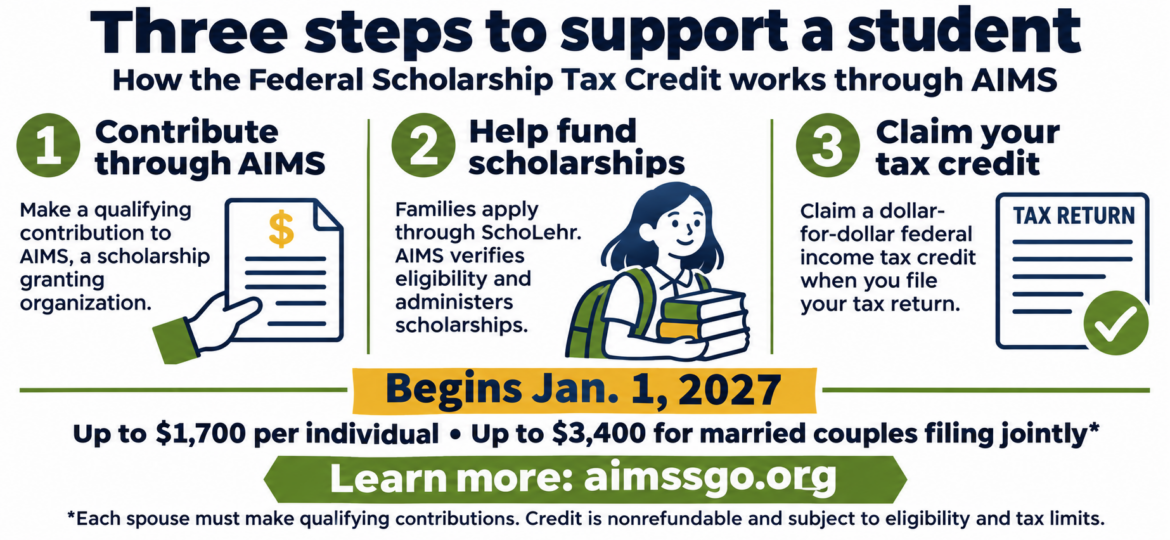
Through the Federal Scholarship Tax Credit, individuals can contribute to a qualified scholarship granting organization and receive a dollar-for-dollar reduction in their federal income tax, within the program’s limits.
All diocesan Catholic schools are participating through AIMS – Advancing Independent Missions for Schools – which will administer the scholarships. The diocese’s four early learning centers are not included.
For Joni House, executive director of Catholic Education, the opportunity could help both families already enrolled and those who have considered Catholic education financially out of reach.
“Many of our families make financial sacrifices to keep their children in Catholic schools,” House said. “These scholarships could help ease that burden and allow them to continue providing their children with a Catholic education rooted in faith, academic excellence, and service.”
“For families who have always wanted Catholic education but felt they could not afford it, this opportunity could open doors that were previously closed,” she said.
Russ Nelson, principal of St. Richard Catholic School in Jackson, said tuition can be a significant decision for families, especially those with more than one child or whose circumstances change after years of enrollment.
“I’m glad we’re working with AIMS because a scholarship could help a family enroll at St. Richard or help a child who’s already here come back next year,” Nelson said.
A choice about where your tax dollars go
The program gives eligible taxpayers a choice: They can put a portion of the money they would otherwise pay in federal income taxes toward student scholarships.
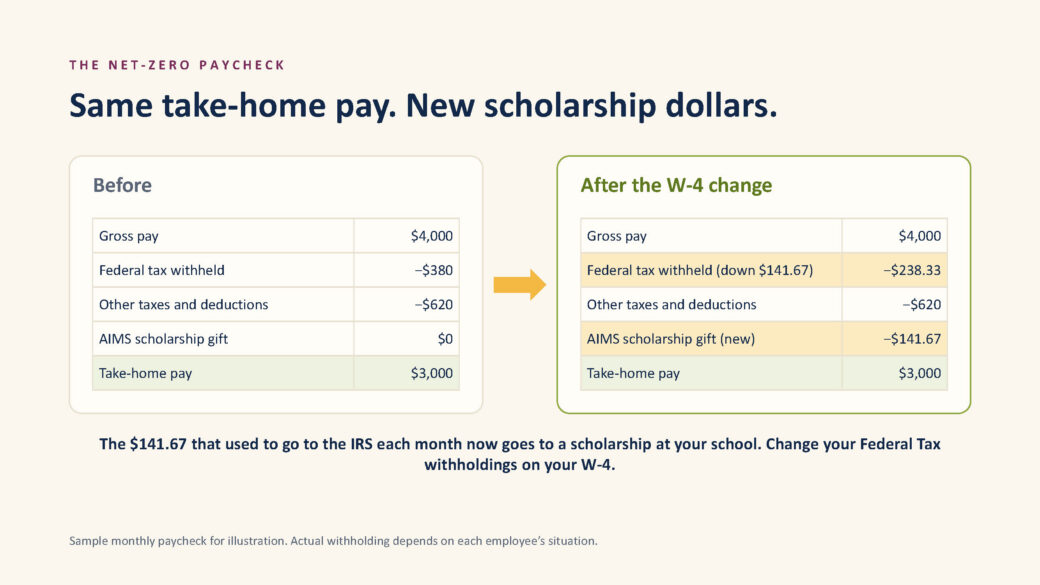
For example, suppose an individual’s federal income tax for the year is $5,000. That person makes a qualifying $1,700 contribution to AIMS and claims the full $1,700 credit, reducing federal income tax to $3,300. The combined amount remains $5,000, but $1,700 now supports scholarships. (See the accompanying graphic for an example of how payroll contributions and adjusted federal tax withholding could support scholarships while maintaining the same take-home pay.)
The example assumes the taxpayer qualifies and can use the full credit.
The annual credit is up to $1,700 per individual. Under current IRS guidance, married couples filing jointly may qualify for a combined credit of up to $3,400, with each spouse making qualifying contributions.
This is different from a regular charitable deduction. A deduction reduces the income subject to tax. This credit reduces federal income tax dollar for dollar.
Taxpayers make their contribution through AIMS and claim the credit when filing their federal income tax return. Qualifying contributions made in 2027 would generally be claimed on returns filed in 2028. Federal taxes already withheld from a paycheck count toward the year’s tax payments; receiving a refund does not automatically prevent someone from using the credit.
The credit is nonrefundable, meaning the amount a taxpayer can use depends on their federal income tax liability. Federal law allows unused credit to be carried forward for up to five years. Taxpayers should consult their tax preparer about their individual circumstances.
Congress established the program in legislation enacted July 4, 2025. Mississippi has elected to participate.
Connecting families with assistance
Families seeking scholarships will apply through SchoLehr, AIMS’ online platform, where they can follow their application’s progress. AIMS will review applications, verify eligibility and administer awards.
Federal eligibility requirements include household income no greater than 300% of area median gross income and a student’s eligibility to enroll in public elementary or secondary school. Students attending Catholic schools can qualify.
Scholarship amounts will depend on the award process and available funding. The donor’s $1,700 tax credit limit does not establish the amount an individual student will receive.
Mississippi Catholic will provide a closer look at scholarship eligibility and application procedures in a future article.
House emphasized that the potential benefit extends beyond help with tuition.
“Catholic education is about more than academics,” she said. “We focus on educating the whole child – spiritually, academically, socially, and emotionally.”
“This opportunity could allow more children to experience the gift of Catholic education while strengthening our schools and the communities we serve,” she said.
A shared mission
Participation offers parishioners, grandparents, alumni and other supporters an opportunity to help students, whether or not they currently have a child in Catholic school.
“Catholic education is a mission we all share as a Church,” House said. “Our schools help children grow in faith, build strong values, and develop a heart for serving others.”
She encouraged supporters to consider the difference their involvement could make for a family.
“Your participation could help a child remain in a Catholic school or give another child the opportunity to attend for the first time,” House said.
Nelson sees the mission of Catholic education in students’ weekly worship and classroom conversations.
“At St. Richard, I get to see that when our students go to Mass together on Wednesdays and when they talk about God in their classrooms during the week,” he said.
“When parishioners and others support these scholarships, they can give a child right here in Jackson the chance to be part of that.”
Readers can learn more and sign up for updates ahead of the January launch at aimssgo.org. Questions about participating through AIMS can be directed to info@aimssgo.org.