
From the Archives
By Mary Woodward
“From the Archives” is back after a short hiatus that can be attributed to many wonderful events going on in our diocese, travel, the World Cup, and the dentist. The summer heat is upon us full force and once again we find ourselves thanking the Lord for sturdy HVAC systems.
Last week I was talking with a friend who had just returned from an Alaskan cruise with family. I was rather envious hearing of the cool temperatures and whale sightings on that great Northwestern adventure.
Providentially, this conversation sparked a memory of a transatlantic cruise Bishop Richard Gerow took in September 1929. So, for the next couple of columns, let us transport ourselves back almost 100 years and journey with Bishop Gerow together with five seminary classmates as he sails on ocean breezes to exotic ports-of-call in Europe, Africa, and the Holy Land.
The voyage began on Sept. 21 from New York and ended with his arrival back in Natchez on Dec. 22 to several inches of snow and diocesan financial woes due to the collapse of the stock market in October while the Bishop was in Sicily.
So … let’s get sailing. We begin on the deck of the “Augustus,” an Italian cruise liner who along with her sister ship “Roma” were the premier sailing vessels for transatlantic crossings from North and South America. The Augustus was diesel-powered and could make the crossing in five days if the seas cooperated.
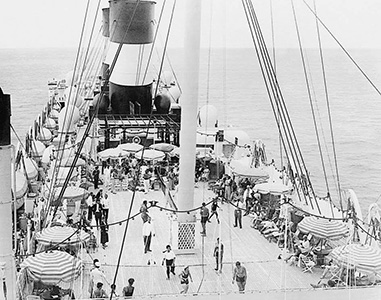
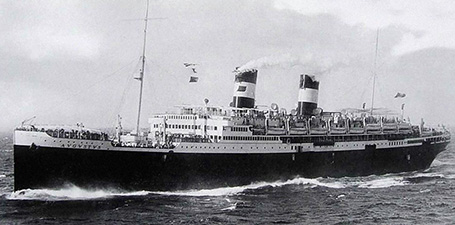
The Augustus was the most powerful motorship of her day. She was also the first ocean liner with a completely outdoor swimming pool. Bishop Richard Gerow – along with five seminary classmates – traveled to exotic ports-of-call in Europe, Africa and the Holy Land in the fall of 1929 on the premier Italian cruise liner. (Photos from Wikipedia)
At one time it was the largest motorship in the world, according to Wikipedia. Unfortunately, the Augustus meets a sad end. It was converted into an aircraft carrier by the Italian navy during World War II, then it was seized by the occupying Germans and was sunk in the Port of Genoa as a blockade. After the war, it was raised but eventually turned into scrap.
To think it once majestically ferried six 1909 graduates of the North American College in Rome and countless thousands from New York to all parts of the Mediterranean only to meet such an undignified ending.
Bishop Gerow begins his travel log with this description of the view from the deck:
“There is a thrill in watching a great steamer leave its berth for an ocean voyage. This morning we stood at the deck rail of the Augustus looking down upon the surging mass of people on the pier who had come to see the great ship depart.
“The ship’s gong had already sounded the notice ‘all ashore who are going ashore,’ and we but waited for the moment of departure. Friends ashore called to those aboard, and their calls were answered with showers of confetti. …
“Soon the great gangplank was lowered to the wharf. The great ropes which had held the ship were loosed, and … slowly, almost imperceptibly at first the great ship began to move. The crowd ashore shouts, handkerchiefs are waved from the pier. We see a silent face looking tenderly towards the moving ship, while a tear lingers on the eyelid.
“And in the midst of it all, seamen and wharf hands, officers and policemen move about as if this event, so important to many another, is merely a matter of routine in their lives.”
Bishop Gerow goes on to describe the first moments when all on the shore were no longer in sight. He and his classmates began to explore the Augustus to learn more about it. According to his description of the ship, it was about 700 feet long and around 32,500 tons. The open upper deck had a tennis court, shuffleboard courts, and a pool filled with blue salt water.
“On the decks are long promenades with comfortable steamer chairs. And inside, what gorgeous apartments – the great lounging saloon, the dining room, the smoking room, fitted with the most luxurious furniture, ornamented with beautiful tapestries and paintings.
“And spacious bedrooms with private bath, instead of the little rooms of olden days. All the arts of man seem to have been called upon to make this ship comfortable and luxurious. Certainly it is a far reach from the old sailing vessel that once carried our forefathers from Europe to America to the modern palatial Atlantic liner.”
Bishop Gerow would have gone to seminary in Rome and would have been in one of those “little rooms of olden days.” Now 20 years later he and his classmates have embarked on one of the finest ships on the sea. He has gone from steerage to upper decks. If anyone has flown on a long flight lately, you can somewhat imagine the difference of being in the main cabin versus being in the front.
So next time, we will be on the open seas and arriving off the coast of Spain as the adventurers make their way across the world.
(Mary Woodward is Chancellor and Archivist for the Diocese of Jackson.)