
By Bishop Joseph R. Kopacz, D.D.
The excommunication promulgated by Pope Leo XIV against the ordaining and newly ordained bishops of the Society of St. Pius X (SSPX) has garnered the attention of many within and outside of the jurisdiction of the Catholic Church.
This is a sad chapter whose story began immediately after the conclusion of the Second Vatican Council in 1965. At that time, Archbishop Marcel Lefebvre founded the Society of St. Pius X, a group that opposed many of the changes inaugurated by the Council, especially with respect to the liturgy, ecumenism, church discipline and the authentic development of doctrine.
For the next 20 years, there was considerable engagement and fraternal dialogue with the leadership of the SSPX but to no avail. On June 30, 1988, Archbishop Lefebvre ordained four bishops without the approval of Pope St. John Paul II, who immediately responded with a decree of excommunication. The Holy Father followed with the Apostolic Letter “Ecclesia Dei” which addressed the grave matter of schism brought about by the rebellious actions of Lefebvre.
Pope St. John Paul II wrote: “In itself, this act was one of disobedience to the Roman Pontiff in a very grave matter of supreme importance for the unity of the Church, such as the ordination of bishops whereby the apostolic succession is sacramentally perpetuated. Hence, such disobedience, which implies in practice the rejection of the Roman primacy, constitutes a schismatic act.”
He also emphatically stated, “I wish to make an appeal both solemn and heartfelt, paternal and fraternal, to all those who until now have been linked in various ways to the movement of Archbishop Lefebvre, that they may fulfill the grave duty of remaining united to the Vicar of Christ in the unity of the Catholic Church, and of ceasing their support in any way for that movement. Everyone should be aware that formal adherence to the schism is a grave offense against God and carries the penalty of excommunication decreed by the Church’s law.”
Pope St. John Paul II followed up his Apostolic Letter in 1988 with a historic pastoral response to the schism with the establishment of the Priestly Fraternity of St. Peter. This Clerical Society of Apostolic Life was created as a bridge for those who in good conscience were committed to the traditional Latin Mass, but at the same time desirous of remaining in the fold of the Catholic Church. In their own words, “we chose Saint Peter as our special patron to express the gratitude, filial love, and loyalty to the Supreme Pontiff.” In 1993, Bishop James C. Timlin of the Diocese of Scranton, Pennsylvania, invited the Fraternity to establish their North American Headquarters in the diocese where they are based to this very day. The Priestly Fraternity of St. Peter and the Society of St. Pius X are not to be confused as one and the same.
Pope Benedict XVI lifted the ban of excommunication against the Society of St. Pius X in 2009 in the hope that they could be reconciled to the Catholic Church in the manner of the Priestly Fraternity of St. Peter. As Cardinal Ratzinger, Pope Benedict had worked closely with the leadership of the Society of St. Pius X, and now as the Holy Father he dearly wanted to heal the fractured relationship.
However, the succeeding generation of leadership following the example of their founder, Archbishop Lefebvre, remained a defiant body. They continue to be such and nearly 40 years later Pope Leo XIV finds himself in the same schismatic waters that Pope St. John Paul II had to navigate in 1988.
In the aforementioned apostolic letter, Pope St. John Paul II expressed his grief over the failed efforts for reconciliation. “This affliction was particularly felt by the Successor of Peter to whom in the first place pertains the guardianship of the unity of the Church.”
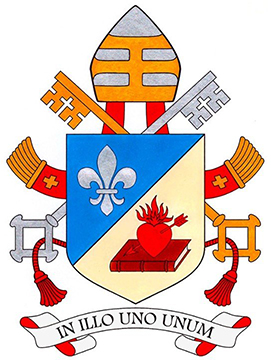
For certain, this is the same sorrow of Pope Leo over this most recent division in the Body of Christ. Recall that his motto is In illo uno, unum, or in the one, (Christ), we are one.
Even more than most popes, Leo XIV’s particular charism is the unity of the Church. As an Augustinian, his papal crest contains a heart pierced by an arrow resting on the Bible. For certain, his heart is pierced by the schismatic decisions of the SSPX and the ensuing excommunication. Let us recall that standing under the Word of God, we hear the Lord’s timeless prayer for unity at the Last Supper, “that all may be one.” (John 17:21) This is binding for all who are faithful members of the Lord’s body, the Church.