
REFLECTIONS ON LIFE
By Melvin Arrington
Several weeks ago the U.S. government began releasing previously classified documents concerning unidentified flying objects, or UFOs, a move that has sparked renewed interest in the question of whether there is intelligent life beyond the planet we call home.
The fact that UFOs are once again in the news takes me back to the era of Sputnik, when rocket launches and speculation on aliens from other galaxies visiting Earth triggered the imagination of children of my generation and filled our heads with dreams of future space travel.

When I was a child, I enjoyed watching TV programs about rocket ships and alien worlds. One of my favorites was the old 1930s Flash Gordon movie serials that often ran on TV in those days. And my reading material of choice was science fiction comic books. Well into adulthood I still believed and hoped that someday, someplace, our space explorations would eventually discover other planets inhabited by scientifically advanced peoples.
However, as I got older and, I hope, wiser, my childhood notions gradually developed into more mature thinking. Now, I’m fairly confident that planet Earth is the only place in the known universe capable of sustaining higher life forms. But occasionally uncertainty creeps in, as on that afternoon a few years ago when, while driving to work, I actually saw a UFO in broad daylight.
To clarify, I saw some type of thin, oblong-shaped object moving along in the sky that I couldn’t identify, a description that seems to fit the definition of a UFO. Whatever it was, I doubt it was an alien spacecraft. It was probably just a fast-moving cloud illuminated by rays of sunlight, which would explain its unusually bright and shiny glow. Or maybe not. Who knows?
The major consideration that changed my mind about life beyond our planet was my discovery of the astonishing level of fine-tuning that went into the creation of the universe. The Great Designer has fashioned everything with such amazing precision that living things not only survive on Earth but flourish. He has arranged all the necessary elements to just the right degree and in the exact position that even the slightest variation in any one of these factors – for example, electromagnetism, the force of gravity, or the speed of light – would so disrupt this delicate balance that our planet would cease to exist.
According to Francis Collins, who headed the Human Genome Project and served as director of the National Institutes of Health, “The chance that all of these constants would take on the values necessary to result in a stable universe capable of sustaining complex life forms is almost infinitesimal. And yet those are exactly the parameters that we observe.” In other words, God made a perfect world for us to live in, the only such place throughout all the galaxies, and He created it only for us and for no one else. So, in that sense, we truly are alone in the vastness of the universe.
But just because I no longer believe in aliens traveling to Earth in UFOs doesn’t mean I think we should feel abandoned in the cosmos. God created us and placed us here to be in communion with Him and with one another. However, there are a lot of lonely elderly people who have no one to love them or even think about them. I know many nursing home residents who have been discarded by their families. In most cases, someone just dropped them off at the nursing facility the same way people leave dogs at animal shelters. To them, loneliness is the normal state of affairs, day after day, year after year.
But these precious souls are not really alone because God is never far from any of them. He is as near as a prayer or a Bible on a nightstand. And in the Eucharist He is as close to us as He can possibly be in this life.
The scriptures consistently demonstrate that God desires to be in an intimate relationship with us. Both the Old Testament and the New bear this out in verse after verse. Among the many examples are these lines from the first chapter of the Book of Joshua, where the Lord says: “I will always be with you; I will never abandon you” (v. 5), and “the Lord, your God, is with you wherever you go” (v. 9). And in Psalm 23, one of the best-loved chapters in the entire Bible, we read that in our darkest moments, when all seems hopeless, God is there accompanying us in our time of trials: “Even though I walk through the valley of the shadow of death, I will fear no evil, for you are with me; your rod and your staff comfort me” (v. 4). Likewise, in Psalm 73 we find this simple phrase of reassurance: “I am always with you” (v. 23).
In a similar vein, Jesus, at the conclusion of Matthew’s Gospel, says: “I am with you always, until the end of the age” (Matt. 28:20). Also, in the fourteenth chapter of John’s Gospel, Our Lord promises to send the Holy Spirit: “I will not leave you orphans; I will come to you” (v. 18). Later, in His High Priestly Prayer, Jesus prays to the Father that all who believe in Him “may all be one, as you, Father, are in me and I in you, that they also may be in us” (John 17:21).
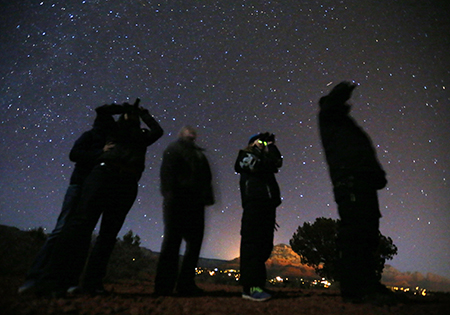
As we look up into the night sky and speculate on whether we are the only rational beings in the universe, whether there are any other creatures like us in this galaxy or anywhere else out there, we can be confident that we are not alone. We can take great comfort in God’s promises that He loves us, that He is always near, and that He will never abandon us. He who knows the number of hairs on our heads, He who knows when a single sparrow falls to the ground, is surely watching over us. May we always watch over and care for each other, especially for the lonely and the cast-offs and all those who have no one to call on.
(Melvin Arrington is a Professor Emeritus of Modern Languages for the University of Mississippi and a member of St. John Oxford.)