
By Carol Glatz
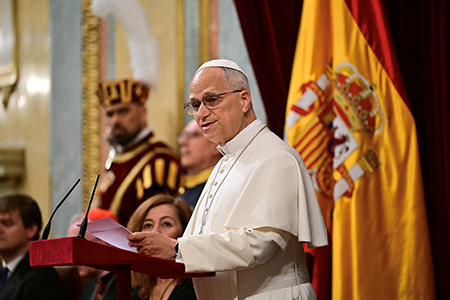
MADRID (CNS) – In a highly anticipated and historic speech to Spain’s parliament, Pope Leo XIV urged modern-day leaders to be guided by ancient and Catholic principles that gave birth to universal human rights based on the inalienable dignity of the human person.
While Church and state legitimately remain separate, many virtues and aims of good governance and just laws are rooted in values profoundly marked and inspired by the Christian tradition, he told hundreds of lawmakers and leaders of judiciary branches June 6 in Spain’s Congress of Deputies.
When lawmakers ask themselves “how to ensure that what is possible is just, that what is legal is truly humane, and that the will of the majority safeguards those goods that belong to all and respects that which no majority can legitimately violate,” he said, the answer needs to “stand before the dignity of the person and pass that test without shame.”
Even though “society and the Church herself did not always live up to these insights found in their own Christian tradition,” he said, Spain’s Christian thinkers introduced the idea of “the irreducible value of every human being and the moral limits of power,” which led to the core principles of international human rights.
Even today, the pope said, the whole world “continues to ask itself how to build peace on the recognition of the person and not on the imposition of force.”
Recalling Pope Francis’ criticism of a lingering “throwaway culture,” which fails to recognize the inherent dignity of every human being, Pope Leo challenged the lawmakers to consider their serious “responsibility of legally ordering social coexistence.”
“If life ceases to be recognized as a fundamental value, what future can our societies have? Can a community that casts into the shadows the unborn child, the elderly, the sick, those who suffer in silence, or those who depend entirely on the care of others be called fully just?”
When “the most vulnerable are the first victims,” he said, “the law loses its deepest meaning: to serve and protect every person.”
“For this reason, the moral greatness of a nation is manifested, above all, in its capacity to accompany, protect and love those lives that are most fragile.”
“I invite you, then, to lift your gaze to the world around you, not to turn away from reality, but to remember that every decision by public authorities affects real people, especially those who have less power to make their voices heard,” Pope Leo said.