
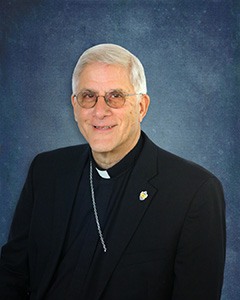
By Bishop Joseph R. Kopacz, D.D.
For 50 days the Church throughout the world celebrates the Easter season culminating in the great Solemnity of Pentecost. From the empty tomb on Easter Sunday morning to the community of disciples – including the Apostles and the Blessed Mother – gathered in expectant faith for the coming of the Holy Spirit, the Church each year returns to her roots to rediscover our founding story.
The kerygma is the theological understanding that arises from an encounter with Jesus Christ, the crucified and risen one. “Repent and believe in the one risen from the dead and be baptized and your sins will be forgiven, and you will receive the gift of the Holy Spirit. (Acts 2:38)
In the time between the resurrection and ascension into heaven – ten days before Pentecost in our finite framework of time – the Lord appeared to his apostles and disciples on numerous occasions in order to reconcile their doubts, fears, denials, trauma, and confusion, and to prepare them to be the first family of witnesses of God’s love in the world.
Pope Benedict in his concise and eloquent manner often spoke about the impact of encountering the crucified and risen Lord on our daily journey. “Being Christian is not the result of an ethical choice or a lofty idea, but the encounter with an event, a person, which gives life a new horizon and a decisive direction.”
We see this clearly in the lives of the Lord’s first followers who were scattered after the crucifixion, but by Pentecost Sunday these same lost sheep were fearless in the face of considerable opposition to proclaim the Gospel to the nations, beginning in Jerusalem. Through the encounter they were at peace, alive for God in Christ Jesus (Romans 6:11) with a decisive direction toward a new horizon.
Our dawning Christian story reveals that the encounter with the risen Lord is always both inwardly and outwardly directed. During three resurrection appearances, the Lord rallied and gathered his disciples with the gift of his peace, Shalom. This was the inward healing that had to flourish before it was possible to bring the horizon of God’s salvation into clear focus. The gift freely received was to be given as a gift.
This is the Lord’s mandate in all four Gospels, not only for the first family of disciples but for all time:
- “Go into all the world and proclaim the gospel to the whole creation.” (Mark 16:15)
- “As the Father has sent me, so I send you.” (John 20:21)
- “Repentance for the forgiveness of sins is to be preached to all the nations beginning in Jerusalem.” (Luke 24:46-49)
- “Go, therefore, and make disciples of all nations.” (Matthew 28:18-20)
Ongoing conversion and evangelization are the constant markers of our life in God. Yet, there are many outside the walls and halls of the Church, and our commitment to the Kingdom of God in the world – a kingdom of justice and peace and the joy of the Holy Spirit (Romans 14:17) – is an essential marker of the Church.
The mission continues in our own time. Last Saturday on Divine Mercy Weekend, Pope Leo XIV from Rome conducted a worldwide prayer service for peace. Like the popes of the modern era before him he is a prophetic voice for justice, peace, sanity and fraternity in a world afflicted by violence, terrorism, war and greed. This is the voice of the risen Lord, the light of the Gospel, and the power of faith, hope and love.
The Lord is risen, alleluia! May the 50 days of Easter be for us a season of refreshment and a gift of the risen Lord to align our lives with a decisive direction and with an ever-new horizon in God.