British Catholics, Pope Francis pay tribute to Queen Elizabeth II

By Simon Caldwell
MANCHESTER, England (CNS) – Catholics in the U.K. paid tribute to Queen Elizabeth II following her death Sept. 8 and the end of a reign that lasted more than 70 years.

Pope Francis sent a telegram addressed “To His Majesty the King, Charles III,” her son who immediately ascended to the throne.

“I willingly join all who mourn her loss in praying for the late queen’s eternal rest  and in paying tribute to her life of unstinting service to the good of the nation and the Commonwealth, her example of devotion to duty, her steadfast witness of faith in Jesus Christ and her firm hope in his promises,” Pope Francis said.
The British sovereign died “peacefully” at Balmoral, the royal residence in Scotland, surrounded by members of her family. She was 96.

Cardinal Vincent Nichols of Westminster, president of the Bishops’ Conference of England and Wales, paid tribute using many of the queen’s own words.

“On 21 April 1947, on her 21st birthday, Princess Elizabeth said, ‘I declare before you all that my whole life, whether it be long or short, shall be devoted to your service,’” Cardinal Nichols said. “Now, 75 years later, we are heartbroken in our loss at her death and so full of admiration for the unfailing way in which she fulfilled that declaration.”
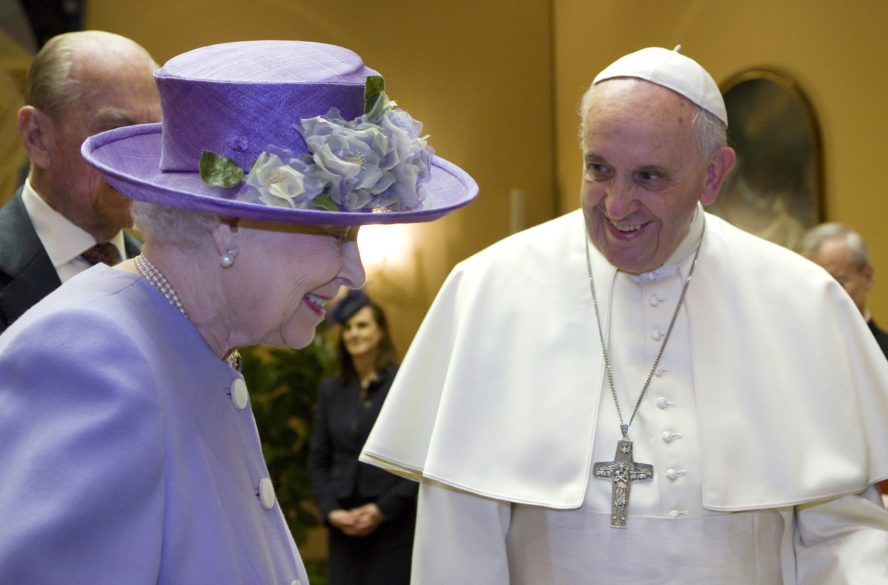
Britain’s Queen Elizabeth II talks with Pope Francis during a meeting at the Vatican in this April 3, 2014, file photo. Queen Elizabeth died Sept. 8, 2022, at the age of 96. (CNS photo/Maria Grazia Picciarella, pool)

“Even in my sorrow, shared with so many around the world, I am filled with an immense sense of gratitude for the gift to the world that has been the life of Queen Elizabeth II,” he said. “At this time, we pray for the repose of the soul of Her Majesty. We do so with confidence, because the Christian faith marked every day of her life and activity.”

The cardinal quoted Queen Elizabeth’s Christmas message from 2000, in which she said the teachings of Christ and her own “personal accountability before God” gave her a framework of how to live, and that Christ’s words and example offered her “great comfort in difficult times.”

Cardinal Nichols said: “This faith, so often and so eloquently proclaimed in her public messages, has been an inspiration to me, and I am sure to many. The wisdom, stability and service which she consistently embodied, often in circumstances of extreme difficulty, are a shining legacy and testament to her faith.”
He also offered prayers “for His Majesty the King, as he assumes his new office, even as he mourns his mother. God save the king.”

Bishop Hugh Gilbert, president of the Bishops’ Conference of Scotland, praised Queen Elizabeth for her life of “outstanding and dedicated public service.”

“Her determination to remain active to the end of her long life has been an example of Christian leadership, which demonstrated her great stoicism and commitment to duty and was undoubtedly a source of stability and continuity in times of great change,” he said. “Scotland’s Catholic bishops will remember her in our prayers and pray for all those who mourn her loss.”

Anglican Archbishop Justin Welby of Canterbury said: “As we grieve together, we know that, in losing our beloved queen, we have lost the person whose steadfast loyalty, service and humility has helped us make sense of who we are through decades of extraordinary change in our world, nation and society.”

Queen Elizabeth died 17 months after the death of her husband, Philip, who died in April 2021 at age 99. Her 73-year marriage to Philip was the longest of any British sovereign.

The U.K. has entered a 10-day period of mourning.

Elizabeth was born on April 26, 1926, to Prince Albert, Duke of York, and Lady Elizabeth Bowes-Lyon.
She acceded to the throne Feb. 6, 1952, and during her coronation in Westminster Abbey June 2, 1953, Queen Elizabeth was open about her Christian faith.

“When I spoke to you last, at Christmas, I asked you all, whatever your religion, to pray for me on the day of my coronation to pray that God would give me wisdom and strength to carry out the promises that I should then be making,” the queen said in her address. “Throughout this memorable day, I have been uplifted and sustained by the knowledge that your thoughts and prayers were with me.”

The accession of 1952 made 2022 the year when the world’s oldest monarch and the longest-serving monarch in British history celebrated the platinum jubilee of her reign – the point when Elizabeth had sat on the British throne for 70 years.

The queen was able to witness the celebrations in her honor but handed over all of her public duties to her nearest relatives. Her final act of office was to receive Prime Minister Liz Truss in Scotland Sept. 6, when she was also last photographed.

Fourteen prime ministers served during her reign, beginning with Sir Winston Churchill. Truss was the 15th to greet her in that office.

During her reign, Queen Elizabeth met with four popes — Francis, Benedict, John Paul II and John XXIII, and as princess she met Pope Pius XII.

The queen sometimes joked about her longevity, once quoting Groucho Marx, saying: “Anyone can get old. All you have to do is live long enough.”
Retired New Orleans Archbishop approaches 90
with no signs of slowing down

By Peter Finney Jr.
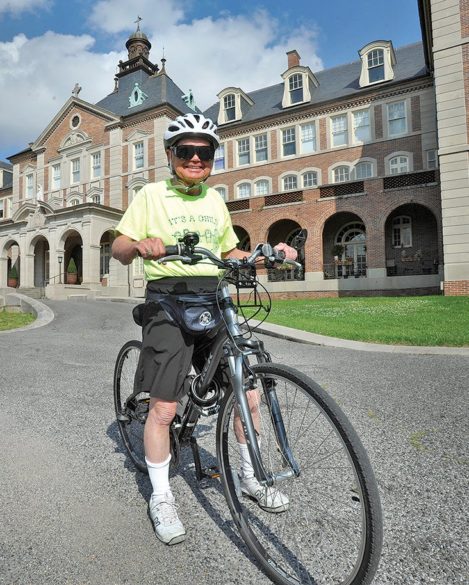
NEW ORLEANS (CNS) – Retired Archbishop Alfred C. Hughes of New Orleans will turn 90 in December, but the bike rack on his car at Notre Dame Seminary proclaims, in a fittingly understated way, that God isn’t finished with him yet.

He still cycles to Audubon Park in New Orleans every Sunday – “That’s the safest day to ride in the city!” – swims daily during the summer in the Notre Dame Seminary pool, provides ongoing spiritual direction for seminarians, priests and religious – “I’ve had to cap it at 30” – and spends every Friday afternoon sitting and praying with the residents of Project Lazarus, the archdiocesan shelter and ministry to homeless men and women with AIDS.

He just finished another book – “Priests in Love with God and Eager to Witness to the Gospel” – and lives out another chapter each day with his cheerful witness.

He’s known as the Katrina archbishop for shepherding the archdiocese during Hurricane Katrina 17 years ago.

Retired Archbishop Alfred C. Hughes of New Orleans is seen in this undated photo. He will turn 90 in December, but still keeps a rigorous schedule of bike riding and swimming in addition to his duties as a spiritual director to 30 seminarians, priests and religious. The retired archbishop also visits homeless men and women with AIDS every Friday at an archdiocesan shelter. (CNS photo/Peter Finney Jr., Clarion Herald)

Archbishop Hughes recalls being inside the adoration chapel at Our Lady of Mercy Parish in Baton Rouge. It finally had become apparent that the floodwalls of the 17th Street Canal had collapsed and Lake Pontchartrain was angry and winning.
“I was just overwhelmed and didn’t know where to begin or what to say or do,” Archbishop Hughes said. “I was putting this all on the Lord, and, of course, the Lord was remaining silent.”

And then, at the end of the hour he said it struck me that the Lord was not saying anything, “but he’s present, and he’s expressing through his presence – support.”
“So, what I say or what I do may be secondary to being God’s presence to the people. That brought inner peace to me,” he told the Clarion Herald, archdiocesan newspaper of New Orleans.

In his life as a priest, spiritual director, seminary rector and bishop, Archbishop Hughes has been masterful in helping others calm the troubled waters churning within themselves. The pitched-fork battles that characterize our social interactions these days – as a nation and as a church – cry out for healing.
Those neuralgic divisions over social policy and the obvious lack of fair play in public discourse are not going to be solved overnight. In his years of spiritual mentorship, Archbishop Hughes says healing must start with a personal commitment to examine our own lives.

“The No. 1 step that’s very helpful to take is to be faithful to some space and time each day of quiet to be present to God,” Archbishop Hughes said. “If we don’t step back from the swirl of messages and emotions going on around us, we’re not going to get sufficient distance to see reality more objectively and sort out truth from falsehood or half-truth. And, we’re not going to experience the peace in ourselves that the world needs so much to receive from us.

“If we’re going to be able to make some positive contribution, we first have to be faithful to a regular time of placing ourselves before God and asking him for the grace to see ourselves, to see other people, to see the world and all that’s going on, and even to see the demonic, as they are and, with his eyes, learn what it is he wants me personally to try to do that reverses, in some small way, and counters evil with good.”

(Finney is executive editor/general manager of the Clarion Herald, newspaper of the Archdiocese of New Orleans.)

Correct view of tradition nurtures beauty, grandeur of the liturgy

By Carol Glatz
VATICAN CITY (CNS) – The liturgy must be nurtured with care and never be neglected or abused, Pope Francis said.

“The liturgy is Christ’s work and the church’s, and as such, it is a living body,” he told members of Italy’s Association of Professors of Liturgy.

The liturgy “is not a monument made of marble or bronze, it’s not a museum piece. The liturgy is alive like a plant, and it must be nurtured with care” and never be “neglected or mistreated,” he said.

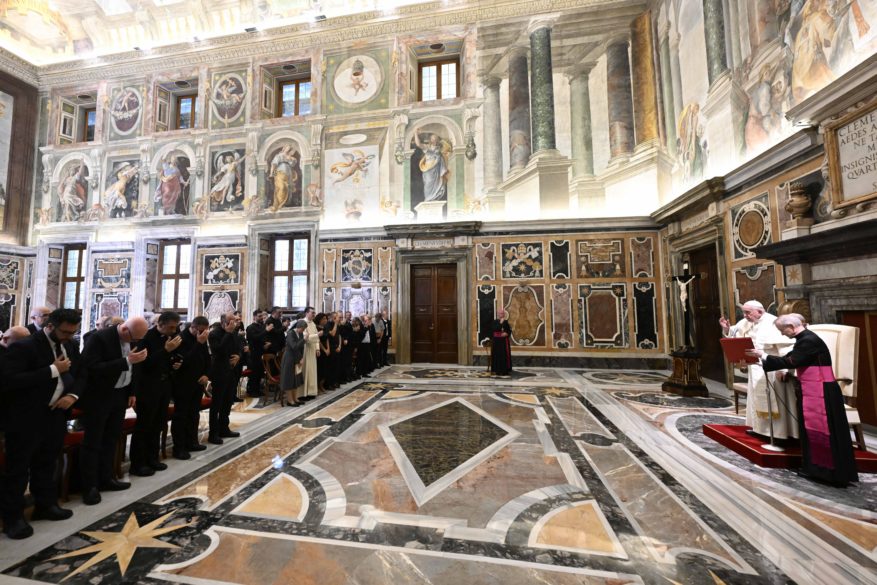
The pope made his remarks during an audience at the Vatican Sept. 1 with members of the association, which was founded 50 years ago to promote the study and teaching of liturgy at seminaries, departments of theology and other educational institutions.

Pope Francis underlined the importance of progress being rooted in a true sense of tradition.
“Progress in the understanding of, and even in the celebration of, the liturgy must also be rooted in tradition, which always advances in the way the Lord wants,” he said. Like with a tree, growth comes from the roots – from tradition, which is “the assurance of the future.”

However, the pope warned there are “many who say, ‘According to tradition …,’” when talking about the liturgy, and “at most they will be traditionalists.”

There is a “worldly spirit” of going backward that is “disguised as tradition” and is “fashionable today,” he said.

Pope Francis meets with members of Italy’s Association of Professors of Liturgy in the Clementine Hall at the Vatican Sept. 1, 2022. (CNS photo/Vatican Media)

This “backwardism,” he said, “is a temptation in the life of the church that leads you to worldly restorationism, disguised as liturgy and theology.”

According to the New Testament’s Letter to the Hebrews, “We are not among those who draw back,” he said. All Christians are called to “go forward, according to the line that tradition gives you. To go backward is to go against the truth and also against the Spirit.”

The association, which was founded after the Second Vatican Council to help promote the reception in Italy of the council’s teachings on the liturgy, continues to assist the church in this “season” of liturgical reform, the pope said.

This ongoing process “requires time and care, passionate and patient care; it requires spiritual intelligence and pastoral intelligence; it requires formation for a celebratory wisdom that cannot be improvised and must be continually refined,” he said.

Their work as experts, researchers and professors requires “synodal” dialogue with others in the fields of theology and the humanities, and with the people of God, who always need the formation and growth that helps their own understanding see “what comes from God and what really leads to him, even in the realm of the liturgy,” the pope said.

“We need more than ever today an exalted vision of the liturgy, so that it is not reduced to rambling about rubrical detail” or liturgical rules, he said.

The liturgy must not be “worldly” nor must it turn its back on the world with “worldly exclusivity,” he said.
The liturgy must make “people raise their eyes to heaven, to feel that the mystery of Christ dwells in the world and life” and, at the same time, it must be a liturgy for the good of humanity, with its “feet on the ground” and not removed from people’s lives, he said.

The liturgy should be “serious (and) close to the people,” he said. “The two things together: turning our gaze to the Lord without turning our backs on the world.”

The liturgy is not a worldly festivity, nor should it feel “gloomy” or funereal, he said. It is filled with the joy of the Holy Spirit, he said, and it celebrates “the beauty and grandeur of the mystery of God, who gives himself to us.”

Seeing what lies near our doorsteps

IN EXILE
By Father Ron Rolheiser, OMI

Henri Nouwen once suggested that if you want to understand the tragedy of the Second World War, you can read a hundred history books about it and watch a thousand hours of video documentaries on it, or you can read the Diary of Anne Frank. In that single memoir of young girl imprisoned and later executed by the Nazis you will see, first-hand, the tragedy of war and what war does to the human soul.

The same might be said about the refugee crisis now taking place everywhere on borders around the world. According to statistics from the United Nations, there are now over eighty million refugees, displaced, homeless, nationless, frightened, and often hungry people on our borders around the world. Two-thirds of these are women and children, and the vast majority are not there by choice, seeking a better economic opportunity in another country. The vast majority of them have been driven from their homes and their countries by war, violence, famine, hunger, ethnic and religious cleansing, and by fear for their lives.

Father Ron Rolheiser, OMI

For many of us, this is a faceless, abstract problem. We have a generic sympathy for their plight but not one deep enough to keep us awake at night, unsettle our conscience, or make us willing to sacrifice some of our own comfort and security to do something for them or to pressure our governments into action. Indeed, too often we are over-protective of our borders and the settled, comfortable lives we live inside our nations. This is our country! Our home! We worked hard for the things we have. It is unfair to us to have to deal with these people! They should go back to their countries and leave us alone!

We need a wake-up call. A recent book, a novel, by Jeanine Cummins, American Dirt, gives us a fictionalized account of a young Mexican woman who because of violence and fear of death had to leave her life behind and flee with her young son in an attempt to reach the borders of the United States as an undocumented immigrant. Full disclosure, the book has been heavily criticized by many because it doesn’t always measure up to the exact facts. Conversely, it has also been highly praised by many others. Be that as it may, the bottom-line is that this is a powerful story and a wake-up call, one meant to wake us up to the real tragedy of those who for reasons of poverty, violence, famine, fear and hopelessness are forced to flee their countries in search of a better life (or any life at all!) elsewhere. Whatever the book’s imperfections, it helps shatter the abstractness we can lean on to protect ourselves against having to look at the issue of refugees today.

Admittedly, the issue isn’t simple. There are extremely complex issues involved in protecting our borders and in having millions of people freely enter our countries. However, as men and women who share a common humanity and a common planet with these refugees, can we remain callous to their plight?

Moreover, as Christians, do we accept the fundamental, non-negotiable principle within Christian social doctrine that tells us that the world belongs to everyone equally and we may not adhere to any nationalistic belief that says, explicitly or implicitly, that our country is ours and we have no obligation to share it with others. To espouse this is unchristian and goes against the clear teaching of Jesus.

We might all, I submit, contemplate a certain parable of Jesus (Luke 16:19-31) where he tells the story of a rich man who ignored a poor man sitting at his doorstep and refused to share his food with him. The poor man dies and finds himself in the bosom of Abraham. The rich man also dies and finds himself tormented by thirst in Hades. He begs Abraham to send the poor man, whom he had ignored during this lifetime, to bring him some water to quench his thirst, but it turns out this is not possible. Jesus tells us that there is an “unbridgeable gap” between the two of them. We have always simplistically assumed that this unbridgeable gap is the gap between heaven and hell, but that is not exactly the point the parable is making. The unbridgeable gap is the gap that already exists now between the rich and poor, and the lesson is that we had best try to bridge that gap now, in this life.

Notice that Jesus does not say that the rich man is a bad man, or that he didn’t earn his riches honestly, or that he wasn’t an upright citizen, or that he wasn’t going to church, or that he was unfaithful to his wife, or that he was a bad father to his children. It only says that he had one fault, a mortal one – inside his richness he did not respond to a hungry man sitting on the borders of house.

(Oblate Father Ron Rolheiser is a theologian, teacher and award-winning author. He can be contacted through his website www.ronrolheiser.com.)

Called by Name

This month we will be welcoming parents of priests and seminarians and religious sisters to the Cathedral of Saint Peter the Apostle for our first ever meeting of POPS, which stands for (you guessed it), Parents of Priests and Seminarians/Sisters.

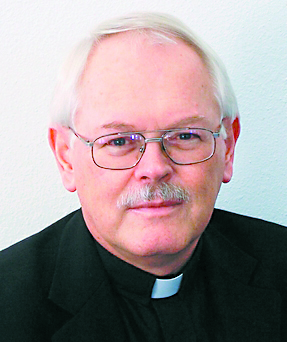
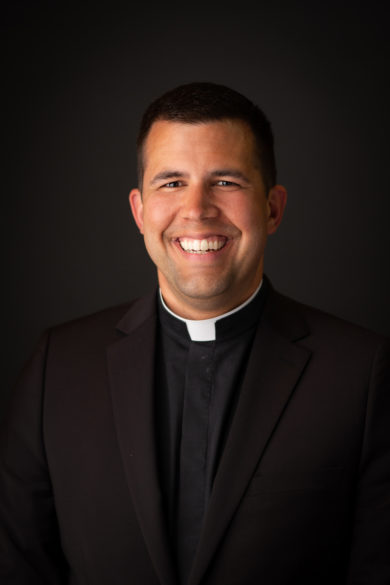
Father Nick Adam
Father Nick Adam

Rhonda Bowden was the driving force behind this initiative which we hope will help our parents build community as they support their sons and daughters who are on a unique path in life. Rhonda certainly has lots of experience after walking with her son Andrew for eight years in the seminary while also supporting her husband Mark in deacon formation and her daughter Laura as she graduated from Millsaps and is now a full-time teacher. I hope that this group provides some good community and fraternity for our parents.

I know that it is both a joy and a challenge to support a child who is discerning priesthood and religious life, and as we try to normalize that experience for our young people we want to make sure that parents are not excluded. As we get more seminarians, we want to build up our network of support for parents as well. I hope that this dinner is the first of many opportunities for parents to network. One of the greatest sources of vocations is family support and consistent encouragement of children to consider priesthood and religious life, and we want our parents to know how much we appreciate their encouragement and support.

       Please promote the possibility of priestly and religious life consistently to your children. This truly is the only way we will have a thriving church in the future. When we normalize vocations in the home, we provide our children with an opportunity to imagine the possibility of being a priest or nun just like they imagine the possibility of being a doctor or lawyer. This is so vital, and I ask for each parent to be intentional and courageous in presenting this possibility to your children. I know that it’s a little scary, but the church is here to support our young men and women, and I encourage you to speak with parents of seminarians/priests/sisters that you know and ask them how their children are doing. They certainly have challenges in their state in life, but they also have great joy and experience great triumphs, and most importantly, all of them believe that the Lord has called them to this task.

       It is probably more difficult in our current culture than ever before to encourage a child to enter ministry. We have been discouraged in many ways, both within the culture and within the church, but still, there are great men and women who are stepping forward and families that are supporting them. Please follow their example. The devil would love for us to believe that our situation cannot be helped, and that vocations have simply “dried up” here in the states, but this is not true. We can always trust that God will provide, but we must be co-workers with the Lord. I am grateful for the parents of our priests, seminarians and sisters, and I ask that you offer prayers specifically for these families after reading this article.  

Father Nick Adam

If you are interested in learning more about religious orders or vocations to the priesthood and religious life, email nick.adam@jacksondiocese.org.

Bishop schedule

Tuesday, Sept. 20, 12 p.m. – Catholic Charities Journey of Hope Luncheon with David Magee, Jackson Convention Complex

Friday, Sept. 30, 6:30 p.m. – St. Joseph School Homecoming Football Game v. Leake Academy, St. Joe, Madison

Thursday, Oct. 6, 1 p.m – St. Richard Special Kids Golf Tournament, Deerfield Golf Club, Canton

Thursday, Oct. 12-13, – Encuentro Regional, St. Augustine, Flordia

Sunday, Oct. 16 – Confirmation, Christ the King, Southaven

Thursday, Oct. 20, 6 p.m. – Catholic Charities Purple Dress Run, The District at Eastover, Jackson

Tuesday, Oct. 25, 6 p.m. – Catholic Foundation Membership Dinner, Country Club of Jackson

All events are subject to change. Check with parishes and schools for further details.

Waters of faith

Editor’s note: Below is the homily Bishop Kopacz delivered at the Red Mass celebrated on Sept. 11, 2022, at St. John, Oxford.

By Bishop Joseph R. Kopacz, D.D.

After the Israelites escaped from the Egyptians through the Red Sea, they quickly realized that they had to have water to survive in the desert. These critical moments are recounted in Exodus, chapters 15 and 17.
First, they came to Marah but could not drink the water because it was bitter, or was it turgid? And so, the Israelites said to Moses, “Got Water?” God directed Moses to throw a tree into the water and it became sweet. Maybe in Jackson we haven’t tried all of our options. Maybe a few good Magnolia trees properly placed in the water treatment facility are the answer. But I digress.

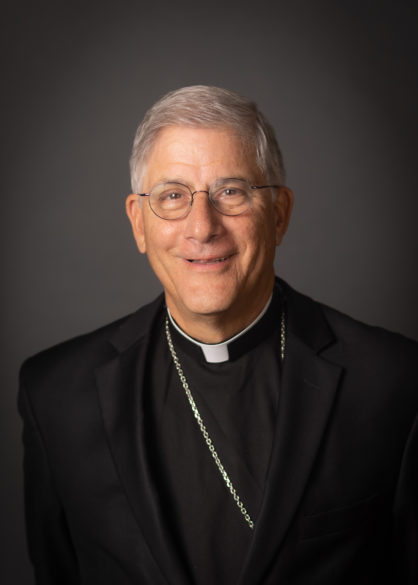
Bishop Joseph R. Kopacz, D.D.

A few chapters later the Israelites received the gift of the ten commandments – the first of these as the cornerstone. “I am the Lord your God; you shall not have strange gods before me.” Or I will punish the iniquity of the Fathers to the third and fourth generation upon those who hate me but show mercy to the thousandth generation to those who love me and keep my commandments. This is the foundation of the Covenant that God formed with the Israelites through Moses as described in the 20th chapter of Exodus.

For the next 12 chapters, Moses the great lawgiver was given numerous laws that concerned the sabbath and slaves, violence and harm, restitution, social and religious laws. This was a long process, and the people lost patience after Moses was gone too long, and they demanded of his brother, Aaron, that they go down a different road, violating the first commandment.

The Golden Calf was a major setback. Aaron’s inability to remain resolute against the hardheartedness of the Israelites was a costly act of infidelity. But in that critical conversation that we heard in the first reading, Moses interceded on behalf of the Israelites and called upon God to remember his just mercy to the 1000th generation, the source and summit of all the commandments and laws. Moses went on to rebuke his brother Aaron and called him and the Israelites to repentance, and to stand with God. Those who did went on to live and go forward as the chosen people.

The mercy of God at work with the Israelites for numerous generations came to fulfillment in Jesus Christ on the Cross. The words of Jesus in today’s Gospel which stretch our spiritual imagination and our human instincts, can only be grasped from his words and actions from the Cross.

St. Luke, the dear and glorious physician in his former life, knew that the only remedy for humanity’s sick soul and incurable wounds, was God’s merciful love. “Father, forgive them for they know not what they do,” and to the repentant thief, “from this day forward you will be with me in paradise.”

The Cross is universal, offering equal access to God’s just mercy through faith. The Mass is our celebration of the New Covenant in God’s mercy as we recall and proclaim the Lord’s own words; “do this in memory of me.” The sacrament of reconciliation is the extraordinary way that we encounter God’s merciful love in the manner of the prodigal son.

Faithful to the tradition of law developed by the Israelites in the Covenant at Mount Sinai the church understands its extensive Canon Law developed for nearly 2000 years to be in the service of justice arising from God’s abundant mercy in the blood of the New Covenant on the Cross.

As we gather this morning, mindful of and grateful for so many professionals whose lives revolve around the law of the land, know that our church has the utmost respect for all just laws and is committed to be a voice for justice, mercy and peace in our country. We take seriously the First Amendment, our nation’s foundation, in the fullest sense. “Congress shall make no law respecting an establishment of religion, or prohibiting the free exercise thereof.”

What we do in this church, and in all of our houses of worship, is the soul for all of our ministries in education and advocacy, in health care and social services.

Our prayer is the springboard for our commitment to realize our nation’s ideals of greater liberty and justice for all, based on the dignity of the human person, made in the image and likeness of God with an eternal destiny. The church must be aware of being too political, but we will always be a voice in the public square where we remain steadfast over the free exercise of the fullness of religion. In this very moment the church is advocating on behalf of just laws on behalf of the common good. Examples follow.
In collaboration with others, we have written an extensive letter to the Department of Health and Human Services on pending legislation regarding Access to Health Care:

“Ensuring access to health coverage and health care, and removing barriers to these, is without question a laudable goal. “Concern for the health of its citizens requires that society help in the attainment of living conditions that allow them to grow and reach maturity … [which includes] health care. …” Catechism of the Catholic Church, no. 2288.

The U.S. Catholic bishops have advocated longstanding moral principles in discerning health care policy: respect for life and dignity, access to all, honoring conscience rights, true affordability, and comprehensive and high quality…

Unfortunately, the proposed regulations go beyond access to care by suggesting that health care providers must provide, and that health plans must cover, procedures that are not medically indicated, may harm rather than heal, and may violate religious and moral convictions. Especially problematic is the suggestion in the preamble that Health and Human Services might be open to imposing requirements with respect to abortion.

Bishops’ Labor Day Statement: “This Labor Day, let us reflect on how we can build a more just economy by promoting the welfare of working families through both charitable works and through advocacy for improved policies such as expanding the Child Tax Credit and passing the Pregnant Workers Fairness Act. Advancing these two policies would have a profound impact on family stability, especially for families who are financially vulnerable. … This is also the first Labor Day since the Supreme Court’s reversal of Roe v. Wade. The ruling is an incredibly significant step towards healing the deep wounds of abortion and protecting all preborn human life. But our aim as Catholics has always been, and remains, to build a society in which abortion is unthinkable. This unique moment necessitates a society and an economy that supports marriages, families, and women; it demands that all of us reach across political aisles and work diligently to reframe social policies in ways that are pro-woman, pro-family, pro-worker and, thus, authentically pro-life.”

Yes, we do have water, the waters of faith and baptism that flowed from the side of the Lord on the Cross. These waters open the fountains of God’s just mercies that renew us to fight the good fight of faith, to finish the race, to keep the faith in this generation and always.

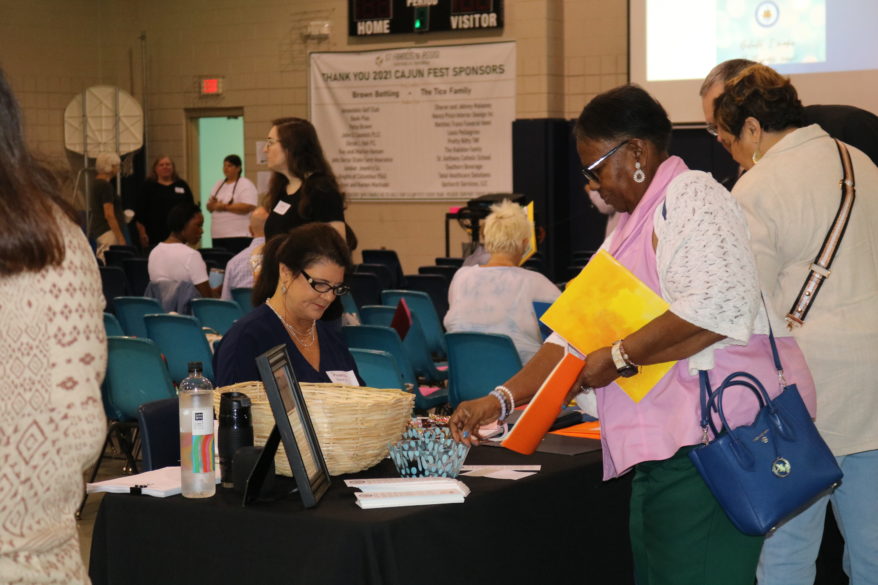
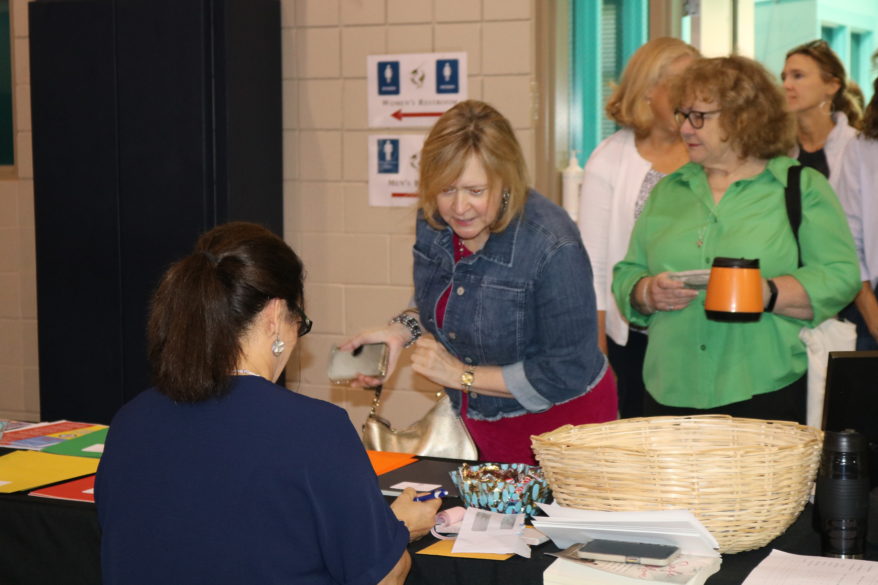
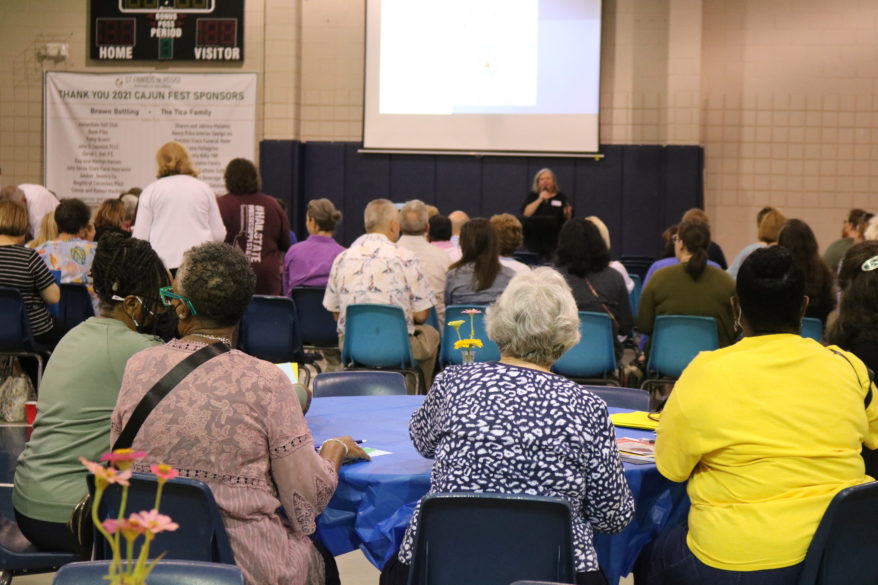
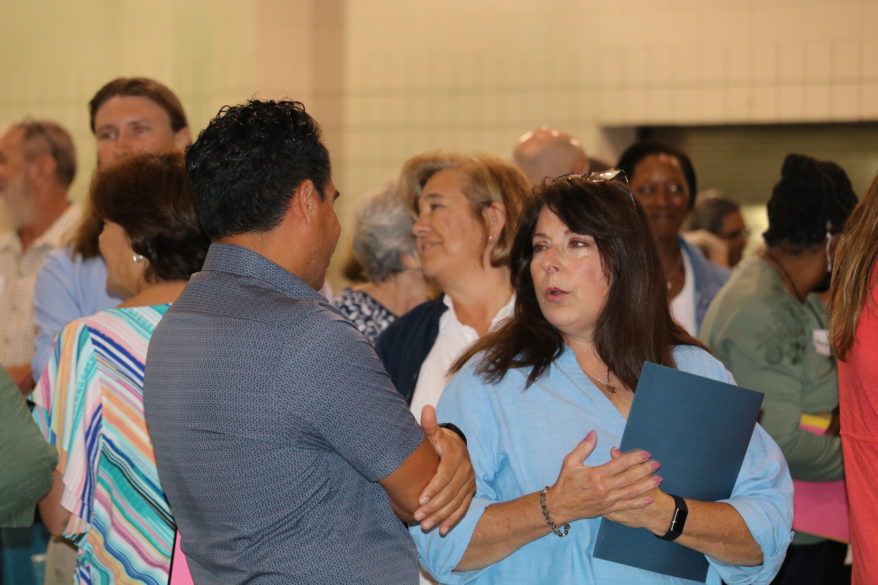
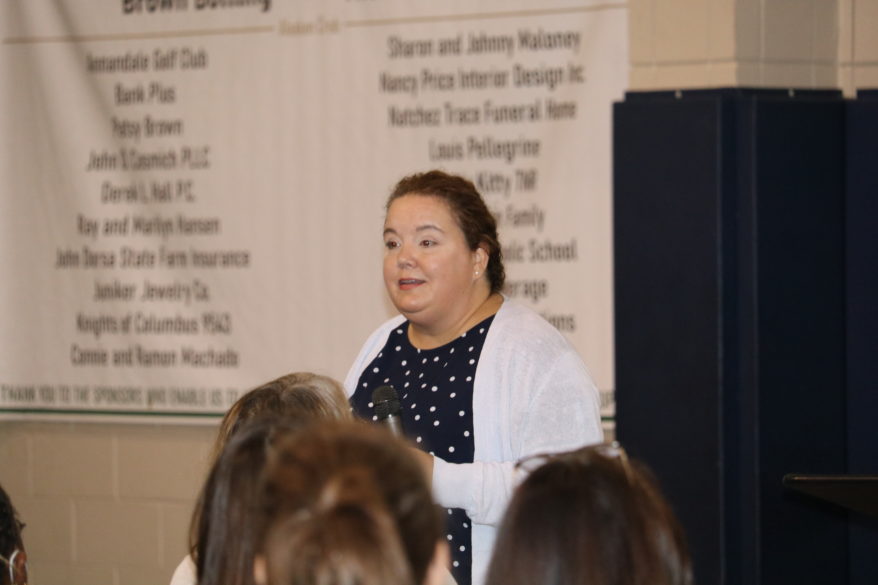
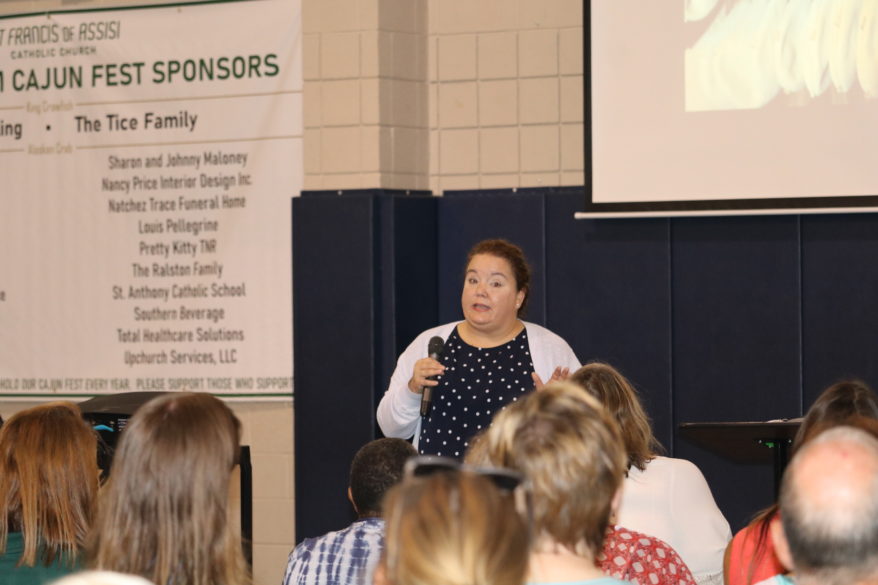
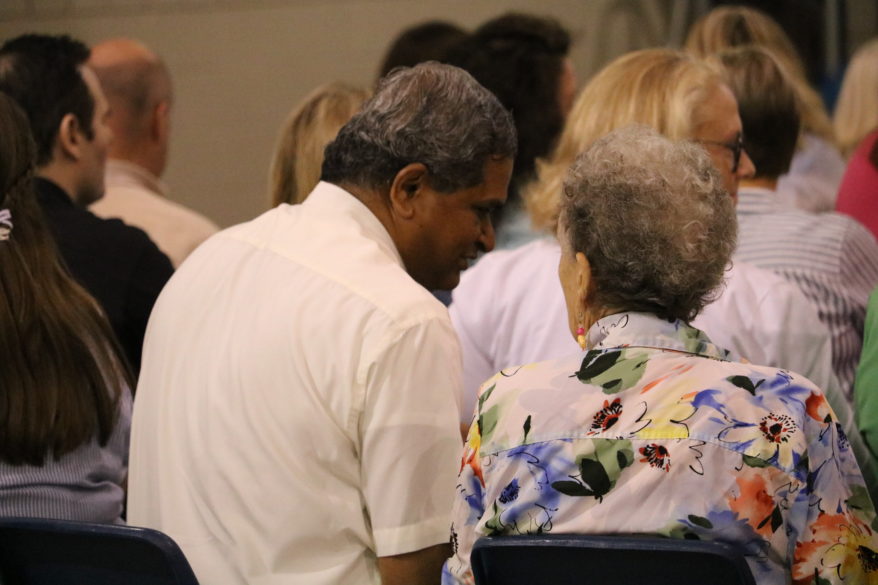
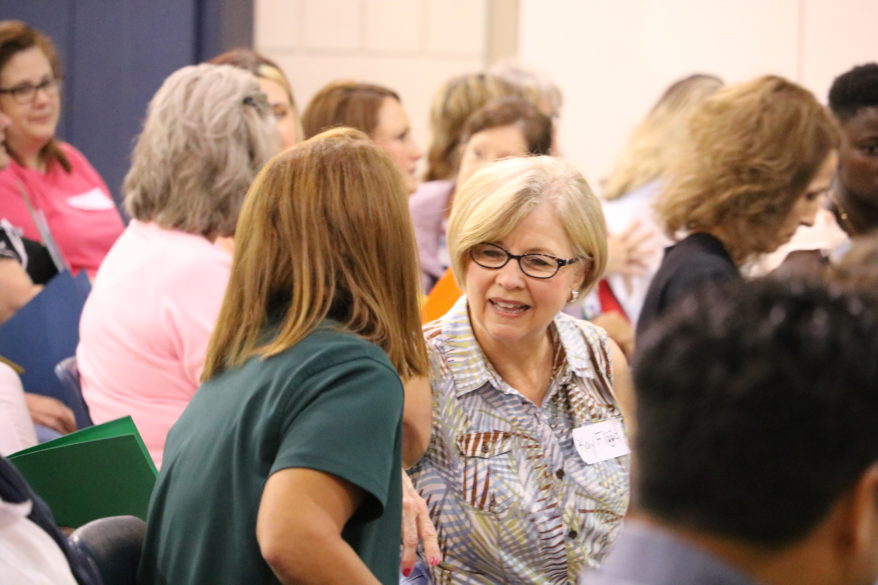
Featured photo… Fall Faith Formation Day …

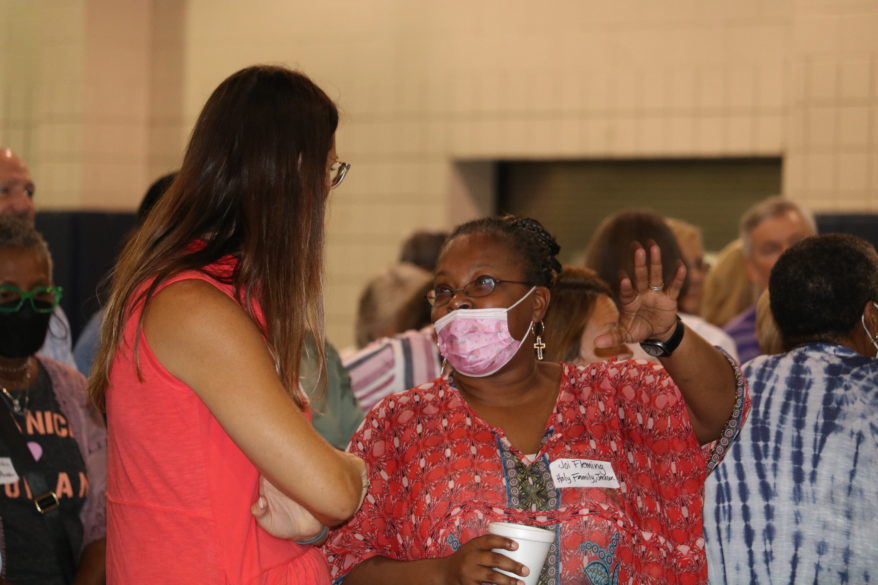
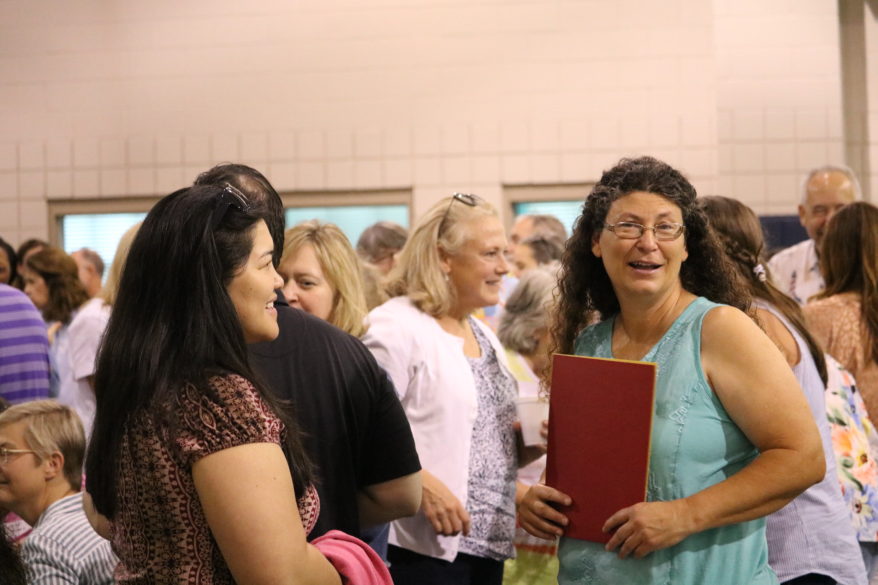
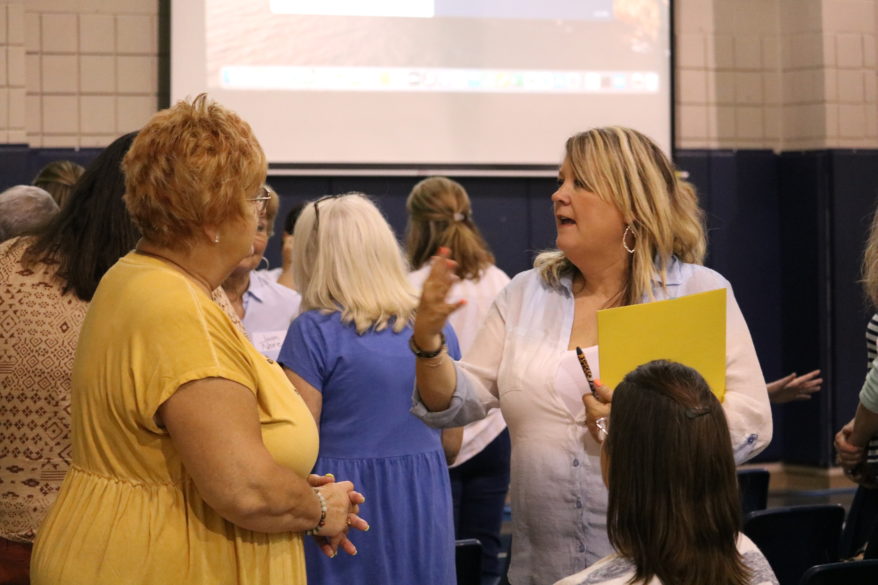
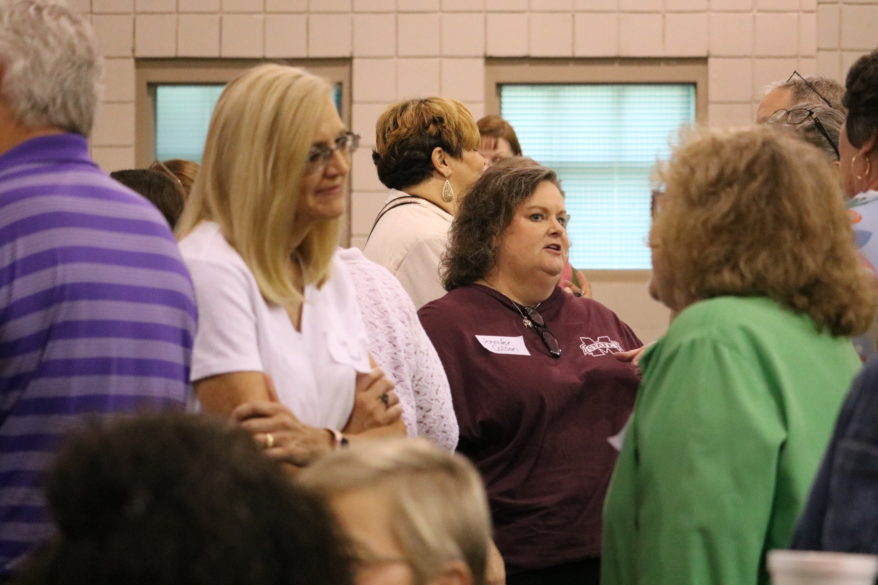
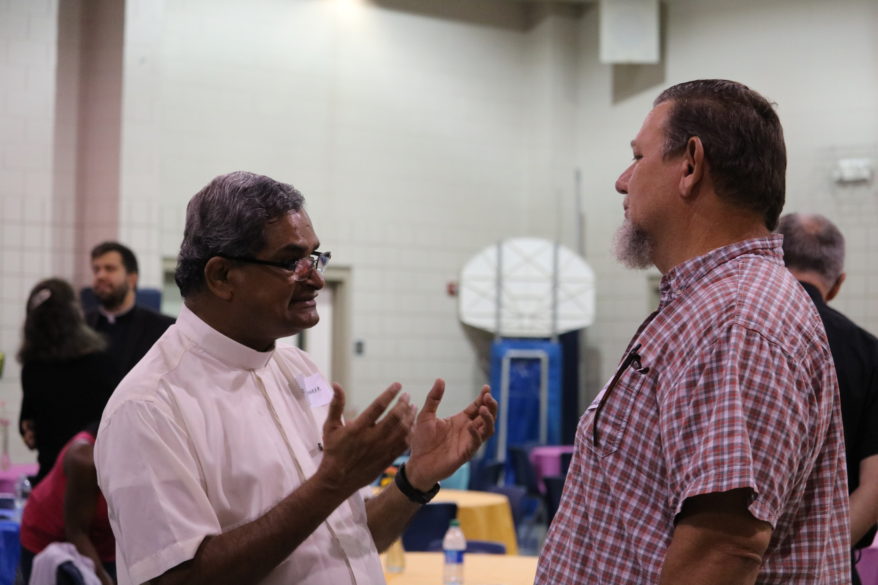
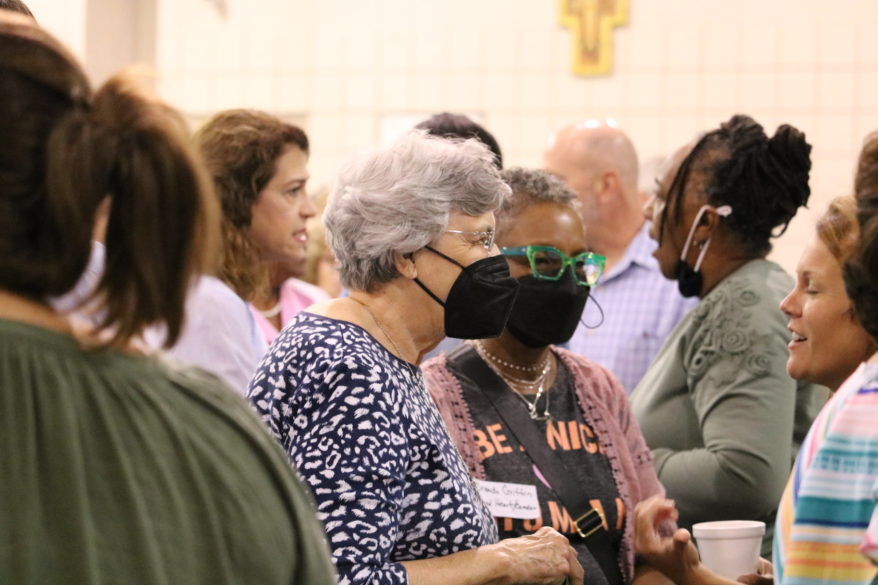
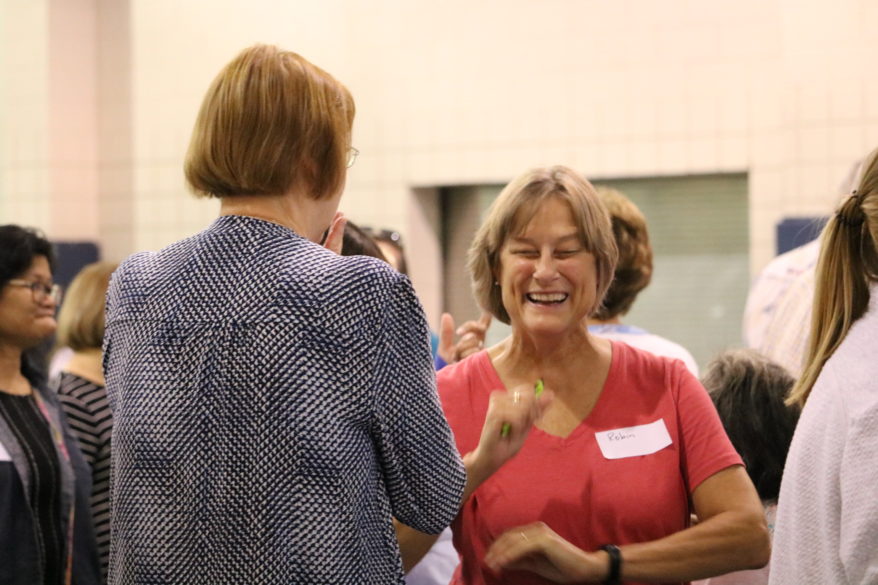
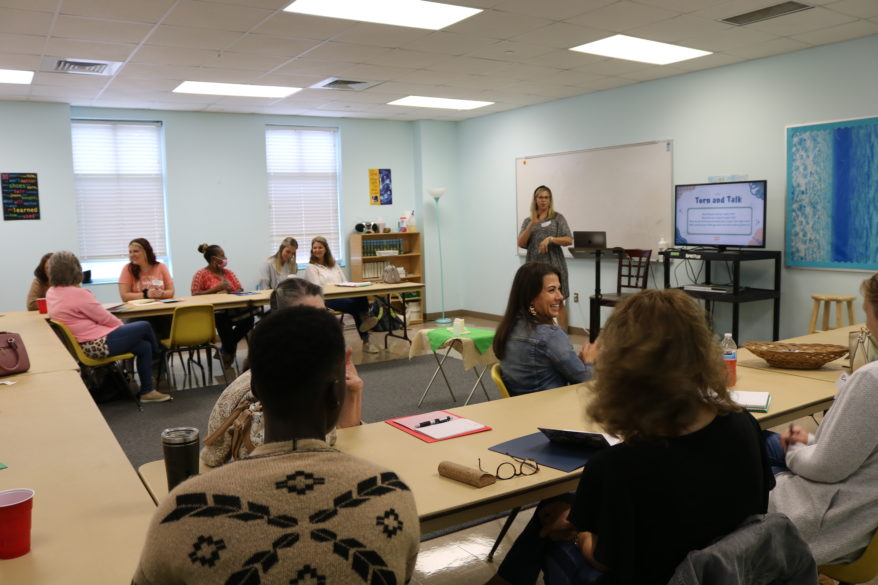
MADISON – Mary Frances Strange of St. James Tupelo and Joi Fleming of Holy Family Jackson socialize during a break during Fall Faith Formation Day on Saturday, Aug. 20 at St. Francis parish. Faith formation leaders from around the diocese gathered for the event with the theme “Behold I make all things new,” with keynote speaker Stephanie Cloutre Davis, an Ignatian trained spiritual director and breakout sessions covering a variety of topics. (Photos by Joanna King)

Calendar of events

SPIRITUAL ENRICHMENT
PEARL St. Jude, Retreat for Healing and Hope, Friday Oct. 14, 6:30-9 p.m. and Saturday, Oct. 15 from 8:30 a.m. to 5 p.m. in the parish hall. Featured speakers: Father Bill Henry, Janet Constantine, LMHC and spiritual director, sponsored by Marian Servants of Jesus the Lamb of God. Registration free, lunch provided. Topics: Our Brokenness; Blocks to Healing; and Receiving God’s Love. All are welcome. Details: Contact Maureen at (601) 278-0423 or Pat at (601) 955-0755 or email msofjlog@gmail.com.

PARISH, FAMILY AND SCHOOL EVENTS
CLARKSDALE St. Elizabeth Fair, Tuesday, Sept. 27. Spaghetti dinner, gift shop, raffle and more. Details: church office (662) 624-4301 or school office (662) 624-4239.

GLUCKSTADT St. Joseph, Germanfest 2022, Sunday, Sept. 25 11 a.m. to 5 p.m. The family-oriented festival is best known for its authentic German food and music. Admission and parking are free. Festival goers may wish to bring a lawn chair. Details: church office (601) 856-2054.

HERNANDO, OLIVE BRANCH and SOUTHAVEN Holy Spirit, Queen of Peace and Christ the King, Drive-thru Blessing of the Animals, Saturday, Oct. 1 from 9-11 a.m. All pets welcome! Details: call parish offices.

JACKSON St. Richard, ChristLife: Discovering Christ, a seven-week series begins Sept. 28 and ends Nov. 9. Held on Wednesday evenings from 6:30-8:30 p.m. in Foley Hall. Come enjoy dinner and explore answers to important life questions. Registration required, child care for ages 3+ is provided. Details: register at StRChristlife@gmail.com or visit https://saintrichard.com/christlife.

MERIDIAN St. Joseph Octoberfest, Saturday, Oct. 1 from 11 a.m. to 2 p.m. Enjoy this day of fellowship with food, youth activities and more. Details: Rhonda (601) 227-1199.

NATCHEZ Cathedral Fall Festival, Saturday, Sept. 24 from 10 a.m. to 2 p.m. and Sunday, Sept. 25 from 11 a.m. to 2 p.m. Midway games, petting zoo, food and craft sales. Plus Adult Night Saturday at 6 p.m. with band and purchase paddles for fantastic packages. Sunday fried chicken lunch at 11 a.m followed by bingo. Details: Contact Carlyle at (337) 962-5323 or visit Facebook @CathedralFallFest.

NATCHEZ St. Mary Basilica, Evening with Father Josh Johnson, Tuesday, Oct. 4 at 6 p.m. Father is well-known for his popular Ascension podcast “Ask Father Josh.” He has written several books including the best-selling “Pocket Guide to Reconciliation” (co-written with Father Mike Schmitz), “Broken & Blessed” and “On Earth as it is in Heaven.” The event is free, contributions to Father Josh’s school in his Baton Rouge parish are welcome. Details: church office (601) 445-5616.

OLIVE BRANCH Men’s Club Golf Tournament, Sunday, Sept. 25 at Wedgewood Golf Club. Sign-up at qopcc.com. Details: to donate door prizes, play or sponsor a hole, contact Tim at (901) 515-8598.
RIPLEY St. Matthew, Parish Feast Day Celebration, Saturday, Sept. 24 beginning at 9 a.m. Enjoy fun with sports tournaments, food booths and more. On Sunday, Sept. 25, Bilingual Mass of Thanksgiving at 3 p.m., followed by a potluck meal. Details: church office (662) 993-8832.

SOUTHAVEN Christ the King, Save the date: Fall Festival, Saturday, Oct. 8. Enjoy international food, basket raffle, entertainment and more. Details: church office (662) 342-1073.

YOUTH EVENTS
DIOCESE Middle School Fall Retreat with NET Ministries, Oct. 15-16 at Lake Forest Ranch, Macon. Retreat is for seventh and eighth graders with opportunity for prayer, faith sharing, fellowship and more. Details: contact Abbey Schuhmann at (601) 949-6934 or abbey.schuhmann@jacksondiocese.org.

HERNANDO Holy Spirit, We Are One Northwest Parishes of Mississippi, Sunday Sept. 25. Day begins with a youth led Mass at 3 p.m., followed by “Community Feud” for high school youth, activities for Pre-K through eighth graders. Dinner, snack and drinks will be provided. Also, door prizes, music, inflatables, games and more. All are welcome! Details: church office (662) 429-7851.

YAZOO CITY St. Mary, Lunch with seminarian EJ Martin, Sunday, Sept. 25. He will talk to youth about the Mass and his decision to become a priest. Lunch will be in parish hall following Mass. Details: church office (662) 746-1680.

SAVE THE DATE
BROOKHAVEN St. Francis, Save the dates: St. Francis Parish Picnic on Oct. 9; Knights of Columbus Blood Drive on Oct. 23; and Fall Festival and Trunk or Treat on Oct. 26. Details: church office (601) 833-1799.

DIOCESE Save the date: #iGiveCatholic on Giving Tuesday Nov. 28. Join Catholics in this nation-wide day of giving.

JACKSON St. Richard School, Krewe de Cardinal set for Feb. 10. Call for tickets and sponsorship opportunities. Details: church office (601) 366-2335.

MERIDIAN St. Patrick, 23rd annual Variety Show/Dinner and Fashion Show, Saturday, Nov. 5 in the Family Life Center. Details: church office (601) 693-1321.

New documentary on Sister Thea Bowman highlights her faith, justice work

By Anna Capizzi Galvez

WASHINGTON (CNS) – A new documentary on Sister Thea Bowman shines a light on her life and work as an advocate for racial justice and intercultural understanding.

The idea for the documentary came to Franciscan Sister Judith Ann Zielinski, who wrote and produced the film, after the 2020 death of George Floyd while in police custody in Minneapolis.

“I thought, I have to do something, what can I do?” and “Thea Bowman popped into my head. She was a Franciscan sister, a woman who had been fighting systemic racism in her own time and in her own way.”
The documentary is a comprehensive look at Sister Thea, the first African American member of the Franciscan Sisters of Perpetual Adoration and one of six Black Catholics known as a “Servant of God.”
It also makes a case for her sainthood and for contemporary spirituality, Sister Zielinski said.

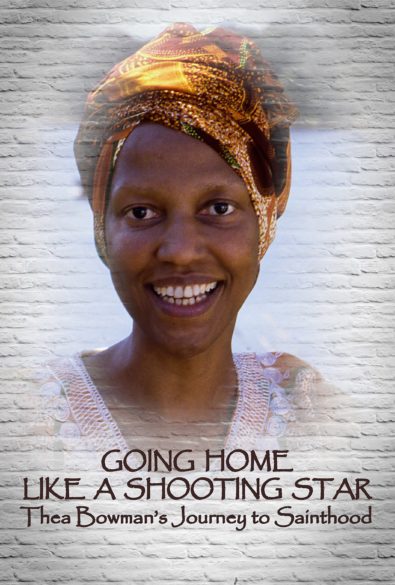
“Going Home Like a Shooting Star: Thea Bowman’s Journey to Sainthood,” comes from NewGroup Media and the Diocese of Jackson, Mississippi. Along with archival media of Sister Thea, the documentary features interviews with her colleagues, friends, fellow Franciscan Sisters of Perpetual Adoration, former students and African American scholars, priests and bishops.

The one-hour film, a part of the Interfaith Broadcasting Commission’s fall documentary season, will begin airing on ABC stations nationwide Oct. 2.

This is an official promotional poster for the documentary “Going Home Like a Shooting Star: Thea Bowman’s Journey to Sainthood.” The documentary will air on ABC stations nationwide beginning Oct. 2, 2022. (CNS photo/courtesy NewGroup Media)

Redemptorist Father Maurice Nutt, associate producer and biographer of Sister Thea, called her an “apostle for racial reconciliation in our church today.”
Noting that she died in 1990, Father Nutt said the film would make her known to a new generation. He also said her life resonates with much of what younger Catholics are looking for in the church – someone who speaks truth to power.

“Her call for justice, justice for the roles of women, justice for those who experience no matter what ethnicity, oppression or hatred” speaks to “us as a church being the body of Christ,” he said.

He also said her call for people to come together and share their gifts is a pivotal message to put a stop to “some of the racial hatred that we see in our society even today,” Father Nutt told Catholic News Service.
Bishop Joseph R. Kopacz of Jackson, Mississippi, petitioner for Sister’s Thea’s cause and executive producer of the documentary, said the film “speaks the need for the church to never give up that desire to be more united and more universal.”

He said Sister Thea had a “timeless message” that included a desire for greater harmony, unity, racial understanding and reconciliation and “being the body of Christ in a more faithful way.”

The bishop also remarked at the depth of her call, describing her as gifted, charismatic, prophetic and a “dynamo of energy.”

Sister Thea was born Bertha Bowman in 1937 in Yazoo City, Mississippi, to Dr. Theon Bowman, a physician and Mary Esther Bowman, a teacher. Her family moved to Canton where she encountered the Franciscan Sisters of Perpetual Adoration at Holy Child Jesus School.

At age 9, Bertha became Catholic and at age 15, she left home for La Crosse, Wisconsin, to attend the Franciscan Sisters of Perpetual Adoration’s high school, later joining the community and taking the name Sister Mary Thea.

Sister Thea went on to receive her doctorate from The Catholic University of America and returned to La Crosse to teach English and linguistics at Viterbo University.

Her parents’ deteriorating health called her back to Canton, where she led the Diocese of Jackson’s first Office for Intercultural Affairs. Her gifts for preaching, singing and teaching led her to countless speaking engagements across the United States.

In 1984, she was diagnosed with breast cancer. She died March 30, 1990, at age 52.

She was declared a “Servant of God” in May 2018 and the U.S. bishops voiced their consent to her canonization cause at their Nov. 2018 fall general meeting in Baltimore.

Sister Eileen McKenzie, president of the Franciscan Sisters of Perpetual Adoration, said Sister Thea’s canonization would “hold up the spirituality and the gift of the Black Catholic Church” and “give courage to our African American brothers and sisters who often don’t have platform.”

It would also be significant for her order. One of the primary values of Franciscans is continual conversion, Sister McKenzie explained, noting that Sister’s Thea’s canonization would call the community into deeper conversion.

“Her spirituality, her witness, her prophetic spirit resonates with us today. It’s hard to even speak of Thea in the past tense. It’s as if she’s with us today,” Father Nutt said.

“Going Home Like a Shooting Star” was funded in part by the Catholic Communication Campaign. Streaming opportunities will be announced by the Diocese of Jackson. To watch a preview of the film, visit: https://youtu.be/tkzhnKG7mxc