Vatican declares SSPX in schism. What does it mean?

By Paulina Guzik
VATICAN CITY (OSV News) – The Vatican has declared the Society of St. Pius X to be “in schism” after the traditionalist group consecrated four bishops without the papal mandate, marking the most serious rupture in the Church since Archbishop Marcel Lefebvre’s unauthorized episcopal consecrations in 1988.

In a bombshell move, the Vatican also declared sacraments of penance and marriage invalid if they proceeded within the society.
The decree also said, “Clerics and lay faithful are warned not to adhere to the schism of the Priestly Society of Saint Pius X, as they would ipso facto incur the penalty of latae sententiae excommunication.”

In a case of history repeating itself after the 1988 excommunication of the society’s founder along with four bishops he then consecrated without the papal mandate, the Vatican on July 2 excommunicated four SSPX bishops consecrated without the authorization of the pope at the society’s seminary in Écône, Switzerland, along with two bishops leading the liturgical celebration July 1.

“Despite the warnings addressed to the Superior General” of SSPX, Bishop Alfonso de Galarreta led the consecration liturgy on July 1, accompanied by Bishop Bernard Fellay, and thus “committed an act of a schismatic nature through the episcopal consecration of four priests, without pontifical mandate and against the will of the Supreme Pontiff,” the Dicastery of the Doctrine of Faith said in a July 2 decree, released in Italian.

The rebel bishops, the DDF said, “have ipso facto incurred a latae sententiae excommunication reserved to the Apostolic See,” with latae sententiae meaning “automatic,” or “by the deed itself” in Latin.

The four newly consecrated SSPX bishops – Fathers Pascal Schreiber, Michael Goldade, Michel Poinsinet de Sivry, and Marc Hanappier – were also excommunicated, the DDF said in a document signed by Cardinal Victor Manuel Fernández, prefect of the DDF, Archbishop John Kennedy, secretary of the disciplinary section, and Msgr. Armando Matteo, secretary of the doctrinal section of the dicastery.

The apostolic mandate is required to proceed with bishops’ consecrations, which the society did not have for the July 1 ceremony – a fact that they publicly acknowledged.

At the episcopal consecrations, Father Foucauld Le Roux, secretary general of the society, read the declaration in which the society “sets forth the reasons justifying these consecrations in the current circumstances of the Church,” claiming “The authorities of the Church have been animated by a spirit contrary to that of the Faith, and act against holy Tradition.”

Father Davide Pagliarani, superior general of the society, in his homily on July 1 called the consecration an “exceptional” measure “proportionate to this necessity” and in line with “a duty to keep the faith that the Church has always taught.”

Saying that “some might consider that we are facing a dilemma,” Father Pagliarani said SSPX did not choose “between faith and the Church.”

The explanatory memorandum that followed the decree from the DDF included measures affecting both ministers of the society and lay faithful, preceded by the note that from the time of St. Paul VI “until the most recent discussions held at this Dicastery, the multiple attempts to bring the adherents of the movement initiated by Archbishop Lefebvre back into full communion with the Catholic Church have proven futile.”

Noting that “this situation has been further aggravated by the recent episcopal consecrations celebrated without pontifical mandate, against the will of the Holy Father, in open violation of canon law,” the dicastery said that the “act constitutes the crime of schism, with canonical consequences for the sacred ministers and lay faithful involved.”

In a memorandum signed by the same group of prelates as the decree, the DDF said that “the sacred ministers belonging to the Priestly Fraternity of Saint Pius X are in schism and must therefore be considered schismatic,” citing the 1988 letter of St. John Paul II “Ecclesia Dei” and the 1996 Explanatory Note from the Pontifical Council (now Dicastery) for Legislative Texts on the excommunication for schism incurred by the adherents of the movement of Archbishop Lefebvre (1905-1991).

According to Canon 751, “schism is the refusal of submission to the Supreme Pontiff or of communion with the members of the Church subject to him.”

According to point five of the 1996 Explanatory Note, the “latae sententiae excommunication for schism concerns those of the lay faithful who ‘formally adhere’ to the said schismatic movement,” noting that the “formal adherence to the schism” must “imply two complementary elements.” One is of “internal nature,” consisting in “freely and consciously sharing the substance of the schism,” that following SSPX’s founder’s path “is placed above obedience to the Pope” and the second of “external nature,” the most evident sign of which will be “the exclusive participation in the Lefebvrian ‘ecclesial’ acts, without taking part in the acts of the Catholic Church.”

According to canon lawyer Father Jan Dohnalik, chancellor of the Archdiocese of Kraków, Poland, the line “exclusive participation” means that “occasional participation of the lay people does not mean automatically participating in the schism –but consciously and permanently choosing to participate in SSPX liturgies does. For instance if a family or friend of the bishop consecrated without the papal mandate just came to that July 1 Mass to participate, they are not automatically in schism with the Catholic Church, but if they deliberately choose to participate in SSPX liturgies in the future, ignoring the papal power of the Roman Pontiff – that’s participating in a schism.”

The long list of documents regarding SSPX spanning almost four decades prove the long process of the Vatican to try to reach an agreement with the traditionalist group.

For decades – since 1988 when St. John Paul excommunicated the society’s founder, Archbishop Lefebvre and four bishops consecrated without papal mandate in his “Ecclesia Dei” apostolic letter – the Vatican had sought several ways to reintegrate SSPX members into the life of the Catholic Church.

Pope Benedict lifted the excommunications of the four bishops in 2009, opening the way for more regular talks.

During the 2015-2016 Year of Mercy, Pope Francis made special provisions to validate the absolution offered by SSPX priests through the sacrament of confession. After the Holy Year ended, he extended that provision “lest anyone ever be deprived of the sacramental sign of reconciliation through the church’s pardon.”

In April 2017, the late pontiff continued pursuing initiatives aimed at a reconciliation with the SSPX by allowing their bishops to ensure the validity of marriages celebrated in the traditionalist communities.

Bishop Galarreta is an embodiment of the Vatican’s longtime mercy toward SSPX. He was consecrated as a bishop by Archbishop Lefebvre in 1988 and was excommunicated by St. John Paul, but in 2009, Pope Benedict declared the remission of the excommunication. And now in 2026, he has been excommunicated for the second time after leading the liturgical celebration of the bishops’ consecrations on July 1.

After the July 1 ceremony, the Vatican took measures to extend its decree to the whole society, including the laity, and said that lay faithful “who formally adhere to the Priestly Fraternity of Saint Pius X … are to be considered schismatic and excommunicated.”

The Holy See warned that “the sacred ministers of the Priestly Fraternity of Saint Pius X are administering the sacraments illicitly,” declaring invalid the sacrament of penance and marriage administered by SSPX priests.

The celebration of the Mass and the confection of the Eucharist, because they are done by an ordained priest, are still valid, though illicit. The sacraments of penance and marriage need an authorization, or faculty, which the society lacks.

According to Canon 966, “The valid absolution of sins requires that the minister have, in addition to the power of orders, the faculty of exercising it for the faithful to whom he imparts absolution” – a priest can be given this faculty “either by the law itself or by a grant made by the competent authority.”

According to Canon 1111, “As long as they hold office validly, the local ordinary and the pastor can delegate to priests and deacons the faculty, even a general one, of assisting at marriages within the limits of their territory” – with bishops consecrated without the papal mandate, the local authority to grant such faculty is not in place.

Father Dohnalik pointed out that the faithful of the Church must be warned that receiving the holy sacraments in the Society of St. Pius X “is associated with a real threat to the life of faith, and that such important sacraments as penance and marriage are simply invalid.”

“The Church, as a caring mother, will welcome with sincere affection and lively solicitude all those who wish to return to full communion,” the DDF prelates concluded, pointing to the apostolic nuncios as ones that “will have procedures that the Ordinaries can use in different cases.”

The canon lawyer emphasized in a conversation with OSV News that the move coming from the pontiff whose episcopal motto is “In Illo uno unum” – or literally “In the One, we are one” – was a much needed step for the unity of the Church.

“Precisely because the unity of the Church is so dear to the Holy Father’s heart, he had to announce the threat posed by this tragic step taken by the Lefebvrists,” Father Dohnalik said, adding that the pope was acting “as a good shepherd who does not shy away from danger but wants to protect his flock.”

The canonist remembered that on the feast of Sts. Peter and Paul, Pope Leo urged the superior of the society to retreat from the path of division and refrain from moving forward with the schismatic act “because to tear the seamless garment of Christ is a sin of extreme gravity.”

“Concerned for the faithful who may not understand the immense spiritual harm associated with separation from communion with the pope and the Church, the Holy Father made this sad but necessary move to declare excommunication, which merely reveals the dramatic consequences of this schismatic act,” Father Dohnalik told OSV News.

The DDF noted in the memorandum that “all the faithful are exhorted to remain steadfast in communion with the Roman Pontiff, with the Bishops in communion with him and with the whole Church” and to “abstain from participating in the celebrations and activities” promoted by SSPX.

(Paulina Guzik is international editor for OSV News. Follow her on X @Guzik_Paulina)
The meaning of Jesus’ suffering

IN EXILE
By Father Ron Rolheiser, OMI
I heard this story from a renowned theologian who prefers I don’t use his name in sharing this, though the story speaks well of his theology.

He was giving a lecture and at one point stated that God didn’t want Jesus to suffer like he did. A woman in the audience immediately raised her voice: “Do you mean that?” Not knowing whether this was an objection or an affirmation, he invited the woman to speak to him at the break. Approaching him at the break, she repeated her question: “Do you mean that? Do you believe that God didn’t want Jesus to suffer as he did?” He replied that indeed he meant it. God didn’t want Jesus to suffer as he did. Her response: “Good, then I can pray again. I struggle to pray to a God who needs this type of suffering to pay some kind of debt.”

Father Ron Rolheiser, OMI

Why did Jesus suffer? Was his suffering needed to pay a debt that only a divine being could pay? Was the original sin of Adam and Eve so great an offense to God that no human sincerity, worship, altruism, or sacrificial suffering could appease God? Indeed, does God ever need to be appeased?

The idea that Jesus needed to suffer as he did to somehow appease God for our sins lies deep within our popular understanding of Jesus’ suffering and death, and there are seemingly strong references in support of that in scripture and in the theology of atonement. What these suggest is that some quota of suffering was needed to pay the debt for sin, and Jesus’ suffering paid that debt. And since the debt was huge, Jesus’ suffering had to be severe.

But, how much of this is metaphorical and how much of this is to be taken literally? Here’s another take on why Jesus chose to accept suffering as he did.

He did it to be in full solidarity with us. He accepted to suffer in such an extreme way so that no one would be able to say: “Jesus didn’t suffer in a way that I have! I have suffered in more painful and humiliating ways than he ever did!”

Well, let’s examine Jesus’ suffering in the light of that challenge.

First, in his life before his passion and death, he suffered the pain of poverty, misunderstanding, hatred, betrayal, plus the loneliness of celibacy. As well, on the cross he suffered a dark night of faith. But these are ordinary human sufferings. It’s in his passion and death that his sufferings become more extraordinary.

Jesus was crucified. Crucifixion was designed by the Romans as more than just capital punishment. It was also designed to inflict the optimum amount of pain that a person could absorb. That’s why they would sometimes give morphine or some other drug to the one being crucified, not to dull his pain, but to keep him conscious so that he would suffer longer.

Worse still, crucifixion was designed to utterly humiliate the one being crucified. Crucifixions were public events, and the one being crucified was stripped naked so his genitals would be exposed and in the spasms as he was dying, his bowels would loosen. Utter humiliation. This is what Jesus suffered.

Moreover, scholars speculate (albeit there is no direct evidence for this) that on the night between his arrest and his execution the next day he was sexually assaulted by the soldiers who had him in their custody. This speculation grounds itself on two things: a hunch, since sexual assault was common in such situations; and to suffer this kind of humiliation would be Jesus’ ultimate solidarity with human suffering.

Perhaps no humiliation compares with the humiliation suffered in sexual assault. If Jesus suffered this, and the hunch is that he did, that puts him in solidarity with one of the deepest of all human pains. Everyone who has suffered this humiliation has the consolation of knowing that Jesus may have suffered this too.
Why did Jesus accept to suffer as he did? Why, as the Office of the Church puts it, did he become sin for us?

Whatever the deep mystery and truth that lie inside the motif of paying a debt for our sins and atoning for human shortcomings, the deeper reason Jesus chose to accept suffering as he did was to be in full solidarity with us, in all our pain and humiliation.

Jesus came from our ineffable God, brought a human face to the divine, and taught us what lies inside God’s heart. And in doing this, he took on our human condition completely. He didn’t just touch human life, he entered it completely, including the depth of human pain.

Indeed, there are particular sufferings that perhaps Jesus didn’t explicitly experience (racism, sexism, exile, physical disability) but in his dark night of faith on the cross and in his humiliation in his crucifixion, he suffered in a way that no one can say: “Jesus didn’t suffer as I have suffered!”

(Oblate Father Ron Rolheiser is a professor of spirituality at Oblate School of Theology and award-winning author.)

St. James Knights support Talbot House with gift

By Brian Volman
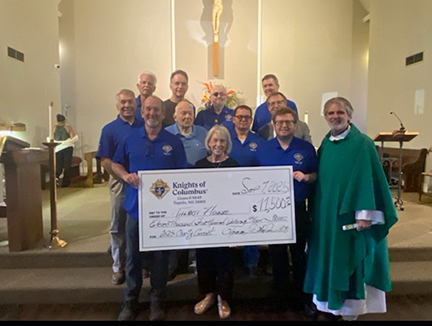
TUPELO – The Knights of Columbus Council 8848 at St. James Church presented a check for $11,500 to Talbot House, supporting its mission of serving those in need.

The donation marked the culmination of the Knights’ summer project, which included selling tickets to their annual charity concert and securing contributions from local businesses. Ticket sales began in May and concluded with the concert on Aug. 2 at the Catholic Life Center on the grounds of St. James.

The evening’s concert highlighted the talents of local residents and parishioners, who provided outstanding entertainment for the community.

The Knights of Columbus is a Catholic fraternal organization founded on the principles of charity, unity and fraternity. Council 8848 continues to serve the Tupelo community through faith-driven charitable works and service projects.

Native Argentina says goodbye to Pope Francis

By David Agren

(OSV News) – Cardinal Jorge Mario Bergoglio of Buenos Aires made history with his election on March 13, 2013, becoming the first Argentine and first Latin American to become pope.

As Pope Francis died in the Vatican April 21 at 88, it was in his Archdiocese of Buenos Aires, where now-Archbishop Jorge García Cuerva remembered him as “the pope for all” and the “the pope of the poor.” The archbishop also remembered him as the pope for all Argentines and exhorted the country to remember their late countryman as a figure of unity in a divided nation.

“Now we’ll have to be a little bit like Francis and also be more merciful to one another. I think the best tribute we Argentines can pay to Francis is to unite. The best tribute we can pay him is to build bridges, to engage in dialogue, to stop constantly confronting each other,” Archbishop García Cuerva said at a Mass celebrated at the Metropolitan Cathedral in Buenos Aires for Pope Francis.

“What greater pain for a father is there than to see his children divided. May Francis go to heaven with the peace of mind that his children will try to live the national unity between us that is still pending.”

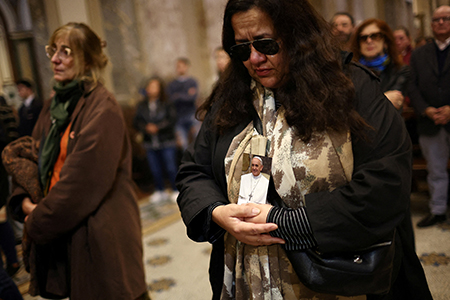
Women pray inside Buenos Aires’ Metropolitan Cathedral in Buenos Aires, Argentina, April 21, 2025, after the death of Pope Francis was announced by the Vatican. Pope Francis, formerly Argentine Cardinal Jorge Mario Bergoglio, died April 21 at age 88. (OSV News photo/Agustin Marcarian, Reuters)

The Argentine bishops conference added in an April 21 statement, “We thank God for the life, ministry and testimony of faith of someone who knew how to guide the universal Church with humility, evangelical firmness and unconditional love for the poor, the discarded and those who suffer.”

The Argentine pope of the people

While his election sparked outpourings of pride, patriotism and hope for reconciliation in a politically divided country – his legacy in his homeland is a complicated one. Few photos of Pope Francis are spotted in Buenos Aires, the Argentine capital, unlike soccer stars Diego Maradona and Leonel Messi, who led their country to World Cup success.

Observers credit the pope’s modest stature in his homeland to politics – with politicians from all sides trying to portray him as a fellow traveler or, in the case of current President Javier Milei, badmouthing the pope for his teachings. The pope’s comments were often scrutinized as much for political sentiments as anything pastoral.

Many Argentines seemingly continued seeing the pope as Cardinal Bergoglio, a figure focused on local matters rather than the leader of the universal church.

“We Argentines have not allowed Bergoglio to be Francis,” Archbishop García Cuerva said at a Feb. 24 Mass, where Argentines prayed for the then-hospitalized pope. “We have always put him in the middle of our sterile discussions, we have put him in our political divides.”

Attendees clutched photos of Pope Francis, wore Argentina’s familiar colors of sky blue and white and carried images of Our Lady of Luján, the national patroness.

“He confirmed me,” said Felipa Acosta, a parishioner at the Our Lady of Caacupé, named for the patroness of Paraguay. Acosta recalled Pope Francis visiting the parish in one of the many villas (shantytowns) in Buenos Aires – places avoided by polite society.

“He was always very close to us,” said Claudia Tejada, who remembers the future pope visiting her parish monthly. She recalled him sipping yerba mate, a popular infusion, and chatting with parishioners.

But there was no avoiding the complicated relationship between the pope and his native country — something Archbishop García Cuerva addressed in comments alluding to Argentine attitudes and those of Catholics further afield.

“We have tried to teach him, almost in a daring way, what it meant to be pope as if we had the manual for that,” Archbishop García Cuerva said in February.

“Yet he loves us, and yet he has us in his heart. He did what a loving father does. That is Francisco, the father of all, but we know that in his heart there is a lot of Argentine and a lot of porteño,” he said of Pope Francis, using a common and affectionate nickname for natives of Buenos Aires.

A complicated legacy

Pope Francis was born in Buenos Aires and raised in the middle-class Flores neighborhood. He served as Jesuit provincial – though his term ended in acrimony, according to observers – and was named auxiliary bishop of Buenos Aires in 1992. He was raised to archbishop in 1998 and cardinal in 2001.

As archbishop of Buenos Aires, Pope Francis was known for his grassroots ministry and confrontations with Argentina’s political elite – particularly with the late President Néstor Kirchner and his wife, former President Cristina Fernández de Kirchner, over their Peronist politics. Though initially icy, Fernández de Kirchner later warmed to Francis, visiting him in Rome multiple times. Still, his papacy has often been entangled in Argentina’s political tensions, with his expressions — or silences — scrutinized by leaders across the spectrum.

So-called “friends of Francis” also started appearing, along with supposed spokesmen with messages after trips to Rome. This forced the Argentine bishops’ conference to ask people to desist, saying the practice “has generated confusion and justified regrettable distortions of his figure and his words.”

Criticisms also emerged about the pope not visiting Argentina. He visited some countries of South America during his pontificate and twice flew over Argentine territory en route to Paraguay and Chile. He often spoke of visiting, but never did.

“If Francis were to come to Argentina, it would be assumed that he would be used politically in favor of the government in power or against the government in power,” De Vedia said. “I think that he would have had great popular fervour in the streets” had he visited “and at the same time debates about his positions,” Marianon De Vedia, editor for Argentina’s La Nacion said.

A changing nation

Argentina continued its drift away from Catholicism after Francis’ election. Some 62.9% of Argentines identified as Catholic in a 2019 survey from research institution CONICET, down from 76.5% in 2008. The number of people identifying as non-religious reached 18.9%, outpacing the growth in Protestant and other congregations.

Abortion was decriminalized in 2020 as a feminist movement became influential. Argentina’s bishops bitterly opposed abortion decriminalization, especially as it came during a pandemic in which the church – especially priests in the shanties, known as “curas villeros” – worked to feed and care for populations thrown into economic hardship.

Pope Francis paid special attention to the “villas” at a time when few others would enter the shantytowns, supporting their work serving communities rife with poverty and addictions.

“We felt really close (to him) and that he has acted like a bishop who is present and also seeks to solve the problems,” said Father José María di Paola, a prominent cura villero known as Padre Pepe.

The curas villeros promoted the pope’s vision of going to the peripheries. They took special offense at the rise of President Milei, who once branded the pope a “filthy leftist.” The curas villeros celebrated a Mass of reparation in a shantytown after Milei’s comments.

Milei took office in 2023 on an agenda of slashing the government. Pope Francis was quick to congratulate him. Milei traveled to the Vatican for a visit and asked the pope to visit.

On April 21 Milei said: “Despite our differences, experiencing his kindness was a true honor.”

The president’s office had formally communicated the news saying that the pope led the Catholic Church “with dedication and love from the Vatican.”

(David Agren writes for OSV News from Buenos Aires.)

Father Daniel Gallagher: A life of faith and service

By Joanna Puddister King
JACKSON – Rev. Daniel Noel Gallagher, a devoted priest of the Diocese of Jackson, passed away on Wednesday, Nov. 27, 2024 at St. Catherine’s Village in Madison, Mississippi. A native of Cashel, South Curry in County Sligo, Ireland, Father Dan was born on Dec. 19, 1940. From an early age, he displayed a profound commitment to his faith, which ultimately led him to pursue the priesthood at St. Kieran’s College in Kilkenny, Ireland.
Father Dan was ordained on June 6, 1965, in the hallowed halls of Kilkenny’s St. Mary Cathedral. His priestly journey, spanning six decades, brought him to the Diocese of Jackson, where he faithfully served parishes in Yazoo City, Hattiesburg, Bay St. Louis, Batesville, Rosedale, Natchez and West Point.
In 1994, Father Dan found his true calling in hospital chaplaincy. Ministering at the VA Hospital in Jackson, the University of Mississippi Medical Center, and Methodist Rehab Center, he provided comfort and solace to patients and their families. Known for his humility and determination, Father Dan continued his ministry despite losing much of his eyesight. Unable to drive, he often walked or took the bus to reach those in need, embodying the essence of a shepherd tirelessly seeking his flock.

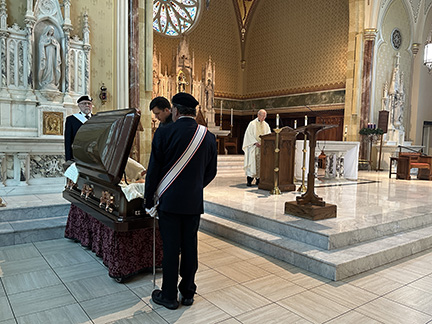
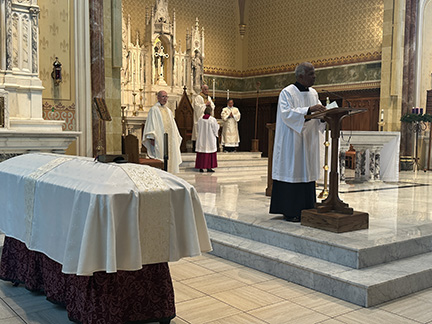
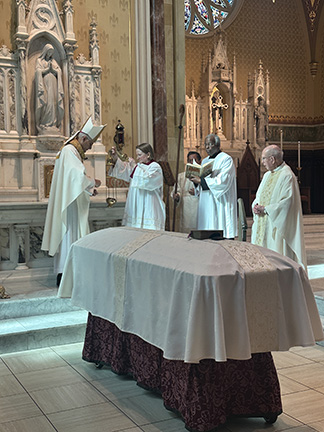
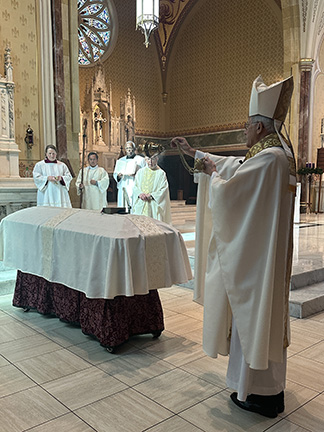
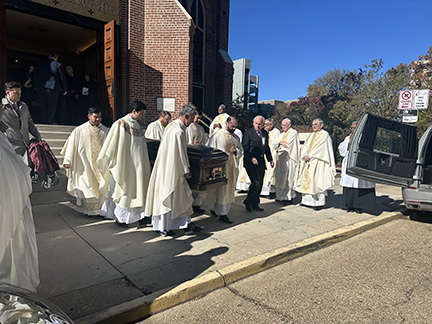
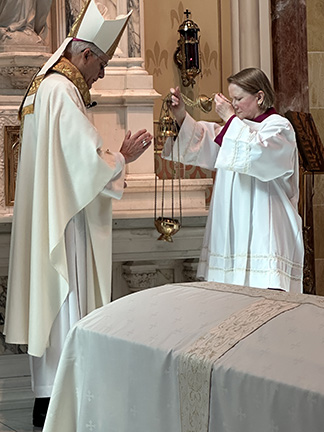
JACKSON – The visitation and funeral for Father Dan Gallagher was held at St. Peter the Apostle Cathedral on Friday, Dec. 6. Pictured: Father Nick Adam pays respects to Father Gallagher and Father Frank Cosgrove prepares his homily in honor of his friend. (Photos by Tereza Ma)

Father Dan’s service extended to leadership roles in the diocese. In 2002, he was appointed Director of the Cursillo Movement, a testament to his dedication to spiritual renewal. Later, in 2007, he became the in-residence chaplain at St. Dominic’s Hospital in Jackson, where his compassionate care brought peace to the sick and their loved ones.
Even in retirement, Father Dan remained a quiet yet profound witness to God’s love. Friends and colleagues described him as a man of deep spirituality and unwavering faith. “Although Father Dan had weak vision, he had a very strong faith,” said Father Frank Cosgrove, a lifelong friend and fellow priest.
Father Cosgrove, who first met Father Dan just after their seminary days, recalled their unique bond. Raised only 30 miles apart in Ireland, they crossed paths on an airplane bound for Jackson. Their friendship deepened over the years, particularly during their days off in Batesville and Oxford, where they would ride bicycles together as young, vibrant men in their 30s.
Father Dan’s humility and resilience were perhaps most evident in how he embraced his blindness. “What always impressed me was how he accepted the gradual deterioration of his sight,” Father Cosgrove said. “He didn’t let his suffering make him bitter. It made him better.”
Father Dan’s ministry continued even at St. Catherine’s Village, where he remained a priestly presence, offering prayers and guidance to all who sought it. “Father Dan was too humble to ask for a miracle, but God gave him the grace to bear his cross patiently,” Father Cosgrove remarked.
A Mass of Christian Burial was held on Dec. 6, 2024, at the Cathedral of St. Peter in Jackson. As he entered into eternal rest, his friends and parishioners found solace in knowing that Father Dan, who had walked by faith, now walked by sight in the presence of God.
Father Daniel Gallagher leaves behind a legacy of unwavering faith, boundless compassion, and a life wholly dedicated to God’s service. May he rest in peace.

Breves del mundo

A statue of Mary, Our Lady of Grace, is seen on the altar as Pope Francis celebrates Mass at Gelora Bung Karno Stadium in Jakarta, Indonesia, Sept. 5, 2023. (CNS photo/Lola Gomez)

NACIÓN
WASHINGTON (OSV News) – El Secretariado de Diversidad Cultural en la Iglesia de la Conferencia de Obispos Católicos de los Estados Unidos (USCCB) anunció que desarrolló un kit de recursos que ayudará “a ilustrar el profundo impacto de la comunidad hispana/latina dentro de la Iglesia Católica en los Estados Unidos”. Este recurso – publicado en inglés y en español – incluye información estadística sobre la población católica en los Estados Unidos, categorizada por raza/etnia, un perfil estadístico del ministerio hispano/latino, el porcentaje de católicos hispanos/latinos por diócesis y el crecimiento porcentual de los católicos hispanos/latinos en las generaciones Millennial y Gen Z. Así mismo, informa sobre el crecimiento de la población hispana/latina en las 14 regiones episcopales y sobre la población hispana/latina estimada en Estados Unidos en 2022 por país de origen; además de los eventos y logros del ministerio hispano/latino en una cronología que abarca desde 1945 hasta el 2024. Alejandro Aguilera-Titus, subdirector de Asuntos Hispanos del Secretariado de Diversidad Cultural en la Iglesia, dijo en este comunicado de prensa que gracias a la información contenida en este recurso esperan “ayudar a mostrar la fe vibrante y la riqueza de las comunidades hispanas y latinas dentro de nuestra Iglesia y la sociedad”. Para acceder a este kit de recursos y conocer en detalle la información, visite https://www.usccb.org/committees/hispaniclatino-affairs y descargue el PDF.

VATICANO
JAKARTA, Indonesia (CNS) – Incluso los miembros de las comunidades cristianas más remotas, pequeñas y pobres están llamados a compartir el Evangelio y a hacerlo, en primer lugar, con su forma de vivir, dijo el Papa Francisco a los católicos de Indonesia. Con decenas de miles de personas reunidas en el estadio Gelora Bung Karno de Yakarta el 5 de septiembre – y miles más viéndolo en pantallas desde el estadio Madya, un lugar más pequeño cercano-, el Papa Francisco presidió su única misa pública en I –donesia. Tenía previsto volar a Papúa Nueva Guinea a la mañana siguiente. La multitud, sentada y vestida con las brillantes camisetas verdes, amarillas, blancas, azules, rojas o negras que designan la parroquia, diócesis u organización católica a la que pertenecen, hizo que el estadio principal pareciera construido con ladrillos de Lego. La gente llegó al estadio horas antes, visitándose unos a otros, cantando himnos y animadas canciones cristianas modernas y rezando el rosario. En su homilía, el Papa Francisco instó a los católicos indonesios a «sembrar semillas de amor, recorrer con confianza el camino del diálogo, seguir mostrando vuestra bondad y amabilidad con vuestra característica sonrisa y ser constructores de unidad y paz.» El Papa Francisco pidió a la multitud que no olvidara que «la primera tarea del discípulo no es revestirse de una religiosidad exteriormente perfecta, hacer cosas extraordinarias o comprometerse en empresas grandiosas. El primer paso, en cambio, es saber escuchar la única palabra que salva, la palabra de Jesús.»
CIUDAD DEL VATICANO (CNS) – Mientras la Iglesia Católica y los cristianos en general experimentan una intensa persecución en Nicaragua, el Papa Francisco expresó su aliento y apoyo a las personas que viven bajo el régimen autoritario del país. “Al amado pueblo de Nicaragua: les animo a renovar su esperanza en Jesús”, dijo después de rezar el Ángelus el 25 de agosto. “Recordad que el Espíritu Santo guía siempre la historia hacia proyectos más altos”. La semana anterior, el gobierno nicaragüense revocó el estatus legal de 1.500 organizaciones sin ánimo de lucro que operaban en el país, muchas de ellas iglesias cristianas, así como organizaciones caritativas católicas y congregaciones religiosas. La Asamblea Nacional de Nicaragua también aprobó el 20 de agosto nuevas medidas fiscales que requerirían a iglesias y organizaciones religiosas de todas las confesiones a pagar impuestos. Además, durante las tres primeras semanas de agosto, nueve sacerdotes católicos fueron detenidos en Nicaragua y exiliados a Roma. “Que la Virgen Inmaculada los proteja en los momentos de prueba y los ayude a sentir su ternura materna; que Nuestra Señora acompañe al amado pueblo de Nicaragua”, rezó el Papa con los visitantes en la Plaza de San Pedro.

MUNDO
CIUDAD DE MÉXICO (OSV News) – El cardenal Álvaro Ramazzini de Huehuetenango, Guatemala, ha advertido que los cárteles de la droga controlan la frontera entre México y Guatemala, provocando espasmos de violencia que han hecho huir a cientos de mexicanos a su diócesis. En declaraciones a la prensa en Panamá tras la X Reunión de Obispos y Agentes de Pastoral Migratoria de América del Norte, Centroamérica y el Caribe, el cardenal Ramazzini cuestionó la inacción del gobierno mexicano mientras cárteles de la droga rivales se disputan territorios en el sureño estado de Chiapas. “Estamos en un área donde los cárteles de la droga tienen el poder total”, dijo el cardenal el 22 de agosto. “No logro entender verdaderamente qué es lo que el gobierno mexicano ha dejado de hacer para haber llegado a este punto de perder el control total de ese de ese lado de la frontera nuestra,” dijo el cardenal el 22 de agosto. Sus comentarios siguieron a una declaración conjunta del 21 de agosto de las Diócesis de Huehuetenango y San Marcos, Guatemala, y San Cristóbal de las Casas, México, en la que describían siete comunidades de Chiapas, convertidas “en un campo de batalla por la disputa del territorio entre grupos criminales que obligan a los hombres (de la zona) a ir al frente, a cuidar las plumas, a cerrar caminos, ellos y sus familias enfrentar un terror que nunca imaginaron. … que ningún nivel de gobierno ha querido escuchar y atender en sus raíces”. La declaración está firmada por el cardenal Ramazzini, el obispo de San Marcos, Bernabé Sagastume, y el obispo de San Cristóbal de las Casas, Rodrigo Aguiar Martínez. El obispo José Guadalupe Torres Campos, obispo de Ciudad Juárez y director de la Pastoral de Movilidad Humana del Episcopado Mexicano.

Reflections on the legacy of Catholic schools

THINGS OLD AND NEW
By Ruth Powers

Now that the summer break is a little more than halfway over, parents and students begin to turn their attention to the start of the next school year. Although this topic may seem more suited to the celebration of Catholic Schools Week in January, as we look toward the start of the new school year it may be beneficial to take a look at the history of Catholic schools in our country and the role they played in transmitting the faith to our children. My own family has benefitted as we have had our faith shaped by Cathedral School in Natchez for six generations (my grandchildren being the sixth.)

Catholic education in what would become the future United States began with Franciscan friars establishing schools in Spanish territories in the 1500s, educating both Indigenous people and Spanish settlers. The French later established schools along the Ohio and Mississippi Rivers. Notably, the Ursuline Academy in New Orleans, founded in 1727, which is still in operation today.

In English colonized areas, however, there was a different story. Although the original Puritan settlers came looking for religious freedom, they did not practice religious toleration. Their strict Calvinists beliefs led to hostility towards Catholics, influencing attitudes across the original colonies, especially in New England and the Northeast. Maryland, initially a haven for persecuted Catholics, was overtaken by Calvinist rebels in 1689, leading to the outlawing of Catholicism.

After the Revolutionary War religious toleration became much more widespread in law, allowing Catholics to again freely worship without fear of persecution, but social attitudes remained staunchly anti-Catholic in many places. Into this situation stepped St. Elizabeth Ann Seton, an Episcopalian convert to Catholicism, who is credited with founding the U.S. Catholic School system. Seton was approached by a priest of the Sulpician order to come to Maryland and start a school for Catholic girls, which she did in 1810. She also gathered a number of women around her and founded the Daughters of Charity. Members of this religious order travelled around the United States and founded Catholic Schools in areas where there were concentrations of Catholics.

From the 1820s through the 1850s Catholic immigration from Ireland and Germany dramatically increased, sparking a rise in anti-Catholic sentiment. This era saw the formation of the “Know-Nothings,” a political party aimed at halting Catholic immigration and eradicating Catholic influence in the United States. To achieve this, the public school system, where most immigrant children were educated due to the scarcity of Catholic schools, became a battleground. Horace Mann, the system’s advocate, staunchly opposed institutional religion, particularly Catholicism. The idea was for the Protestant teachers to use Protestant prayers, hymns, and study of the Protestant Bible to indoctrinate Catholic children against the teachings of the Catholic Church.

In response to the Know-Nothing movement and the violence it engendered, a series of Councils were held in Baltimore, Maryland in 1852, 1866 and 1884. The second and third of these councils were instrumental in the development of the system of parish-based Catholic schools that many of us grew up with. The Second Council called for the erection of parochial schools in every Catholic parish, and Catholic teachers working in public schools should be employed in Catholic parish schools wherever possible. Catechism classes were to be provided for students who couldn’t afford to attend the parish school. The Third Plenary Council went even further. It called for the establishment of Catholic high schools and addressed parents as well. It stated, “we not only exhort Catholic parents … but we command the with all the authority in our power, to procure a truly Christian education for their dear offspring … (and) send them to Catholic … schools,” unless they otherwise obtained permission from their local bishop.

Parochial schools grew exponentially after this, due in large part to the work of women religious who were willing to staff them for very little in the way of salary or benefits. Catholic schools continued to flourish, and the next waves of immigrants in the late nineteenth and early twentieth century (Italians) and after WWI (Poles and other Eastern Europeans) found schools ready not only to help their children learn academics, but also to enculturate into American society without giving up their Catholic faith.

Parochial schools thrived until the early 1960’s, but declining numbers of religious vocations necessitated hiring lay teachers, coupled with rising operational costs, leading to the closure of numerous Catholic schools in recent years. Increased tuition has further restricted access for many families, resulting in a significant resurgence of Catholic students in public schools, marking a pivotal moment in the landscape of U.S. education.

Currently, there is a move to once again integrate religious chaplains and required bible study into public school classrooms. Catholic parents need to look back at what happened in the nineteenth century and ask some hard questions – what will these chaplains do, which Bible will be taught, and who will be doing the teaching to make sure there is not another attempt to indoctrinate our children.

(Ruth Powers is the program coordinator for the Basilica of St. Mary in Natchez.)

May we hear the voice of the Lord

By Bishop Joseph R. Kopacz, D.D.
Throughout the Easter season of 50 days there are outstanding manifestations of the Lord from week to week that strengthen our faith in him, and love for him. Divine Mercy Sunday, the second Sunday of Easter is the culmination of the Easter Octave reverberating with the loving mercy, peace and power of the resurrection. Good Shepherd Sunday, the fourth Sunday of Easter enfolds us in perhaps the most beloved image of God in the entire Bible revealing the personal relationship that the Lord wants with each of us and all of us together as his flock, his body. Two weeks later we celebrate the great feast of the Ascension, with the assurance that our citizenship is in heaven. From that moment until Pentecost we will maintain vigilance in prayer awaiting to be clothed with power from on high.

Although Good Shepherd Sunday has a much longer tradition in the Catholic Church than Divine Mercy Sunday, it is St. John the Evangelist who has blessed the church until Christ comes again with these beloved manifestations.

Bishop Joseph R. Kopacz, D.D.

The beloved disciple, apostle and evangelist embraced the image of the Good Shepherd, beloved to Jew and Christian, and made it the centerpiece of his Gospel at nearly the halfway point in chapter 10. It is an image that is deeply rooted in the Old Testament portraying that God for the Israelites was far more than a lawgiver.

He was a loving presence who renewed their strength, anointed their heads with oil, set a table before them, and led them through dark valleys and rough patches. It is such a powerful image that it easily transcended its origins to become the earliest rendition of the risen Lord in Christian art as discovered in the catacombs.

It continues to capture the imagination of believers even though many of us have never directly experienced this way of life, except for the sheep barn at the County Fair. It endures because it represents God as loving and personal, wedded to his people forever. “I am the Good Shepherd. The Good Shepherd lays down his life for his sheep… I know my own and my own knows me… My sheep listen to my voice. I know them and they follow me. I give them eternal life and they shall never perish.” (John 10:1ff)

On Good Shepherd Sunday, the church prays for vocations to the priesthood and religious life. As part of the flock of the Good Shepherd all are grafted onto the vine of the priesthood of Jesus Christ, and we pray that all will respond generously to the voice of the Lord to live their vocation.

From the household of God, we pray for vocations to the ordained and consecrated life. We recall Jesus’ words at the Last Supper to his apostles. “You did not choose me, but I chose you and appointed you so that you might go and bear fruit, fruit that will last.” (John:15-16) Ultimately, this is the work of the Lord, but we are to beg the harvest master to send out workers to the vineyard because the harvest is great. (Matthew 9:35-38)

The Eucharistic Revival is intrinsically linked with the priesthood, and all the faithful have a part to play in raising up vocations. In this spirit, the Synod on Synodality is a clarion call for all of the baptized to take their place in the household of God, a chosen race, a royal priesthood, a holy nation, a people set apart to proclaim the excellence of him who called you out of darkness into his own marvelous light. (1Peter 2:9)

May we hear the voice of the Lord, crucified and risen, resound in our hearts and minds in order to follow him faithfully.

Bishop gives thanks for Pastoral Reimagining process

By Joanna Puddister King
JACKSON – Bishop Joseph Kopacz gathered representatives from Deanery II for the third phase of the diocesan “Pastoral Reimagining” process on Monday, April 8 at St. Mary Basilica for a Mass of Thanksgiving for the process; as well as, time to meet to discuss challenges and the growing edges and diminishing areas of ministry locally within the deanery and within the diocese as a whole.

“This process is about how to we dig deeper; how to we strengthen who we are as local parishes and as a diocese,” said Bishop Kopacz.

“We can grow where it’s possible and we can be stronger.”

Bishop Kopacz also met with Deanery III at Immaculate Heart of Mary in Greenwood and Deanery I at St. Francis of Assisi parish in Madison earlier this month.

He invites those in deaneries that have yet to meet, to come participate in a special Mass of Thanksgiving.
The Masses are as follows: Deanery V in the Golden Triangle area on Monday April 22 at 12 p.m. at Immaculate Conception West Point; Deanery V on Monday, April 22 at 5 p.m. at St. James Tupelo; Deanery VI on Monday, April 29 at 6 p.m. at St. Therese Kosciusko; and Deanery IV on Tuesday, April 30 at 5 p.m. at St. Mary Batesville.

NATCHEZ – Bishop Joseph Kopacz continues listening across the diocese for the Pastoral Reimagining process that has been taking place since Pentecost 2023. On Monday, April 8, he met with stakeholders from parishes making up Deanery II at St. Mary Basilica. (Photo by Joanna Puddister King)

Vatican publishes full papal schedule for Holy Week, Easter

By Justin McLellan
VATICAN CITY (CNS) – Pope Francis’ calendar for Holy Week and Easter is just as full as in previous years despite a mild illness which has caused him to cancel meetings in the days leading up to the release of his liturgical calendar for March.


The pope canceled meetings Feb. 24 and Feb. 26 due to “flu-like symptoms,” the Vatican said. Although he held his general audience Feb. 28, an aide read Pope Francis’ prepared remarks, and the Vatican said he briefly visited a Rome hospital after the audience for medical tests.


The pope is scheduled preside over all the major liturgical celebrations of Holy Week.


As is customary when first publishing the pope’s calendar for Holy Week, the Vatican did not provide the time or place for his celebration of the Mass of the Lord’s Supper on Holy Thursday, March 28.

Pope Francis has made it a tradition to celebrate the Mass and foot-washing ritual at a prison or detention center, refugee center or rehabilitation facility; last year he did so at a prison for minors in Rome.


Here is the schedule of papal liturgical ceremonies and events for March released by the Vatican Feb. 29:

– March 24, Palm Sunday, morning Mass in St. Peter’s Square.

– March 28, Holy Thursday, morning chrism Mass in St. Peter’s Basilica.

– March 29, Good Friday, afternoon liturgy of the Lord’s passion in St. Peter’s Basilica.

– March 29, Way of the Cross at night at Rome’s Colosseum.

– March 30, Easter vigil Mass in the evening in St. Peter’s Basilica.

– March 31, Easter morning Mass in St. Peter’s Square, followed at noon by the pope’s blessing “urbi et orbi” (to the city and the world).