Make beauty shine

FROM THE HERMITAGE
By sister alies therese
Mother Teresa commented, “Everywhere there is suffering, but there is also a great hunger for God and love.” Gotta go for that, and as we welcome the ‘Pope named Bob’ as our shepherd, I suspect the tension between the two will continue to be addressed. One way Pope Francis left us, not long before his passing, was his charge to artists. As we move into this new era, let us not forget how critical beauty is!

At White Night in St Peter’s, Papa Francis told artists, “the responsibility of artists is to make beauty shine.” He included all sorts of artists … writers, dancers, musicians and painters, among many, and he set a bar for happy hearts. There is much suffering, and there is much hunger, and one way these are addressed is through the arts. That Pope Francis charged artists with the ‘responsibility’ of ‘making beauty shine’ is no small assignment. Most countries have a national arts something or other that shares culture and beauty … some nations restrict how they share it. Even the poorest of nations have marvelous works of art that lift the spirits of their families and peoples and share with others the joy of their culture.
Francis suggested that “artists must help humanity not to lose its way … to be witnesses to the revolutionary vision of the beatitudes … not only creating beauty but also ‘revealing the truth and goodness hidden within the folds of history giving voice to the voiceless.’” Over centuries, artists, builders and designers have left behind impressions and monuments, pots and aqueducts, which have stood the test of time. We saw a lot of Rome as the conclave met … buildings, statues, paintings … all telling stories that the artists wanted us to remember. The scriptures were announced, and we were reminded of the functionality of buildings and also the ways they brought exquisite beauty and harmony to the scene.

Francis continued, “We need artists to help us ask questions about time and purpose … are we pilgrims or wanderers? Does our journey have a destination, or are we directionless?” What demanding questions for people with great insight and courage. It takes both for a person to function as an artist … partly because the criticism can be high enough to cancel them out! No, he asks artists to show us the way forward … to move us beyond selfishness to sharing. If you notice, the conductor has his/her back to the applause. The conductor caresses and encourages the musicians and takes care that they make the music beautiful. Her/his responsibility is to share that joy with listeners so that their hearts might light up and their anguish be set free.

“We must learn,” he said, “to discern between the chaff scattered by the wind from what is solid like trees planted by streams of water (Ps1).” The artist leads us in at least two ways … outward toward the universe (into the 6-20 trillion galaxies and their swirls of old and new designs of stars) and/or down deep into our hearts where we are touched to grow and create. Ecclesiastes reminds us that “God has made everything beautiful in its time.” When the writer says ‘everything’, I have to remind myself that everything means just that … difficulties as well as successes, hard times as well as times of ease. Our God, the greatest of artists, has created for us such beauty and wonder that we can never, even in the longest of lifetimes, take it all in. We are grateful as well to those who can draw our attention to it through their creativity, sharing in these gifts of God. And Paul in Ephesians reminds us that we are indeed God’s work of art … and no artist wants his/her art to be trashed or considered less than. Francis would want us to remember that as we learn to treat one another with greater dignity and respect.

I imagine the era of Pope Leo XIV to be one of learning even more how to care for one another and let us thank Pope Francis for his invitation and charge to artists to make beauty shine.

Blessings.

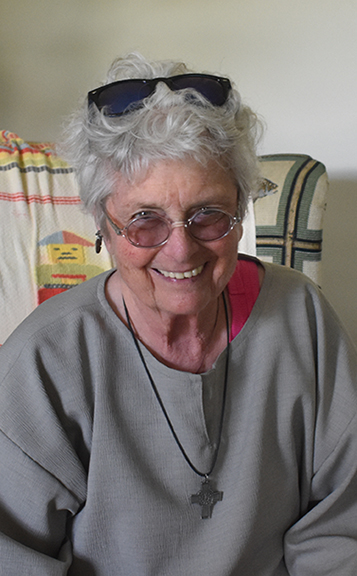
(sister alies therese is a canonical hermit who prays and writes.)
Heart of a Deacon: A life of service and growth

GUEST COLUMN
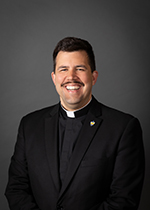
By Deacon Ted Schreck
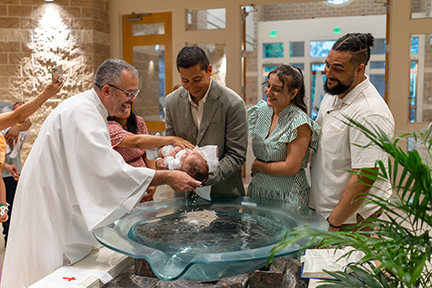
As I look back over the years since my ordination to the permanent diaconate in June 2016, I recall so many wonderful memories and some difficult times as well. Actually, my journey began years earlier. My baptism was when I was 10 days old back in December 1969; however, when I think about what led more immediately to my call, I think of the time from 2011 when my older brother Mike was ordained as a permanent deacon for the Archdiocese of Kansas City in Kansas. I watched my brother and his family for the years of his formation and was blessed to be present for his ordination. To say the least, this made a lasting impression on me.

SOUTHAVEN – Deacon Ted Schreck baptizes a new child into the faith as a part of his duties as a permanent deacon for the Diocese of Jackson. (Photo courtesy of Deacon Ted Schreck)

In 2009-2010, I began earnestly considering my own call to consider making an application for the permanent diaconate formation program. At that time, we in the Diocese of Jackson had not had any formation classes for permanent deacons in a very long time. However, while I was watching my brother’s call coming to fruition at his own ordination, I was being encouraged to consider my own call especially among my brother deacons serving in the Diocese of Memphis where I was working both at Memphis Catholic High School and Middle School and at Holy Spirit Catholic Church in East Memphis.

So, the discernment process for me continued in earnest. I wanted to know for myself that I was not seeking some title or specific affirmation for my service in the church. When we finally had an information session at St. Mary’s Catholic Church in Batesville, Mississippi, I welcomed the words from the presenters that the call was “not about you,” but about answering God’s call for his church and his people. This realization that my call to consider the permanent diaconate was not about me, but about seeking to do God’s will in my community was what I needed.

I learned a lot about myself as I reflected on my spiritual autobiography and began to share with friends and long-time neighbors from years previous that I was seriously considering this call to become a permanent deacon. The amazing thing that I heard from these friends and family members was “It’s about time … I’ve seen the servant in you for years.” Talk about God showing others our gifts and we ourselves not recognizing those gifts.

To fast forward, I loved (for the most part) my years of formation with my cohort from the Diocese of Jackson and the men (and their wives) from the Diocese of Memphis. I truly experienced being stretched and formed. I recognized strengths within me and some weaknesses as well. I have to say that while the information and knowledge gained was very important, I grew the most I believe through walking with my brothers through the formation process. We each experienced joys and sorrows over that 5-year period. But we stood together, and we laughed and we cried together.

One funny story that we like to look back on from time to time is when I parked my vehicle at St. James in Corinth to ride along with my brothers from St. Joseph in Starkville up to a retreat at St. Meinrad in Indiana. You may know that Corinth (in the New Testament – the home of the Corinthians) is in modern day Turkey. Well, on that day as I parked my vehicle at St. James in Corinth, I met some not-so-friendly wild “turkeys” that the priest at that time was raising on the church property.

Finally, after five years of formation, I and my brother deacons arrived at the Cathedral of St. Peter in Jackson for our ordination. I remember so many different feelings and joys on that day. The very next day as I returned to Christ the King parish in Southaven for the first Mass after our ordination, I had the opportunity to preach the homily for the first time. Understandably, I wanted to include thanks to my family and my fellow parishioners who had walked along this journey with me. Several parishioners asked me not to make them cry every time I preached like they did that day as I remembered my mother who had passed away many years prior.

So, what have these last almost nine years brought about in my life as a husband, brother, dad, grandfather and deacon? I have celebrated over 75 baptisms, 18 weddings, 4 presentations, 29 funerals, and many opportunities to walk alongside families from very different cultures. And, I have grown with each individual, couple and family I have encountered.

This growth has primarily come through my ability and desire to listen and to connect with others. Each day, I pray that God gives me the strength and the courage to be a better husband, a better father/grandfather/brother, a better friend and a better deacon. And he keeps on answering that prayer beyond my wildest expectations. I’ve certainly made my share of mistakes, but I am truly blessed to get to listen to and connect with more and more people in the six parish communities which I serve and in other parish communities when I have been invited to offer Advent or Lenten reflections.

In my case, I was working in a Catholic school throughout my years of formation and then worked at another Catholic elementary school as the director of development even after my ordination. In early 2022, I took a further step outside my comfort zone and joined the parish staff for the six Catholic parishes of Northwest Mississippi which are served by the Priests of the Sacred Heart as the director of evangelization. I say that this was outside my comfort zone as I considered which qualifications I did not possess (or my weaknesses). But I have been beyond blessed as I pursued this work especially in adult faith formation, OCIA, sacramental preparation, and so much more. I believe that any real success that has come through trusting in God’s will and pursuing my strengths (more than focusing on my weaknesses).

What’s next? I know that there is so much work to do in helping God’s people draw closer to Him and closer to His church. That’s where my focus is! I just pray that I allow God to use me as he sees fit. My goal is to continue to grow as a Man of God, to be faithful to my family, and to fulfill my baptismal promise. Amen!

(Deacon Ted Schreck is the director of evangelization for the Catholic Parishes of Northwest Mississippi. He can be reached at nwms.evangelization@gmail.com. To learn more about the permanent diaconate visit https://bit.ly/JacksonDiaconate.)

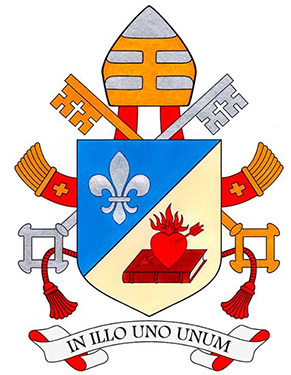
Pope Leo’s motto, coat of arms pay homage to St. Augustine

VATICAN CITY (CNS) – Pope Leo XIV’s devotion to St. Augustine, his life and ministry as a member of the Augustinian order and his focus on the church unity are reflected in his episcopal motto and coat of arms.
When he appeared on the balcony of St. Peter’s Basilica shortly after his election May 8, he introduced himself as “an Augustinian, a son of St. Augustine.”

And he explained that the cardinals who elected him “have chosen me to be the Successor of Peter and to walk together with you as a Church, united, ever pursuing peace and justice, ever seeking to act as men and women faithful to Jesus Christ, in order to proclaim the Gospel without fear, to be missionaries.”

His episcopal motto is, “In Illo uno unum,” or literally “In the One, we are one.”

Vatican News explained that the phrase is taken from St. Augustine’s “Exposition on Psalm 127,” where he explains that “although we Christians are many, in the one Christ we are one.”

Pope Leo XIV’s coat of arms with his episcopal motto, “In Illo uno unum,” literally “In the One (Christ), we are one,” is seen in an image published by the Vatican Secretariat of State May 10, 2025. (CNS photo/Vatican Media)

As a cardinal, he told Vatican News in 2023, “As can be seen from my episcopal motto, unity and communion are truly part of the charism of the Order of St. Augustine, and also of my way of acting and thinking.”

“I believe it is very important to promote communion in the church, and we know well that communion, participation and mission are the three keywords of the Synod” of Bishops on synodality, he said. “So, as an Augustinian, for me promoting unity and communion is fundamental.”

His shield, now topped by a miter instead of the red galero hat on the shield of cardinals, is divided diagonally into two. The upper half features a blue background with a white lily or fleur-de-lis, symbolizing the Virgin Mary, but also his French heritage.

The lower half of the shield has a light background and displays an image common to the religious orders named after and inspired by St. Augustine: a closed book with a heart pierced by an arrow.

Vatican News said, “This is a direct reference to the conversion experience of St. Augustine himself, who described his personal encounter with God’s word using the phrase: ‘Vulnerasti cor meum verbo tuo’ – ‘You have pierced my heart with your Word.’”

10 things to know about Pope Leo XIV

By Maria Wiering
(OSV News) – As the Catholic Church welcomes its first American pope, here are 10 things to know about Pope Leo XIV, formerly Cardinal Robert F. Prevost.

  1. Chicagoan. Pope Leo was born Sept. 14, 1955, and grew up in the south suburbs of Chicago. His father, Louis Marius Prevost, was an educator, and his mother, Mildred Martínez, was a librarian. He has two older brothers, was active in his childhood parish and his brother John says he is a White Sox fan. His family is reportedly of French, Italian and Spanish origin, with Creole heritage on his mother’s side. He loves the sport of tennis and plays regularly.
  2. Cosmopolitan. While American, Pope Leo has a global perspective, having lived most of his adult life in Peru and Rome. Based on his assignments, it appears that he has spent less than five years combined living in the United States since his priesthood ordination in 1982.
  3. Augustinian. He is a member of the Order of St. Augustine, a religious order that dates to 1244 and was founded to live the spirituality of early Christians. The order considers St. Augustine, a fifth-century theologian, philosopher and bishop of Hippo, its father. Before ordination, Pope Leo attended St. Augustine Seminary High School in Holland, Michigan, and Villanova University near Philadelphia, both Augustinian institutions. Augustinians are mendicant, meaning that they traditionally survive on begging or their own work, do not hold property and do not spend their life in a single location. Pope Leo is the first Augustinian to assume the chair of Peter, and the second member of a religious order to do so in nearly two centuries – the first being the first Jesuit pope, Pope Francis.
  4. Canonist. Pope Leo is a canon lawyer, having received his licentiate and doctorate in canon law from the Pontifical University of St. Thomas Aquinas, also known as the Angelicum, in Rome. He wrote doctoral thesis on “The role of the local prior in the Order of Saint Augustine.” For nearly a decade he served the Archdiocese of Trujillo, Peru, as its judicial vicar, which oversees the diocesan tribunal. During that time he was also a professor of canon, patristic and moral law in the San Carlos e San Marcelo Major Seminary.
  5. Leader. Pope Leo has an impressive range of leadership experience. After several pastoral and seminary formation roles in Chicago and Peru, he was elected in 1999 to oversee his order’s province in Chicago, and then two years later, he took the helm of the order worldwide. He was reelected for a second six-year term, ultimately holding the Rome-based position for 12 years. Then, in 2014, Pope Francis appointed him to oversee the Diocese of Chiclayo, Peru, a role he held for nine years and that included a year-long stint as the apostolic administrator of the Diocese of Callao, Peru, whose see city is nearly 500 miles south of Chiclayo. In 2023, Pope Francis appointed him as prefect of the Holy See’s Dicastery for Bishops, which oversees the appointments of bishops worldwide.
  6. Baby boomer. At age 69, Pope Leo is seven years younger than Pope Francis was when he was elected in 2013, and nine years younger than Pope Benedict XVI when he was elected in 2005. He is 11 years older than St. John Paul II, who was 58 at his 1978 election.
  7. Socially minded. His name is an apparent nod to Pope Leo XIII, who led the church from 1878 until 1903 and is especially known for his 1891 encyclical “Rerum Novarum,” or “On the Condition of the Working Classes.” That document responded to the state of the industrial society at the end of the 19th century and cemented Pope Leo XIII’s position as the modern father of Catholic social doctrine. Pope Leo XIII also composed the popular St. Michael prayer, penned an 1879 encyclical calling for the rooting of Christian philosophy in the writings of St. Thomas Aquinas, and issued an 1899 apostolic letter condemning “Americanism,” a worldview he feared was held by American prelates that bolstered American values such as pluralism and individualism to the detriment of Catholic teaching.
  8. Peace bearer. Pope Leo’s first words to the world were “Peace be with you” on a balcony of St. Peter’s Basilica overlooking masses of people in the square. “Beloved brothers and sisters, this is the first greeting of the Risen Christ, the Good Shepherd who has given his life for the flock of God,” he continued. “I, too, would like this greeting of peace to enter your hearts, reach your families, to all people, wherever they may be, to all peoples, to all the earth. … It comes from God, God who loves us all unconditionally.”
  9. Polyglot. Pope Leo speaks English, Spanish, Italian, French and Portuguese, and he reads Latin and German. He gave his first greeting May 8 in Italian but switched to Spanish to greet the faithful of his former Diocese of Chiclayo before giving the “urbi et orbi” blessing in Latin. On May 9, he began his first public homily with English but preached most of it in Italian.
  10. Successor of Peter. On his first full day as pope May 9, Pope Leo preached before the College of Cardinals who elected him, speaking of an exchange between Jesus and St. Peter, the first pope. He called the church “an ark of salvation sailing through the waters of history and a beacon that illumines the dark nights of this world. And this, not so much through the magnificence of her structures or the grandeur of her buildings – like the monuments among which we find ourselves – but rather through the holiness of her members.”

(Maria Wiering is senior writer for OSV News.)

White smoke and eternal light

By Bishop Joseph R. Kopacz, D.D.
The celebration of the Lord’s resurrection during the Easter season always bears the marks of resurgent life in the church as well as in the natural world around us. Beginning with the Easter Vigil, the waters of Baptism, the anointing with chrism, the proclamation of the Word of God, and the reception of the Body and Blood of the Lord are the ordinary and extraordinary ways that our parish communities flourish as members of the Body of Christ. The hope and joy that arise from the love of risen Lord take root all around us.

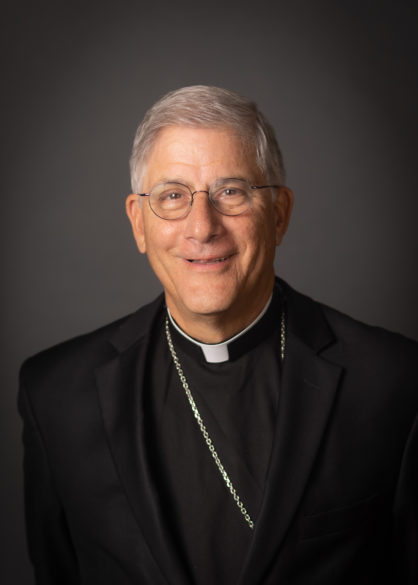
Bishop Joseph R. Kopacz, D.D.

In this light it’s evident that the death of Pope Francis and the election of Pope Leo XIV have deepened our experience of the rhythms of the Paschal mystery in the Easter season.

The passing of Pope Francis after 12 years as the Holy Father evoked a world-wide outpouring of loving gratitude on behalf of this spiritual leader whose prophetic voice inspired many within the church and beyond. The funeral liturgy and the accompanying solemn rites and processions placed the church on the world stage for an extended period of time proclaiming to all participants and observers the essence of our faith and hope in the one crucified and risen from the dead.

That Francis embodied the mind and heart of the Good Shepherd through words and gestures, through teaching and evangelizing, and through his stature as the voice of conscience and human rights across the globe, was evident in responses from across life’s spectrum, including both heads of state, and homeless. Let our hope-filled prayers from the funeral liturgy accompany this servant of God. “May the angels lead you into paradise; may the martyrs come to greet you on the way, and take you to the holy city, the new and eternal Jerusalem. May choirs of angels welcome you and lead you to the bosom of Abraham; and where Lazarus is poor no longer may you find eternal rest.”

After pausing for a suitable time of mourning and allowing the cardinal electors the opportunity to settle in and prepare for the conclave, the 24-hour news cycle kicked in once again. From churchmen to Vegas oddsmakers there was considerable speculation over who would emerge as the 267th pope.

A man holding a rosary and U.S. flag reacts as Cardinal Robert Francis Prevost, who has chosen the papal name Leo XIV, appears on the central balcony of St. Peter’s Basilica at the Vatican May 8, 2025, following his election during the conclave. He is the first American pope in history. (OSV News photo/Dylan Martinez, Reuters)

The 700-year-old tradition of conclave was explored and dissected in every conceivable way, and indeed it gripped the imagination. Even far more impressive was the reality that the 130+ cardinals represented 71 countries, walking proof of the global Catholic Church. But would the conclave drag on, or would it be over in a matter of two to three days, its duration in recent elections, was a repeated question? The thousands of people who joyfully and prayerfully gathered in St. Peter’s Square to await the white smoke and the pealing bells represented countless others from around the globe who remained vigilant in prayer and joyful hope. At last, the moment arrived. Habemus Papam!

To the surprise of most who were glued to the proceedings, the church is celebrating the first American pope. It seems that the oddsmakers didn’t factor in the impact of the Holy Spirit.

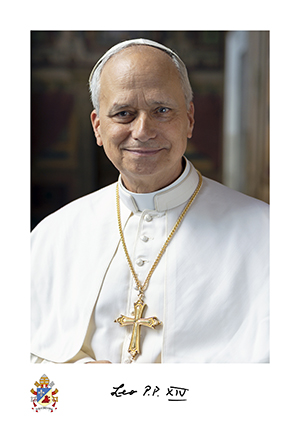
We are at the beginning of a new day in the center of the Catholic Church with the election of Pope Leo XIV, the former Cardinal Robert Francis Prevost. His Augustinian religious community, and the nations of Peru and the United States along with the entire Catholic world rejoice to welcome him as the successor of St. Peter, the Vicar of Christ, the Bishop of Rome, and the Servant of the Servants of God. The name of Leo is profoundly significant for our times and speaks volumes regarding our Holy Father’s hopes and dreams for our church and world.

Called by Name

As we head into summer, I’m continuing to review seminary applications. I’m happy to report we have nine seminarians lined up for this fall – up from six in recent years!

One of our newest is Joshua Statham from Richland, who attends St. Jude in Pearl. Josh entered the church while a student at Southern Miss and began seminary formation for the Diocese of Biloxi in 2023. He recently transferred to Jackson, completing his application earlier this month. I’ve known Josh for many years and appreciate the prayerful care he’s taken in making this decision. We’re glad to welcome him. Special thanks to Father Braxton Necaise, vocation director in Biloxi, and Bishop Kihneman for their help with the transfer.

Josh joins two others beginning formation this year. I previously introduced Eli McFadden from St. Paul in Flowood, and we have one more new seminarian I’ll be sharing more about soon. With several applications still pending, I’m hopeful we’ll have even more good news this summer. For now, at least nine young men will be in formation this fall – a hopeful sign of how the Lord is working in hearts across our diocese.

I was also encouraged by the incredible generosity of the Knights of Columbus at the state convention in April. Councils across the diocese donated more than $50,000 for seminary education. I gave them a standing ovation when they presented the check to Bishop Kopacz.

I’m also honored to give the invocation at the annual Luella & Floyd Q. Doolittle Golf Classic, sponsored by the St. Francis Madison Knights of Columbus. It will be held June 14 at Whisper Lake Country Club in Madison. Everyone is invited to sign up to play or sponsor. For info, contact Tunney Vandevender at (601) 622-4145 or tunneyv1@icloud.com. I wish I could play – but at least I can pray!

Our Spring Vocations Appeal is still underway. A second collection was taken on Mother’s Day weekend, and a mail appeal went out as well. If you haven’t yet contributed, there’s still time. Every dollar supports vocation promotion and the education of our seminarians – whose numbers, as you can see, are growing. I’m deeply grateful for your support. I know there are many worthy causes in the church, and I promise we are doing all we can to be faithful stewards of every gift.

Please keep praying – not just for more priests, but for holy priests.

Father Nick Adam, vocation director

Join Vocations Supporters on Flocknote for updates from the Vocations Office: https://jacksondiocese.flocknote.com/VocationsSupport

FEATURE PHOTO: … Servant leadership lesson…

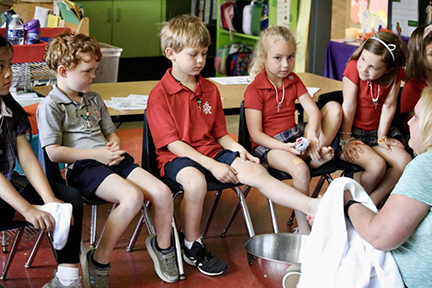
JACKSON – During Lent, K-5 teacher Kate Morris washed the feet of the kindergarteners. This was a lesson for students to think about servant leadership and what it means for God to serve others. Students were asked how it made them feel and what they thought to have their teacher wash their feet. Students said they felt loved, and it reminded them of when Jesus washed his disciples’ feet. Pictured: St. Richard students John Stanton, Eliza Weisenberger, Louise Simmons, with Kate Morris. (Photo by Celeste Saucier)

Pope Leo prays for vocations, for peace and for mothers on Mother’s Day

By Cindy Wooden
VATICAN CITY (CNS) – With a huge and festive crowd gathered in St. Peter’s Square, Pope Leo XIV led his first Sunday recitation of the “Regina Coeli” prayer and urged all Catholics to pray for vocations, especially to the priesthood and religious life.

Before the pope appeared on the central balcony of St. Peter’s Basilica May 11, the crowd was entertained by dozens of marching bands and folkloristic dance troupes who had marched into the square after attending an outdoor Mass for the Jubilee of Bands and Popular Entertainment.

Pope Leo also noted that it was Mother’s Day in Italy, the United States and elsewhere. “I send a special greeting to all mothers with a prayer for them and for those who are already in heaven,” he said. “Happy holiday to all moms!”

Italian officials estimated 100,000 people were in St. Peter’s Square or on the surrounding streets to join the new pope for the midday prayer.

In his main address, Pope Leo said it was a “gift” to lead the crowd for the first time on the Sunday when the church proclaims a passage from John 10 “where Jesus reveals himself as the true Shepherd, who knows and loves his sheep and gives his life for them.”

It also is the day the Catholic Church offers special prayers for vocations, especially to the priesthood and religious life.

Pope Leo XIV leads the midday recitation of the “Regina Coeli” prayer for the first time from the central balcony of St. Peter’s Basilica at the Vatican May 11, 2025. (CNS photo/Lola Gomez)

“It is important that young men and women on their vocational journey find acceptance, listening and encouragement in their communities, and that they can look up to credible models of generous dedication to God and to their brothers and sisters,” the pope said.

Noting that Pope Francis had released a message in March in preparation for the day of prayer, Pope Leo told the crowd, “Let us take up the invitation that Pope Francis left us in his message for today: the invitation to welcome and accompany young people.”

“And let us ask our heavenly Father to assist us in living in service to one another, each according to his or her state of life, shepherds after his own heart, capable of helping one another to walk in love and truth,” the new pope said.

Setting aside his prepared text, he told young people in the square, “Do not be afraid! Welcome the call of the church and of Christ the Lord.”

After reciting the “Regina Coeli,” he mentioned how the 80th anniversary of the end of World War II in Europe was celebrated May 8, the day of his election.

While that is reason to celebrate, he said, “’the Third World War is being fought piecemeal,’ as Pope Francis often said. I, too, appeal to the leaders of the world, repeating this ever-relevant plea: Never again war!”

Pope Leo prayed for the people of Ukraine, saying, “May everything possible be done to achieve as soon as possible an authentic, just and lasting peace. May all prisoners be freed, and may the children return to their families.” Ukraine says thousands of children have been forcibly taken to Russia during the war.

The pope also told the crowd, “I am deeply saddened by what is happening in the Gaza Strip. Let the fighting cease immediately. Humanitarian aid must be given to the exhausted civilian population, and all hostages must be released.”

He praised India and Pakistan for reaching a ceasefire agreement, but said, “But how many other conflicts are there in the world?”

Pope Leo entrusted his “heartfelt appeal” for peace to Mary, “Queen of Peace, that she may present it to the Lord Jesus to obtain for us the miracle of peace.”

Earlier in the day, Pope Leo had celebrated Mass at an altar near the tomb of St. Peter in the grotto of St. Peter’s Basilica. Father Alejandro Moral Anton, the prior general of the Order of St. Augustine, to which the pope belonged, was the principal celebrant.

Afterward, the Vatican press office said, he stopped to pray at the tombs of popes who are buried in the grotto.

Calendar of Events

SPIRITUAL ENRICHMENT
BIRMINGHAM, Ala. – Catholic Charismatic Renewal Conference “Come Holy Spirit With Your Fire” on July 25 and 26, featuring Ralph Martin as the main speaker. Details: email Jeannie Wade at Jwade3585@outlook.com or call Ray Makofsky at 205-999-8947. To register, visit www.catholiccharismaticrenewal.org.

PARISH, FAMILY & SCHOOL EVENTS
CANTON – Catholic Charities, Birdies for Born Free Golf Tournament, Tuesday, June 10, registration and lunch at 11:30 a.m. and tournament begins at 12:30 p.m. Details: register at https://www.catholiccharitiesjackson.org/event-details/birdies-for-born-free. For more information contact deja.errington@ccjackson.org or (601) 355-8634.

CLARKSDALE – St. Elizabeth, Vacation Bible School “True North: Trusting Jesus in a Wild World,” June 9-12 from 8 a.m. to noon. Open to students leaving PreK-3 through fifth grade. Register at https://vbspro.events/p/stelizabeth2025. Details: church office (662) 624-4301.

CLEVELAND – Our Lady of Victories, Vacation Bible School – “True North” for PreK-3 through third grade, June 16-18 from 5:30-7:30 p.m. Details: register online: www.myvbs.org/olvcleveland.

CLINTON – Holy Savior, Vacation Bible School “True North: Trusting Jesus in a Wild World,” June 2-6 from 6-8 p.m. Register at https://bit.ly/440Z1HA. Details: church office (601) 924-6344.

FLOWOOD – St. Paul, Vacation Bible School “True North: Trusting Jesus in a Wild World,” June 16-19 from 5:45-8 p.m. Details: For more information and to register visit https://bit.ly/3SJKmcI.

GLUCKSTADT – St. Joseph, Vacation Bible School “True North: Trusting Jesus in a Wild World,” June 23-27 from 5:15-8 p.m. in the parish hall. Dinner and games from 5:15-6 p.m. Open to all children entering K through sixth grade. Cost: $15 per child/$30 max per family. Details: https://giving.parishsoft.com/app/stjosephgluckstadt – select one-time donation and then VBS 2025 as the fund.

JACKSON – Holy Ghost, 50th Anniversary of the Knights of Peter Claver Ladies Auxiliary, Saturday, June 21 in the parish life center. Details: Please RSVP for luncheon by call or text to Sandra Lynn at (601) 505-1679.

JACKSON – Catholic Charities, 20th annual Bishop’s Ball, Saturday, July 19 at the Two Mississippi Museums. Cocktail hour at 6 p.m. with an auction at 7 p.m. Live music by the Patrick Harkins Bank. Details: call (601) 355-8634 or visit https://event.gives/bb25.

MADISON – St. Francis, Vacation Bible School, June 23-26 from 9 a.m. till noon. Students ages four through fourth grade are welcome to join the “Prayer Safari” and students in grades fifth through eighth are invited to the “Creativity Kingdom” VBS Creative Arts camp. Details: email mc.george@stfrancismadison.org.

St. Francis, Celebration of Father Frank Cosgrove’s 60th Ordination Anniversary, Monday, June 2 at 6 p.m. Details: Please RSVP to sallieann.inman@stfrancismadison.org.

MERIDIAN – St. Patrick, “True North” Vacation Bible School, June 23-27 from 8 a.m. to noon, with lunch provided. Details: register at vbspro.events/p/meridian.

St. Patrick, Jubilee Mass of Hope, Saturday, June 14 at 11 a.m. Details: church office (601) 693-1321.

OLIVE BRANCH – Queen of Peace, Vacation Bible School “Passport to Peace,” June 16-20 from 5:30-8 p.m. Details: church office (662) 895-5007.

Queen of Peace, Yard Sale, Saturday, June 8 and Sunday, June 9 from 8 a.m. to 1 p.m. Furniture, books, clothing tools, toys and more. Items half off on Sunday.

SOUTHAVEN – Christ the King, Vacation Bible School for grades K through eighth, June 16-20 from 6:30-8:30 p.m. Registration forms in gathering area of the church. Join us for crafts, Bible stories, games and snacks. Details: church office (662) 342-1073.

A needed reminder

IN EXILE
By Father Ron Rolheiser, OMI
Benedictine monk shared this story with me. During his early years in religious life, he had been resentful because he was required to ask permission from his Abbott if he wanted anything: “I thought it was silly, me, a grown man, an adult, having to ask a superior if I wanted a new shirt. I felt like a child.”

But as he aged his perspective changed: “I’m not sure of all the reasons, though I’m sure they have to do with grace, but one day I came to realize that there was some deep wisdom in having to ask permission for everything. We don’t own anything; nothing comes to us by right. Everything is a gift. So ideally everything should be asked for and not taken as if it were ours by right. We need to be grateful to God and the universe for everything that’s been given us. Now, when I need something and need to ask permission from the Abbott, I no longer feel like a child. Rather, I feel that I’m more properly in tune with the way things should be in a gift-oriented universe within which nobody has a right to ultimately claim anything.”

Father Ron Rolheiser, OMI

What this monk came to understand is a principle which undergirds all spirituality, all morality, and every one of the commandments, namely, that everything comes to us as gift, nothing can be claimed as if owed to us. We should be grateful to God and to the universe for giving us what we have and careful not to claim, as by right, anything more.

But this goes against much in our instinctual selves and within our culture. Within both, there are strong voices which tell us that if you cannot take what you want then you’re a weak person, weak in a double way. First, you’re a weak personality, too timid to fully claim life. Second, you’ve been weakened by religious and moral scruples and are unable to properly seize the day and be fully alive. These voices tell us that we need to grow up because there is much in us that’s fearful and infantile, a child held captive by superstitious forces.

It’s precisely because of these voices that today, in a culture that professes to be Christian and moral, leading political and social figures can in all sincerity believe and say that empathy is a human weakness.
We need an important reminder.

The voice of Jesus is radically antithetical to these voices. Empathy is the penultimate human virtue, the antithesis of weakness. Jesus would look on so much that is assertive, aggressive and accumulative within our society and, notwithstanding the admiration it receives, tell us clearly that this is not what it means to come to the banquet which lies at the heart of God’s kingdom. He would not share our admiration of the rich and famous who too often claim, as by right, their excessive wealth and status. When Jesus states that it is harder for a rich person to go to heaven than for a camel to pass through the eye of a needle, he might have qualified this by adding: “Unless, of course, the rich person, childlike, asks permission from the universe, from the community, and from God, for every new shirt!”

When I was a religious novice, our novice master tried to impress upon us the meaning of religious poverty by making us write inside every book that was given to us the Latin words: ad usum. Literally: for your use. The idea was that, although this book was given to you for your personal use, you didn’t own it. It was only for your use; real ownership lay elsewhere. We were then told that this was true as well of everything else given to us for our personal use, from our toothbrushes to the shirts on our backs. They were not really ours, merely given to us for our use.

One of the young men in that novitiate group who left the order is today a medical doctor. He remains a close friend and he once shared with me how today, as a doctor, he still writes those words ad usum in every one of his books. His rational is this: “I don’t belong to a religious order. I don’t have a vow of poverty, but the principle our novice master taught us is just as valid for me in the world as it is for a religious novice. We don’t own anything. Those books aren’t really mine. They’ve been given to me, temporarily, for my use. Nothing ultimately belongs to anybody and it’s best never to forget that.”

No matter how rich, strong and grown-up we are, there’s something healthy in having to ask permission to buy a new shirt. It keeps us attuned to the fact that the universe belongs to everyone, to God ultimately. Everything comes to us as gift and so we may never take anything for granted, but only as granted!

(Oblate Father Ron Rolheiser is a theologian, teacher and award-winning author. He can be contacted through his website www.ronrolheiser.com.)