Attending school Christmas concert, pope thanks children for sharing love

CASTEL GANDOLFO (CNS) – At the end of his one day off each week, Pope Leo XIV went to the local school in Castel Gandolfo and joined hundreds of excited parents in watching the children’s Christmas concert.

After 45 minutes of songs in Italian, Latin, English and Spanish, Pope Leo thanked the children and their teachers for “the invitation that mysteriously arrived at my house, but maybe even more mysterious was the response when you learned I had decided to come.”

Shortly after the pope arrived Dec. 16 and school staff convinced the parents to sit down, more than 200 students, from the oldest to the youngest, filed on to risers on the stage in the gym wearing white sweatshirts and dark trousers.

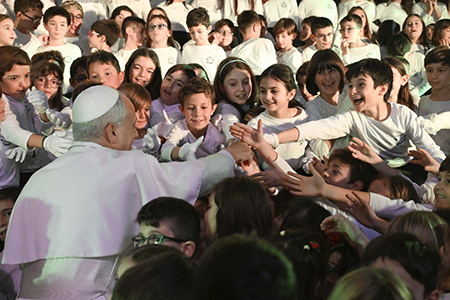
Pope Leo XIV shakes hands with students at the Pontifical Paul VI School in Castel Gandolfo, Italy, after he attended their Christmas concert in the school gym Dec. 16, 2025. (CNS photo/Vatican Media)

The children all begin studying English in primary school, and the first piece they sang in English was a rousing “Joy to the World.” They also sang “The Little Drummer Boy” with drumming hand motions.

At the end of the concert, before leading the children in the Lord’s Prayer – which one class did in Italian sign language as well – Pope Leo spoke about the first song, a modern Italian carol, that recounted the angels singing the news of Jesus’ birth.

“The most beautiful words were about ‘angels who bring love,’ and you are the ones who brought love to all of us this evening,” the pope told the children.

St. Augustine once said, “One who loves, sings,” he told them.

“This is Christmas – God who wanted to draw near to us, especially to the smallest,” the pope said, expressing his hope that “we can feel and live this love” all year long.

Pope Leo also thanked the children for singing in several languages, showing that Christmas fills the hearts of believers everywhere with joy and peace.

He also quoted a well-known Italian song that says, “At Christmas you can do more.”

“It’s an invitation to all of us,” the pope said. “Let’s do more to proclaim peace, love and unity in the world.”

Lebanese have what is needed to build a future of peace, pope says

By Cindy Wooden
BEIRUT (CNS) – Even in the face of difficulties and the constant threat of war, the young people of Lebanon and the country’s religious leaders have enormous resources that can build a better future for all people, Pope Leo XIV said.

“The true opposition to evil is not evil, but love, a love capable of healing one’s own wounds while also caring for the wounds of others,” he said Dec. 1 as he met thousands of young people outside the headquarters of the Maronite Patriarchate of Antioch in Bkerké, overlooking Beirut.

Pope Leo met the 15,000 young people after meeting their elders – representatives of the country’s Christian, Muslim, Druze and Alawite communities – in Beirut’s Martyrs’ Square, which honors those who fought for Lebanon’s independence and were executed there in 1916. The martyrs came from every religious community.

At their meeting, the young people posed two questions to the pope: How to preserve one’s inner peace and hope “in a country deprived of stability, whether in terms of security or economy”; and how can people keep their families, marriages and friendships solid in a world dominated by the digital and ephemeral.

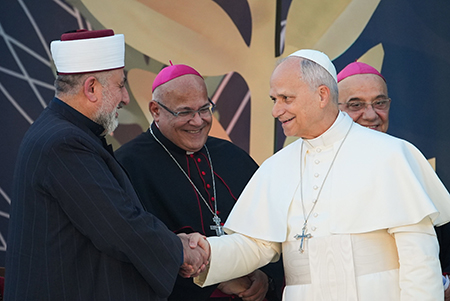
Pope Leo XIV shakes hands with Sheikh Ali Kaddour, head of the Alawi Islamic Council in Lebanon during an ecumenical and interreligious meeting in Martyrs’ Square in Beirut, Lebanon, Dec. 1, 2025. (CNS photo/Lola Gomez)

Pope Leo told them to look for good examples around them.

“Draw from the good roots of those dedicated to serving society without using it for their own interests,” he said. “Be the source of hope that the country is waiting for!”

For Christians, the pope said, Jesus is the first person to look to for help both with peace and with relationships because both require love.

“If our ego is at the center of a friendship or loving relationship, it cannot bear fruit,” he said. “Similarly, it is not true love if we only love temporarily, as long as the feeling lasts: if love has a time limit, it is not truly love.”

Love and charity express God’s presence in the world “more than anything else,” the pope told them. “Charity speaks a universal language, because it speaks to every heart.”

Pope Leo encouraged them to look at the example of their peers who have not been discouraged “by injustices and negative examples, even those found within the church. Instead, they have tried to forge new paths in search of the kingdom of God and its justice.”

“Drawing on the strength you receive from Christ, build a better world than the one you inherited,” he told them, and make friends with people from different cultures and religions.

In a tent in the shadow of the Mohammad Al Amin Mosque in Beirut, Pope Leo told the leaders that the central role of faith in the life of Lebanon is obvious.

The pope prayed that every toll of the bell and every call to prayer would “blend into a single, soaring hymn … to lift a heartfelt prayer for the divine gift of peace.”

Too often, he said, when people think of the Middle East, they think of ongoing conflict.

“Yet,” Pope Leo said, “in the midst of these struggles, a sense of hopefulness and encouragement can be found when we focus on what unites us: our common humanity, and our belief in a God of love and mercy.”

“In an age when coexistence can seem like a distant dream,” he said, “the people of Lebanon, while embracing different religions, stand as a powerful reminder that fear, distrust and prejudice do not have the final word, and that unity, reconciliation, and peace are possible.”

Dig deep, work patiently to keep church on solid foundation, pope says

By Cindy Wooden
ROME (CNS) – In many ways, the Catholic Church is always a “construction site” where God is constantly shaping its members who must dig deep and work diligently but patiently, Pope Leo XIV said.

The construction site is “a beautiful image that speaks of activity, creativity and dedication, as well as hard work and sometimes complex problems to be solved,” the pope said as he celebrated Mass at Rome’s Basilica of St. John Lateran Nov. 9, the feast of the basilica’s dedication in the fourth century.

The basilica is the pope’s cathedral as bishop of Rome and is referred to as “the mother of all churches.”
Standing at the “cathedra” or bishop’s chair, Pope Leo preached about the basilica as “a sign of the living church, built with chosen and precious stones on Christ Jesus, the cornerstone.”

He also spoke about the feast day when he returned to the Vatican for the midday recitation of the Angelus prayer.

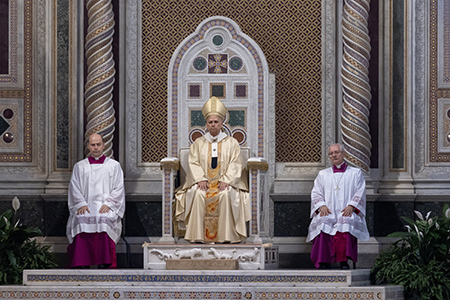
Pope Leo XIV sits in the “cathedra” or bishop’s chair at Rome’s Basilica of St. John Lateran as he celebrates Mass Nov. 9, 2025, the feast of the basilica’s dedication. (CNS photo/Pablo Esparza)

“We are the church of Christ, his body, his members called to spread his Gospel of mercy, consolation and peace throughout the world, through that spiritual worship that must shine forth above all in our witness of life,” he told people gathered to pray with him in St. Peter’s Square.

“So often, the frailties and mistakes of Christians, together with many clichés and prejudices, prevent us from grasping the richness of the mystery of the church,” he said.
However, the holiness of the church “is not dependent upon our merits, but on the ‘gift of the Lord, never retracted,’ that continues to choose ‘as the vessel of its presence, with a paradoxical love, the dirty hands of men,’” the pope said, quoting Pope Benedict XVI’s 1968 book, “Introduction to Christianity.”

In his homily at the basilica, Pope Leo asked the congregation to consider the foundations of the church they were standing in.

“If the builders had not dug deep enough to find a solid base on which to construct the rest, the entire building would have collapsed long ago or would be at risk of doing so at any moment,” he said. “Fortunately, however, those who came before us laid solid foundations for our cathedral, digging deep with great effort before raising the walls that welcome us, and this makes us feel much more at ease.”
As members of and laborers in the church, he said, Catholics today also “must first dig deep within ourselves and around ourselves before we can build impressive structures. We must remove any unstable material that would prevent us from reaching the solid rock of Christ.”

The church and its members must constantly return to Christ and his Gospel, the pope said, “otherwise we risk overloading a building with heavy structures whose foundations are too weak to support it.”
Building up the church of Christ is a time-consuming labor requiring hard work and patience, he said.
Part of that work, the pope said, is being humble enough to allow God to work on each member, the “living stones” who make up the church.

“When Jesus calls us to take part in God’s great project, he transforms us by skillfully shaping us according to his plans for salvation,” Pope Leo said. “This implies an uphill journey, but we must not be discouraged. Instead, we should continue with confidence in our efforts to grow together.”

Love, forgiveness defeat hatred, vengeance, pope tells chivalric order

By Carol Glatz
VATICAN CITY (CNS) – Pope Leo XIV thanked the Equestrian Order of the Holy Sepulchre of Jerusalem for supporting the Christian communities in the Holy Land, especially during the “tragic days of war.”

“In a world where arrogance and violence seem to prevail over charity, you are called to bear witness that life conquers death, that love conquers hatred, that forgiveness conquers vengeance, and that mercy and grace conquer sin,” he told members of the ancient Catholic chivalric order.

The pope met with more than 3,000 knights and dames of the Holy Sepulchre in the Vatican’s Paul VI Audience Hall Oct. 23 during their Jubilee pilgrimage to Rome. Cardinal Fernando Filoni, grand master of the order, was also present.

The order, a lay institution under the protection of the Holy See, supports the Latin Patriarchate of Jerusalem with prayers, financial assistance and regular pilgrimages. There are more than 30,000 members around the world.

Pope Leo thanked them for “the considerable help you give, quietly and without publicity, to the communities of the Holy Land, supporting the Latin Patriarchate of Jerusalem in its various activities: the seminary, schools, charitable work and assistance, humanitarian and educational projects, the university, aid to churches, with special interventions in times of greatest crisis, as was the case during COVID and the tragic days of war.”

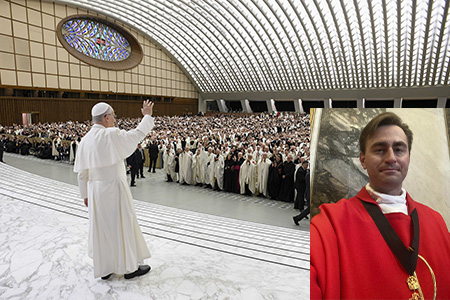
Pope Leo XIV greets members of the Equestrian Order of the Holy Sepulchre of Jerusalem in the Paul VI Audience Hall at the Vatican Oct. 23, 2025. (CNS photo/Vatican Media) Inset: Father Mark Shoffner, pastor of St. John Parish in Oxford, who attended the audience, said the pope looked directly at him and waved. (Photo courtesy of Father Shoffner)

With concrete and varied assistance, he said, “you show that safeguarding the tomb of Christ does not simply mean preserving a historical, archaeological or artistic heritage, however important, but is supporting a church made of living stones, which was born around it and still lives today as an authentic sign of Paschal hope.”

“To pause at the Lord’s tomb means, in fact, to renew one’s faith in God who keeps his promises, whose power no human force can defeat,” the pope said.

“How often, thanks to your work, a glimmer of light reappears for individuals, families and entire communities who risk being overwhelmed by terrible tragedies at every level, particularly in the places where Jesus lived,” he said.

Pope Leo encouraged the order’s members to continue with their “task of being guardians of the tomb of Christ” with “the confidence of expectation, the zeal of charity and the joyful enthusiasm of hope.”

Real faith changes the way Christians live, treat each other, pope says

By Carol Glatz
VATICAN CITY (CNS) – Christians must avoid using their faith to label those who are different – often the poor – as enemies to be avoided and rejected, Pope Leo XIV said.

“Some forms of worship do not foster communion with others and can numb our hearts,” he said in his homily during Mass in St. Peter’s Square Oct. 12 for the Jubilee of Marian Spirituality.

“Mary’s path follows that of Jesus, which leads us to encounter every human being, especially the poor, the wounded and sinners,” Pope Leo said in his homily. “Because of this, authentic Marian spirituality brings God’s tenderness, his way of ‘being a mother,’ to light in the church.”

Members of movements, confraternities and various Marian prayer groups were invited to Rome for their Oct. 11-12 Jubilee, which included an evening prayer service in the square Oct. 11 with Pope Leo in the presence of the original statue of Our Lady of Fatima.

The statue, brought from the Shrine of Our Lady of Fatima in Portugal, also was on display during the Oct. 12 Mass.

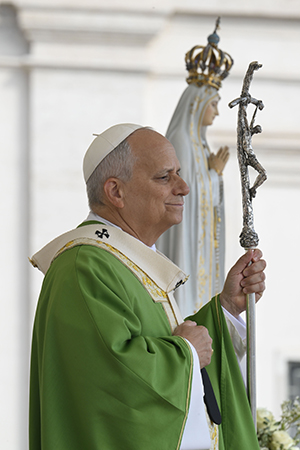
Pope Leo XIV stands with his crosier while in the background can be seen the original statue of Our Lady of Fatima during Mass as part of the Jubilee of Marian Spirituality in St. Peter’s Square at the Vatican Oct. 12, 2025. (CNS photo/Vatican Media)

Marian spirituality, “which nourishes our faith, has Jesus as its center,” Pope Leo said in his homily. Remembering Jesus Christ is what matters.

“The celebration of Sunday, therefore, should make us Christians,” he said. “It should fill our thoughts and feelings with the burning memory of Jesus and change the way we live together and the way we inhabit the earth.”

When some forms of worship fail to foster communion with others, he said, “we fail to encounter the people God has placed in our lives. We fail to contribute, as Mary did, to changing the world, and to share in the joy of the Magnificat.”

“Let us take care to avoid any exploitation of the faith that could lead to labelling those who are different – often the poor – as enemies, ‘lepers’ to be avoided and rejected,” he said.

“Marian spirituality is at the service of the Gospel” because “it reveals its simplicity,” he said.

“Our affection for Mary of Nazareth leads us to join her in becoming disciples of Jesus,” he said, and “it teaches us to return to him and to meditate and ponder the events of our lives in which the Risen One still comes to us and calls us.”

Marian spirituality “helps us to see the proud being scattered in their conceit, the mighty being cast down from their thrones and the rich being sent away empty-handed,” he said, referring to the Canticle of Mary (Lk 1:51-54). “It impels us to fill the hungry with good things, to lift up the lowly, to remember God’s mercy and to trust in the power of his arm.”

Just as God asked Mary for her “yes,” he said, “Jesus invites us to be part of his kingdom.”

“Dear friends, in a world seeking justice and peace, let us revive Christian spirituality and popular devotion to the events and places blessed by God that have changed the face of the earth forever,” he said.

La verdadera fe cambia la forma en que los cristianos viven y se tratan entre si, afirma el Papa León

By Carol Glatz
CIUDAD DEL VATICANO (CNS) – Los cristianos deben evitar usar su fe para etiquetar a los diferentes, a menudo a los pobres, como enemigos que hay que evitar y rechazar, declaró el Papa León XIV.

“El camino de María va tras el de Jesús, y el de Jesús es hacia cada ser humano, especialmente hacia los pobres, los heridos, los pecadores”, dijo el Papa León en su homilía durante la Misa celebrada en la Plaza de San Pedro el 12 de octubre con motivo del Jubileo de la Espiritualidad Mariana “Por eso, la auténtica espiritualidad mariana hace actual en la Iglesia la ternura de Dios, su maternidad”.

Miembros de movimientos, cofradías y diversos grupos de oración mariana fueron invitados a Roma para su Jubileo, celebrado los días 11 y 12 de octubre, que incluyó una oración vespertina en la plaza el 11 de octubre con el Papa León en presencia de la estatua original de Nuestra Señora de Fátima.

La estatua, traída del Santuario de Nuestra Señora de Fátima en Portugal, también estuvo expuesta durante la Misa del 12 de octubre.

El papa León XIV posa con su báculo mientras que al fondo se puede ver la estatua original de Nuestra Señora de Fátima durante la misa celebrada en el marco del Jubileo de la Espiritualidad Mariana en la plaza de San Pedro del Vaticano, el 12 de octubre de 2025. (Foto CNS/Vatican Media)

La espiritualidad mariana, “que alimenta nuestra fe, tiene a Jesús como centro”, dijo el Papa León en su homilía. Recordar a Jesucristo es lo que importa.

“Es necesario que el domingo nos haga cristianos”, afirmó. “Que llene de la memoria incandescente de Jesús nuestro sentir y nuestro pensar, modificando nuestra convivencia, nuestra forma de habitar la tierra”.

El Papa reflexionó sobre el Evangelio del día, en el que Jesús sanó a diez leprosos (Lc 17,11-19). Si bien todos le suplicaron y fueron sanados, solo uno, que era extranjero, dio gracias a Jesús y dio gloria a Dios.

“Los leprosos que en el Evangelio no vuelven a dar las gracias nos recuerdan, de hecho, que la gracia de Dios también puede alcanzarnos y no encontrar respuesta”, dijo. “curarnos y seguir sin comprometernos”.

“Cuidémonos, pues, de ese subir al templo que no nos lleva a seguir a Jesús”, dijo.

Cuando algunas formas de culto no fomentan la comunión con los demás y “nos anestesian el corazón”, dijo, “no vivimos verdaderos encuentros con aquellos que Dios pone en nuestro camino; no participamos, como lo hizo María, en el cambio del mundo y en la alegría del Magnificat”.

“Cuidémonos, pues, de ese subir al templo que no nos lleva a seguir a Jesús. Existen formas de culto que no nos unen a los demás y nos anestesian el corazón. Entonces. Cuidémonos de toda instrumentalización de la fe, que corre el riesgo de transformar a los diferentes – a menudo los pobres – en enemigos, en “leprosos” a los que hay que evitar y rechazar”, dijo.

“La espiritualidad mariana está al servicio del Evangelio” porque “revela su sencillez”, dijo. “El afecto por María de Nazaret nos hace, junto con ella, discípulos de Jesús”, dijo, y “nos educa a volver a Él, a meditar y a relacionar los acontecimientos de la vida en los que el Resucitado continúa a visitarnos y llamarnos”.

La espiritualidad mariana “nos ayuda a ver a los soberbios dispersos en los pensamientos de su corazón, a los poderosos derribados de sus tronos, a los ricos despedidos con las manos vacías”, dijo, refiriéndose al Cántico de María (Lc 1,51-54). “Nos compromete a colmar de bienes a los hambrientos, a enaltecer a los humildes, a recordar la misericordia de Dios y a confiar en el poder de su brazo”.

Así como Dios le pidió a María su “sí”, dijo, Jesús nos invita a ser parte de su reino.

“Queridos hermanos, en este mundo que busca la justicia y la paz, mantengamos viva la espiritualidad cristiana, la devoción popular por aquellos hechos y lugares que, bendecidos por Dios, han cambiado para siempre la faz de la tierra”, dijo. “Hagamos de ella un motor de renovación y transformación”, dijo, especialmente durante este Año Santo, que fomenta la conversión, la restitución, la reflexión y la liberación.

Durante la Misa, una de las oraciones de los fieles pidió que Dios “disipara todo orgullo del corazón de quienes ocupan puestos de poder e inspirara decisiones que favorezcan a los pequeños y a los últimos”.

El Papa ofreció su propia oración, encomendando la Iglesia, el mundo y toda la humanidad a María.
“Virgen Santa, Madre de Cristo, nuestra esperanza, tu presencia solícita en este Año de Gracia nos acompaña y nos consuela, y nos da, en las noches oscuras de la historia, la certeza de que en Cristo el mal es vencido y cada persona es redimida por su amor”, dijo.

“A tu Corazón Inmaculado encomendamos el mundo entero y a toda la humanidad, especialmente a tus hijos atormentados por el flagelo de la guerra”, dijo. “Abogada de la gracia, aconséjanos en el camino de la reconciliación y el perdón, no dejes de interceder por nosotros, en la alegría y en la tristeza, y consíguenos el don de la paz que imploramos con insistencia”.

Pope tells catechists their love and witness can change lives

By Cindy Wooden , Catholic News Service

VATICAN CITY (CNS) — When catechists teach, their aim is not simply to pass on information about the faith but to “place the word of life in hearts, so that it may bear the fruits of a good life,” Pope Leo XIV said.

“The Gospel announces to us that everyone’s life can change because Christ rose from the dead. This event is the truth that saves us; therefore, it must be known and proclaimed,” the pope told some 20,000 catechists from more than 115 countries attending the Jubilee for Catechists.

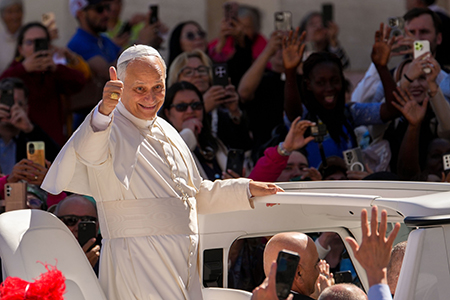
Pope Leo XIV greets people from the popemobile as he rides around St. Peter’s Square following Mass for the Jubilee of Catechists at the Vatican Sept. 28, 2025. (CNS photo/Lola Gomez)

But just proclaiming the Good News is not enough, the pope said in his homily at Mass Sept. 28 in St. Peter’s Square. “It must be loved. It is love that leads us to understand the Gospel.”

During the liturgy, Pope Leo formally installed in the ministry of catechist 39 women and men from 16 countries, including David Spesia, executive director of the U.S. bishops’ Secretariat of Evangelization and Catechesis, and Marilyn Santos, associate director of the secretariat.

Before the pope gave his homily, a deacon called the names of each of the 39, who answered in Italian, “Eccomi,” or “present.” After the homily, Pope Leo presented each of them with a crucifix.

“Let your ministry ever be grounded in a deep life of prayer, let it be built up in sound doctrine and animated by genuine apostolic zeal,” the pope told them. “As stewards of the mission entrusted to the church by Christ, you must always be ready to give an answer to anyone who asks you for a reason for the hope that is in you.”

The Gospel reading at the Mass was the parable of the rich man and Lazarus from Luke 16:19-31.

In the parable, the pope said, Lazarus is ignored by the rich man “and yet God is close to him and remembers his name.”

But the rich man has no name in the parable, “because he has lost himself by forgetting his neighbor,” the pope said. “He is lost in the thoughts of his heart: full of things and empty of love. His possessions do not make him a good person.”

“The story that Christ tells us is, unfortunately, very relevant today,” Pope Leo said. “At the doorstep of today’s opulence stands the misery of entire peoples, ravaged by war and exploitation.”

“Through the centuries, nothing seems to have changed: how many Lazaruses die before the greed that forgets justice, before profits that trample on charity, and before riches that are blind to the pain of the poor,” he said.

In the parable, the rich man dies and is cast into the netherworld. He asks Abraham to send a messenger to his brothers to warn them and call them to repent.

The Gospel story and the words of Scripture that catechists are called to share are not meant to “disappoint or discourage” people, but to awaken their consciences, the pope said.

Echoing the words of Pope Francis, Pope Leo said the heart of catechesis is the proclamation that “the Lord Jesus is risen, the Lord Jesus loves you, and he has given his life for you; risen and alive, he is close to you and waits for you every day.”

That truth, he said, should prompt people to love God and to love others in return.

God’s love, he said, “transforms us by opening our hearts to the word of God and to the face of our neighbor.”

Pope Leo reminded parents that they are the first to teach their children about God, his promises and commandments.

And he thanked everyone who has been a witness to others of faith, hope and charity, cooperating in the church’s “pastoral work by listening to questions, sharing in struggles and serving the desire for justice and truth that dwells in the human conscience.”

Teaching the faith is a community effort, he said, and the Catechism of the Catholic Church “is the ‘travel guidebook’ that protects us from individualism and discord, because it attests to the faith of the entire Catholic Church.”

Migrants, refugees are often models of hope and faith, pope says

By Cindy Wooden
VATICAN CITY (CNS) – Migrants and refugees often are “privileged witnesses of hope through their resilience and trust in God,” Pope Leo XIV said.

“Often they maintain their strength while seeking a better future, in spite of the obstacles that they encounter,” he said Oct. 2 during a meeting with participants in the conference “Refugees and Migrants in Our Common Home,” organized by Villanova University.

The Vatican dicasteries for Promoting Integral Human Development and for Culture and Education and the U.S. bishops’ Migration and Refugee Services were among the co-sponsors of the conference, held in Rome Oct. 1-3 just before the Jubilee of Migrants and the Jubilee of Missions Oct. 4-5.

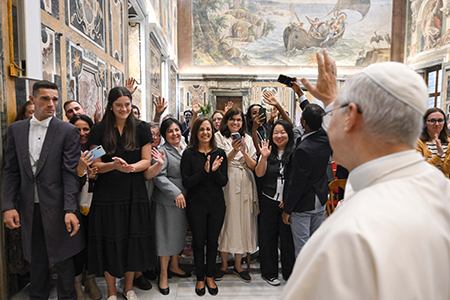
Pope Leo XIV waves goodbye to participants in the conference “Refugees & Migrants in Our Common Home,” organized by the Augustinian-run Villanova University in suburban Philadelphia, at the end of an audience at the Vatican Oct. 2, 2025. (CNS photo/Vatican Media)

Pope Leo encouraged participants to share migrants’ and refugees’ stories of steadfast faith and hope so that they could be “an inspiration for others and assist in developing ways to address the challenges that they have faced in their own lives.”

Overcoming the widespread sense that no one can make a difference “requires patience, a willingness to listen, the ability to identify with the pain of others and the recognition that we have the same dreams and the same hopes,” Pope Leo XIV told the group.

Before the conference, Villanova held the official launch of its Mother Cabrini Institute on Immigration, which promotes programs of scholarship, advocacy and service to migrants.

Pope Leo praised the project’s goal of bringing together “leading voices throughout a variety of disciplines in order to respond to the current urgent challenges brought by the increasing number of people, now estimated to be over 100 million, who are affected by migration and displacement.”

Sister Norma Pimentel, a Missionary of Jesus and executive director of Catholic Charities of the Rio Grande Valley in Brownsville, Texas, said migrants “are missionaries of hope to us, because their presence with us honestly sanctifies who and where we are.”

People who fear migrants and refugees or believe they are coming just to take jobs need to take the time to meet them, Sister Pimentel said. Then, “they will stop seeing them as somebody that is invading my space, but rather as somebody who I have the opportunity to be able to show the presence of God.”

Addressing the conference Oct. 1, she said that “in a world marked by fear, division and uncertainty, we are invited to be people of hope, pilgrims of hope, of that hope which comes from our trust in the Lord.”
“In this Jubilee Year of Hope, we are called to find within ourselves kindness and compassion and courage, especially courage,” Sister Pimentel said.

Migrants are not enemies, just brothers and sisters in need, pope says

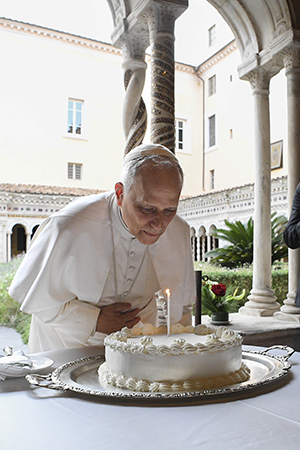
Pope Leo XIV blows out a candle on a cake for his 70th birthday Sept. 14, 2025, as cardinals, Vatican officials and ecumenical leaders look on after a prayer service at Rome’s Basilica of St. Paul Outside the Walls. (CNS photo/Vatican Media)

By Cindy Wooden
VATICAN CITY (CNS) – At a time when people feel powerless to help migrants and refugees, Christians must continue to insist that “there is no justice without compassion, no legitimacy without listening to the pain of others,” Pope Leo XIV said.

In a video message Sept. 12, the pope gave his full support to a bid by the people of the Italian island of Lampedusa to win UNESCO recognition for their “gestures of hospitality” to migrants as an example of an “intangible cultural heritage” that should be protected.

For decades the small island, which lies between Sicily and the northern African nations of Tunisia and Libya, has been a major arrival point for migrants from Africa, the Middle East and Asia seeking a new life in Europe. However, many migrants make the journey in unsafe vessels or without needed provisions. Shipwrecked boats and dead bodies have washed up on the island’s shores.

Pope Leo paid tribute to “the volunteers, the mayors and local administrations that have succeeded one another over the years,” to “the priests, doctors, security forces, and to all those who, often invisibly, have shown and continue to show the smile and attention of a human face to those who have survived their desperate journey of hope.”

But the pope also noted the political divisions and backlash that have accompanied the continued arrival of migrants and refugees on Lampedusa’s shores and to other nations.

“It is true that over the years fatigue can set in. Like in a race, we can run out of breath,” he said.

“Hardships tend to cast doubt on what has been done and, at times, even divide us. We must respond together, staying united and opening ourselves once again to the breath of God.”

“All the good you have done may seem like drops in the sea,” Pope Leo told the island’s people. “But it’s not so – it is much more than that!”

Many of the migrants, including mothers and children, never made it to shore and from the depths of the sea “cry out not only to heaven, but to our hearts,” he said. Others died and are buried on Lampedusa “like seeds from which a new world longs to sprout.”

But, he said, “thank God, there are thousands of faces and names of people who today are living a better life and will never forget your charity. Many of them have themselves become workers for justice and peace, because goodness is contagious.”

Pope Leo said his thanks is the thanks “of the whole church for your witness,” and is meant to renew the thanks of the late Pope Francis, who made a trip to Lampedusa the first official trip of his papacy. He said he hoped he, too, would be able to visit the island soon.

The islanders’ hospitality and welcome, he said, are “a bulwark of humanity, which loud arguments, ancient fears and unjust policies try to erode.”

“The ‘globalization of indifference,’ which Pope Francis denounced beginning from Lampedusa, today seems to have turned into a globalization of powerlessness,” Pope Leo said.

Thanks to the media, people are more aware of “injustice and innocent suffering,” he said, but increasingly “we risk standing still, silent and saddened, overcome by the feeling that nothing can be done.”

People ask themselves, “What can I do in the face of such great evils?” he said.

“The globalization of powerlessness is the child of a lie: that history has always been this way, that history is written by the victors, which makes it seem that we can do nothing,” the pope said. “But that is not true: history is ravaged by the powerful, but it is saved by the humble, the just, the martyrs, in whom goodness shines and true humanity endures and is renewed.”

The antidote, Pope Leo said, is to work to create “a culture of reconciliation.”

“Reconciliation is a special kind of encounter. Today we must meet one another, healing our wounds, forgiving each other for the wrong we have done – and even for the wrong we have not done but which we still bear the consequences of,” the pope said. “So much fear, so many prejudices, so many walls – even invisible ones – exist between us and between our peoples, as consequences of a wounded history.”

While fear and evil can be passed from one generation to the next, he said, so can goodness.

“We must repair what has been broken, delicately treat bleeding memories, draw close to one another with patience, put ourselves in the place of others’ stories and suffering, and recognize that we share the same dreams and the same hopes,” Pope Leo said. “There are no enemies – only brothers and sisters. This is the culture of reconciliation.”

Hope is knowing that God is near and that love will win, pope says

By Cindy Wooden
VATICAN CITY (CNS) – Christian hope is not about avoiding pain and suffering but about knowing that God gives people the strength to persevere and to love even when things go wrong, Pope Leo XIV said.

When Jesus allowed himself to be arrested in the Garden of Gethsemane, he showed that “Christian hope is not evasion, but decision,” the pope told thousands of people gathered in the Vatican audience hall Aug. 27 for his weekly general audience.

“The way that Jesus exercised his freedom in the face of death teaches us not to fear suffering, but to persevere in confident trust in God’s providential care,” the pope said in his address to English speakers.
“If we surrender to God’s will and freely give our lives in love for others, the Father’s grace will sustain us in every trial and enable us to bear abundant fruit for the salvation of our brothers and sisters,” he said.

A person of faith, the pope said, does not ask God “to spare us from suffering, but rather to give us the strength to persevere in love, aware that life offered freely for love cannot be taken away by anyone.”

Jesus lived every day of his life as preparation for the “dramatic and sublime hour” of his arrest, his suffering and his death, the pope said. “For this reason, when it arrives, he has the strength not to seek a way of escape. His heart knows well that to lose life for love is not a failure, but rather possesses a mysterious fruitfulness, like a grain of wheat that, falling to the ground, does not remain alone, but dies and becomes fruitful.”

Pope Leo XIV lifts a baby as he greets visitors at the conclusion of his weekly general audience in the Paul VI Audience Hall at the Vatican Aug. 27, 2025. (CNS photo/Lola Gomez)

Naturally, Pope Leo said, Jesus “is troubled when faced with a path that seems to lead only to death and to the end. But he is equally persuaded that only a life lost for love, at the end, is ultimately found.”

“This is what true hope consists of: not in trying to avoid pain, but in believing that even in the heart of the most unjust suffering, the seed of new life is hidden,” he said.

After spending more than 90 minutes greeting people in the audience hall, including dozens of newlywed couples, Pope Leo went into St. Peter’s Basilica, where hundreds of people who did not get a place in the hall had been watching the audience and waiting for their turn to see the pope.

The pope thanked them for their patience, which, he said, “is a sign of the presence of the Spirit of God, who is with us. So often in life, we want to receive a response immediately, an immediate solution, and for some reason God makes us wait.”

“But as Jesus himself taught us, we must have that trust that comes from knowing that we are sons and daughters of God and that God always gives us grace,” the pope said. “He doesn’t always take away our pain or suffering, but he tells us that he is close to us.”