
Mississippi native ordained to Dominican order

KNEADING FAITH
By Fran Lavelle
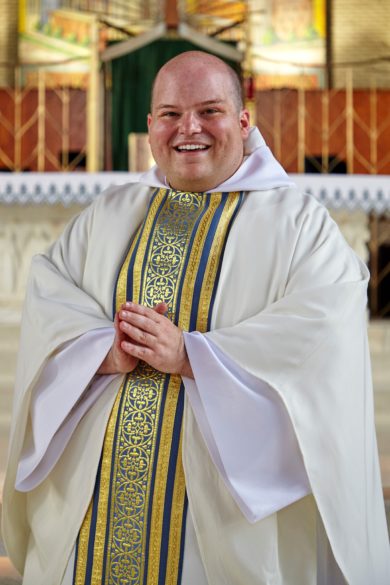
NEW ORLEANS – Father James Martin Nobles, OP formerly known as Adam Nobles was ordained a Dominican priest on June 12 at St. Dominic Catholic Church in New Orleans. He was born in New Orleans and raised in Fernwood, Mississippi. His parents, Dr. Jim and Penny, had five children, Adam being the mold breaker.
I will never forget the first day I met Adam. A ruddy cheeked cherub showed up in the sacristy at St. Joseph’s Catholic Church in Starkville in the fall of 2008. He was one of the many new Catholic freshmen moving to Starkville that fall. Like his contemporaries he was full of energy, had many hopes and dreams, and was anxious about this new chapter of life. But unlike his contemporaries, Adam had been accepted by the Diocese of Jackson to pursue priestly formation with the caveat that his first two years of undergraduate education would be at one of Mississippi’s public universities. Lucky for me, Adam was sent to Mississippi State.
For those of us lucky enough to work in youth and young adult ministry there are times in our ministry when we just know a particular student is going to test our limits. While this does not sound flattering at all Adam will tell you it is true.
The recent high school graduate that I met in 2008 had it all figured out, or at least he thought so. I am not one to let the misgivings of youth get in the way of my call to serve with love. I am grateful Father Kent Bowlds sent Adam to Mississippi State for those first two years of his formation. I witnessed his maturation and his growing understanding of who and whose he is.

Father James Martin Nobles, OP (formerly known as Adam Nobles) was ordained on Saturday, June 12 for the Province of St. Martin de Porres Order of Friars Preachers. He will serve in the Diocese of Memphis. Father Nobles attended St. Alphonsus McComb and spent time “kneading” his faith with Fran Lavelle while a student at Mississippi State University. (Photo courtesy of Father Nobles)

Adam was very involved with our campus ministry program. He served on our leadership team, took mission trips, went on retreats and taught CCD.
I remember one day Adam stopped by to see me and told me about how he got in trouble with the DRE for taking his class to the Knights of Columbus pancake breakfast instead of class one Sunday morning. She was concerned that the children in the other grades would feel left out. Instead of feeling defeated he came to me to help devise a plan to allow the other classes the opportunity to attend the pancake breakfast too.
Of all of the gifts Adam shared with his fellow Catholics at Mississippi State his laughter was, and is, his enduring legacy. He is one of those good souls that God blessed with an extra dose of holy laughter when Adam was born. Anyone who knows anything about holy laughter is that we laugh with, and not at, someone else. It is the kind of laughter that leaves one’s sides hurting for hours if not days. We did a lot of laughing and had our share of tears in those two short years.
In 2010 it was time for Adam to leave us and go to St. Joseph Seminary College to complete his bachelor’s degree in Philosophy and Theological Studies. In 2012, he entered Notre Dame Seminary in New Orleans. Several of our younger priests in the diocese studied with him there. I am certain the stories of shenanigans they can tell would fill a book.
Throughout his formation Adam was diving deeper into who and whose he is. From this place of deep reflection and introspection he discerned that being a diocesan priest was not what God was calling him to. After months of prayer Adam found consolation in the charism of the Dominican Order. In 2014, Adam began the long journey to priesthood as a Dominican friar. No doubt the synthesis of active and contemplative aspects of the order and the richness of community life spoke to Adam.
Over the past nearly thirteen years I have had the privilege to watch a ruddy cheeked cherub with an attitude grow into a compassionate servant leader and preacher. Over the years he has shared milestones with me. With each phase of his formation and education the easy going, fun loving guy I first met was still present, but I also witnessed the emergence of the deeply grounded caring man he is today. I recall his grand ideas of what he thought priesthood was all about. That too has changed. He is someone who now seeks those on the periphery and understands what it means to serve them. Our phone conversations still include robust outbursts of laughter and always end with “I love you.”
That is one thing I know for sure will not change now that he has been ordained a priest. We are all given opportunities to accompany others in this journey. Finding the sacred in the ordinary and not taking oneself too seriously are critical elements in accompaniment for the long haul. My dear Father James Martin Nobles, you know well how to do both. I pray you always will.

(Fran Lavelle is the Director of Faith Formation for the Diocese of Jackson.)
Gift of four friends wrapped in one

Kneading Faith
By Fran Lavelle
Several years ago, when I was still the campus minister at Mississippi State, I also had the privilege to serve as the diocesan director for the Office of Campus Ministry. In that role I was part of the Department of Formational Ministries. A change in leadership in the department came about when Sister Deborah Hughes retired, and Cathy Cook was named the Superintendent of Catholic Schools and the head of the department. When Jeanne Howard retired in 2014, I was approached by a few people and asked to consider the position. I remember meeting with Cathy at Lake Tiak O’Khata that July for an interview. It turned out to be more like a conversation between old friends although we had not known one another very long. It was then that I knew the Holy Spirit was calling me to work in the chancery. Her confidence in me was ultimately the reason I accepted the job. Her confidence in me is ultimately the reason I became the director of the Department of Faith Formation.

Cathy announced earlier this Spring that she would be retiring at the end of April. She has served the church for 30 years in many roles within education and youth ministry. It is always bittersweet when colleagues of Cathy’s caliber announce their retirement. On the one hand I am so pleased that she will be able to pursue interests other than work. On the other hand, I will miss the day-to-day interactions. We both place a high premium on serving the young church.
Sharing a background in youth ministry was the source of many robust conversations. I remember after I moved my personal effects into my office at the chancery, Cathy saw a candle that I had from a diocesan youth convention many years earlier when I served as youth minister for St. Joseph in Starkville. She asked me with some urgency to follow her to her office. There she showed me the candle she had from the same convention when she was the youth minister at St. Mary’s Basilica in Natchez. It was as if our fate was sealed at that Youth Convention those many years earlier though we do not remember meeting one another there.
I was recently with one of Cathy’s former employees from the Office of Catholic Education. We talked about the many people that she empowered over the years in church lay leadership. There are no doubt countless former employees, students, educators, administrators, and other church leaders who have benefitted from her years of dedicated service. In her leadership role, she advocated for training and education for lay leaders.
Over the past six plus years Cathy has helped me keep focused on the mission of Christ and not get bogged down in the mess. She taught me the value of discerning what “hills to die on” and when it is prudent to stay the course. She knows the value of a good laugh, appreciates a good meal, and enjoys sports at all levels. Her love of sports knows no bounds as she recently cheered for my alma mater in the NCAA Basketball tournament. I am Cathy’s only connection to Ohio University, but she wouldn’t let that minor detail get in the way of watching them play and cheering when they knocked off Virginia, the defending tournament champions.
Thinking about Cathy’s retirement reminded me of something I heard in a webinar sponsored by Ave Maria Press that I watched last Summer titled, “Strengthening Your Inner Life in Challenging Times: The Simple Care of a Hopeful Heart” presented by Dr. Robert J. Wicks. Dr. Wicks is Catholic and works as a clinical psychologist. He writes and speaks about the intersection of spirituality and psychology. In his presentation he mentions the four kinds of friends everyone should have:
The Prophet … who helps name what voices are guiding you in your life;
the Cheerleader … who is sympathetic and encouraging;
the Harasser or Teaser … because on the way to taking compassion seriously sometimes we take a detour and take ourselves too seriously; and,
the Inspirational friend that calls us to be all that we can be without embarrassing us that we are where we are.
Little did I know when we first met the impact she would have on my life and the role she would play as a prophet, cheerleader, teaser, and inspirational friend. This is not good-bye. I fully expect to continue to share good laughs, tasty meals, and a sporting event or two. I also expect I’ll continue to seek her advice.
If you are lucky to have the four types of friendships Dr. Wicks identifies you are very fortunate. When they come wrapped up in one bundle of energy, joy, and laughter you are especially blessed. There’s an old Irish proverb that reminds me of Cathy: “A good friend is like a four-leaf clover: hard to find and lucky to have.”

(Fran Lavelle is the Director of Faith Formation for the Diocese of Jackson.)

Indexing your life – a spiritual excercise

Kneading Faith
By Fran Lavelle
I watched a webinar sponsored by Ave Maria Press given by Jonathan Montaldo on “The Spiritual Exercises of Thomas Merton” a few weeks ago. Montaldo was the director of the Thomas Merton Center at Bellarmine University in Louisville, Kentucky. He also served a term as President of the International Thomas Merton Society. I was struck by the unpretentious manner in which Montaldo spoke of Merton. It was evident that Montaldo appreciated the very human, very ordinary Merton. He went so far as to caution against elevating Merton to some kind of guru status. He also reminded the viewer that Merton did not advocate a particular spiritual practice; rather, Merton was calling others to find their own authentic path to a greater intimacy with God. In the spirit of Dom John Chapman, OSB, Merton would have us pray as we can, not as we can’t.

Pointing to the simplicity of Merton’s message, Montaldo shared an entry from one of Merton’s notebooks from the time period he was novice master. In it Merton instructed the novices:
Enter deeply into the school of life itself. Your life is a school of wisdom. Ruminate on the text of your life as a spiritual exercise to excavate God’s loving-kindness to you through your life’s thicket of relationships. Receive every event and learning as a secret instruction from God. Reflect on the action and Grace and detect the innumerable movements of divine Love in your life.

The term “school of life” deeply resonated with me. As Catholic Christians we are called to lifelong conversion. We are called to continue to journey deeper into the mystery of God’s love. Reflecting on our own school of life should not become overly scrupulous or self-centered. We should heed the directive to “receive every event as a secret instruction from God.” Filtering one’s life experience through the lens of what lessons we learn is powerful. Given the correct context, what would ruminating on the text of your life reveal? In journeying back through time ask yourself, who taught you to pray? Who in your church community taught you how to live a life of faith? Who loved you into the “now” of your life?

Merton’s editor compiled an index for his autobiography, The Seven Story Mountain. The index detailed the myriad of people who contributed to Merton’s faith journey. It served as an alphabetical listing of who’s who over the decades of his life. Reportedly the index was Merton’s most prized part of the book.
What would the index of your life look like? What people, places and situations over the course of your life have made you who you are today? Who are the people you owe your life to because of their love for you? Who are the people who have caused you to suffer? Who are the people who have given you wounds that have turned into blessings? What are the places and events that shaped and formed you?
Making an index is a spiritual exercise that can lead to greater gratitude. A thankful heart inevitably leads us into greater intimacy with God.

During our recent ice and snowstorm, I was talking to a friend about the powerful events that seem to continue to drive us indoors. In addition to the ice and snow we are still in the middle of the pandemic that has drastically curbed our exterior lives. As I sat in prayer on Ash Wednesday morning, I reflected on the previous few days of being sheltered in place. I began seeing this situation as a gift rather than a limitation. With our mobility restricted and literally restrained indoors, I wondered what the next few days would look like if I allowed myself to shelter in place in my interior life as well. What would it look like if I invited God in to the icy, slushy, and messy places in my heart?

I thought about the Merton webinar and replayed it. I am working on an index of my life. It is something I plan on working on throughout Lent adding a few names, places, and events every day. So far, each remembrance has reinforced my gratitude for the gift of my journey. Merton believed that each person in his index was an essential part of his salvation story because he was able to see it all as a gift from God.
I am reminded that some of my best teachers taught me by their example of who I did not want to be. In the same way I recognize the giants whose shoulders I am privileged to stand on. And, not just people, but places and events. I am reminded that my maternal heart was first stirred by a calf I received for my seventh birthday. I wrote Hubert letters and signed them “Love, Your Mother.” Hubert is named in my index.

Many people have asked what does one give up for Lent in the middle of a devastating pandemic when we have already given so much up. It is a legitimate question. Maybe this year instead of giving up we can add up. Yes, add up all the lessons from our school of life and offer them back to God in the form of thanksgiving. And to the extent we are able to, give others a reason to be included in their index by loving and living authentically as Jesus calls us to.

(Fran Lavelle is the Director of Faith Formation for the Diocese of Jackson.)

Surrender to peace

Kneading Faith
By Fran Lavelle
For me, there is something so immensely inviting about a cold grey December morning. Perhaps it invokes memories of Winter growing up on our farm in Southeastern Ohio. There is a stillness in a cold grey day that creates room for a pause. It is that pause that I most appreciate. Instead of jumping into the activity of the day I feel permission to sit with a cup of coffee and gaze out the window. I recently had such an experience Saturday morning a few weeks back. Surrounded by incredible peace, for a moment I forgot that our country and the world is being ravished by a pandemic. I also forgot that our politics in this country have become so polarized that death threats levied against political opponents has become commonplace.
It has been a long year. It has been a difficult year; for some much more than others. I try to look for meaning in times that seem senseless and hope in the midst of grief. There are many factors that continue to lead us away from seeing one another as God’s beloved children. What we consume on cable news networks and social media play a big part in that widening chasm. Reconciling our communities with divergent very public (some might say vitriol) views is no small task. Two keen examples are our response to the virus (particularly mask wearing) and the outcome of the recent election. If our faith is what is going to save us, then we need to be willing to put into practice what we believe.
I have spent some time this Fall reading Fratelli Tutti, Pope Francis’ most recent encyclical letter. The thesis of Fratelli Tutti is a timely call for the human family to acknowledge the dignity of one another. In framing the issue of our indifference to one another he is brutally honest about how far we are from true fraternal love. The scriptural centerpiece of this plea is the parable of the Good Samaritan. His approach to Scripture is very Ignatian. He reflects on the characters in the story and asks the reader to imagine themselves in the story in each character role. This mechanism builds a greater understanding of the complexity of the characters and builds a better understanding of the bigger picture. He then takes us deeper into our own reality and challenges us to reflect on whether our actions align with our vision and fulfill our mission.
Pope Francis was very successful in using the Parable of the Good Samaritan to illustrate the meaning of fraternal care. He adeptly negotiates the landscape of identifying not only the issues but allowing for reflection and action. His vision is always aligned with the mission of the Gospel. The continuity of that messaging was an “Ah Ha” moment for me.
If the goal of a leader is to articulate a vision and to motivate others to share in and carry out the vision, clear and accessible communication is necessary. So is honesty in assessing the current situation. We need to be realistic about where we are to successfully map out the path to where we want to go.
I do not think anyone relishes the constant reminders that we are a deeply divided country. I think that most Americans, and really all of humanity, want to live in peace. We cannot expect that government or Church leaders can solely change this narrative. We must all participate if change is to be sustainable. If we all spent less time following social media and more time following the Gospel, we would be less anxious and more hopeful. We do not change the narrative by adding to the cacophony of noise. We change the narrative by turning to God and one another and living the Gospel.
I was recently reminded of the World War I Christmas Truce. On Christmas Eve, German and British troops fighting in World War I sang Christmas carols to each other across the lines. Christmas morning after white flags appeared from both sides, soldiers emerged from their trenches and shook hands with one another. They shared food and drink. There is documentation of soldiers from opposing sides playing a good-natured game of soccer. If amid a World War, so called dehumanized enemies can stop fighting and see one another the way God sees us – as one family – I know we can do the same. This Christmas give yourself a gift. Raise a white flag. Surrender to peace. The division ends when we stop giving our energy to it.

(Fran Lavelle is the Director of Faith Formation for the Diocese of Jackson)

Following Jesus requires action

“While you are proclaiming peace with your lips, be careful to have it even more fully
in your heart.”

St. Francis of Assisi

Kneading Faith
By Fran Lavelle
We are amid a very divisive and heated political election cycle. The flames of division are stoked daily by news outlets, social media, family dinner tables, and yes, even the church. We seek validation of our political agendas by quoting people we respect, often political and religious leaders. I have threatened for years that I am going to write a book entitled, “If we are all right, who’s left?” That is to say that we cannot all be right, all the time. I believe that having deeply held beliefs is a good thing. What we cannot afford to do is judge and dismiss those who think differently than we do. Or worse yet alienate people because we do not see the issues through the same lens, especially those who are members of our family.

We just celebrated the Feast Day of St. Francis of Assisi a few days ago. Imagery of St. Francis evokes a sense of serenity and peace. He is often featured with deer and forest creatures in painted works and in carvings and statutes there is often a bird on his shoulder or in his hand. He is the patron of animals, merchants and the environment. But he is also well known for a prayer he wrote simply known as the St. Francis prayer. In 1967 the prayer was adapted by Third Order Franciscan and South African songwriter Sebastian Temple. The song is literally part of the soundtrack of my Catholic upbringing. I am certain some of you are humming the familiar tune now. Perhaps the familiarity of the prayer and song has overtime cheapened the message. It begins, “Make me an instrument of your peace … where there is hatred let me sow love.” Notice, St. Francis used the word “instrument.” Miriam Webster defines instrument as a means whereby something is achieved, performed, or furthered. When we pray this prayer, we are asking God to use us to fight the agency of hatred, injury, doubt, despair, darkness and sadness. Further we are asking God to replace them with acts of love, forgiveness, faith, hope, light and joy. If I offer myself as an instrument of His peace, I need to mean it.

In thinking about St. Francis and his feast day, I asked myself how I am doing with the challenge of this prayer. I joke that I am Jesuit trained but hold a deep Franciscan spirituality much like another Francis (wink). There is a great gift in the blending of these two powerful spiritualities.

St. Francis offers a reminder that we are to be instruments, that is we are to be used to make peace. St. Ignatius offers a tool to help us assess how we are doing. In Ignatian spirituality one is asked to perform a daily examen, a review of one’s day if you will. The examen utilizes time set aside for reflection on where God is in your everyday life. There are five steps: offer thanks to God, ask the Holy Spirit for light to see what God is revealing to us, review the day, face your shortcomings, and look toward the day to come. For sure, I fall short. Sometimes my ego gets in the way. Sometimes it is my pride. But as in all growth, awareness is the first step to change.

The spirituality of St. Francis and St. Ignatius both offer great resources to help us navigate an increasingly divisive culture. Following Jesus is not merely an intellectual pursuit. Following Jesus requires action.

While none of us are perfect in this pursuit we are called to live out our faith in word and deed. That brings me back to the contentious political environment we are living in. How do we communicate that we are a Christians? Do our conversations and posts on social media reflect Jesus and his teachings? Our words matter. Are we instruments of love, forgiveness, faith, hope, light and joy? If not, are we adding to the hatred, injury, doubt, despair, darkness and sadness that the world already possesses too much of? I am reminded of a story and quote that I first heard in a homily. It is a fitting reminder that our words matter.

In 1977, Frank Outlaw the president of the Bi-Lo stores is attributed in a Texas newspaper to having said, “Watch your thoughts, they become words. Watch your words, they become actions. Watch your actions, they become habits. Watch your habits, they become character. Watch your character, for it becomes your destiny.”

Let your words and your light shine that you may illuminate a path for others to follow that they too may reflect Christ. Be kind to one another, after all we belong to the same Father.

(Fran Lavelle is the Director of Faith Formation for the Diocese of Jackson)

Social teachings make way for dialogue

Kneading Faith
By Fran Lavelle
I have been trying to process the devasting toll the coronavirus has had on so many around the world and the impact of George Floyd’s death. Every day seems to bring its own new set of challenges to our already highly emotionally charged world. In all of it I have been listening to the voices of our young people from teenagers to the 40-somethings. It occurred to me that the generations who were brought up watching Sesame Street, Mr. Rogers, and Barney have taken notice that we are not as Barney proclaimed, ”a happy family.” Watch the news, look at your social media newsfeed, talk to the younger members of your community and you will quickly hear their clarion call for change. And, in thinking about the messaging they grew up with, I totally understand where their clarion call is coming from. Moreover, I truly appreciate it.

In the past decade or so in this country we have allowed the politics of hatred to divide us so deeply that we have stopped seeing one another as God’s beloved and only as opposites. If you are not with us, you are our enemy. The divisiveness is driving wedges between co-workers, church members, friends and family. And the Body of Christ is suffering because we are quick to see one another as hostile enemies, forgetting that we share in our dignity as God’s beloved.

In Genesis 1:27 we read: “God created mankind in his image; in the image of God he created them; male and female he created them.” When the dignity of others is eroded by indifference, prejudice and distrust we stop seeing the beauty of God’s creation. The first Chapter of Genesis teaches us about the goodness of creation and the divine desire that human beings share in that goodness. God brings an orderly universe out of chaos and gives humanity dominion over it. With the power of dominion comes the responsibility to be good stewards of our resources.

The good news is that we have an excellent resource to help us have constructive dialogue. Catholic social teaching is the articulation of Catholic doctrines on matters of human dignity and common good in society. The following is a summary from the USCCB on the core principles of Catholic social teaching:
Life and Dignity of the Human Person: The Catholic church proclaims that human life is sacred, and that the dignity of the human person is the foundation of a moral vision for society. This belief is the foundation of all the principles of our social teaching.

Call to Family, Community and Participation: The person is not only sacred but also social. How we organize our society directly affects human dignity and the capacity of individuals to grow in community. We believe people have a right and a duty to participate in society, seeking together the common good and well-being of all, especially the poor and vulnerable.

Rights and Responsibilities: The Catholic tradition teaches that human dignity can be protected and a healthy community can be achieved only if human rights are protected and responsibilities are met. Every person has a fundamental right to life and a right to those things required for human decency. Corresponding to these rights are duties and responsibilities – to one another, to our families and to the larger society.

Option for the Poor and Vulnerable: A basic moral test is how our most vulnerable members are faring. In a society marred by deepening divisions between rich and poor, our tradition recalls the story of the Last Judgment (Matthew 25:31-46) and instructs us to put the needs of the poor and vulnerable first.

The Dignity of Work and the Rights of Workers: The economy must serve people, not the other way around. Work is more than a way to make a living; it is a form of continuing participation in God’s creation. If the dignity of work is to be protected, then the basic rights of workers must be respected.
Solidarity: We are one human family whatever our national, racial, ethnic, economic and ideological differences. We are our brothers’ and sisters’ keepers, wherever they may be. Loving our neighbor has global dimensions in a shrinking world. Pope St. Paul VI taught that “if you want peace, work for justice.”
Care for God’s Creation: We show our respect for the Creator by our stewardship of creation. We are called to protect people and the planet, living our faith in relationship with all of God’s creation.
Let us listen to the voices of our young people and heed the call for unity.

“Each one of us is called to be an artisan of peace, by uniting and not dividing, by extinguishing hatred and not holding on to it, by opening paths to dialogue and not by constructing new walls!” – Pope Francis

(Fran Lavelle is the Director of Faith Formation for the Diocese of Jackson)

Discerning your yes

Reflections on Life
By Fran Lavelle
I was at Mass at the Cathedral on the Feast of the Immaculate Conception. At the end of his homily, Father Anthony, in reference to Mary’s fiat, asked, “What ‘yes’ is Jesus asking of you?” I kicked that question around in my mind for the balance of the day. It spilled over into the next few days. Jesus is asking all of us for a “yes.” He is asking each one of us to say “yes” to loving and serving His people in our own unique way. With a heavy foot on the gas pedal of life, I realized this question needed to be seriously considered as the days of Advent were passing quickly.

It is my practice to be introspective at the end of the year. I took Father Anthony’s challenge as an opportunity to look back on where I’ve been spiritually and emotionally. It is always an affirming and challenging exercise. Without a doubt there are things on my personal to-do list that did not get done. I still need to Marie Kondo every closet in my house. There were also challenges for me spiritually. Some people refer to these challenges as periods of dryness. Maybe you too have experienced times when you felt like you were just going through the motions. I was able to identify when I felt an emptiness in my faith life, as well as identify the periods of great consolation when unexpected gifts and graces were received that were not anticipated like a colleague’s baby announcement or a visit from dear friends.

There was an ebb and flow to 2019 that at times felt like a bad plane ride with jarring turbulence and other times felt more like a gentle tail wind. This year’s evaluation was the foundation I needed to examine the question Father Anthony posed. My personal need for a decluttering specialist became apparent. When one is overwhelmed with stuff (figuratively or literally) one has two options, one can live with the stuff/chaos that clutters our lives or we can get rid of it. Physically getting rid of clutter (unless one is a true hoarder) is easy. It takes time, boxes and a trip to the nearest second-hand store to dispense with the physical stuff.

The emotional stuff/chaos is harder to get rid of. It is hard to lay down past hurts. It is hard to forget the times we have been dismissed by a colleague or family member. It is hard to make the tapes that recall the litany of hurts from our past to stop playing over and over in our heads. One can’t Marie Kondo those emotions, but one can overcome them. It became apparent to me that Jesus is calling me to let go of the chaos. It does not mean that it no longer exists, but that I have a choice to look like Pig Pen in the Peanuts cartoon or I can claim my peace amid chaos. My “yes” is an affirmation of my desire to not let the chaos and clutter gobble up precious time. The love of Christ, His peace, forgiveness and understanding cannot be manifested if it is not lived. I realized it was time for a hard re-set. To align my desire to love and serve Christ I must clean up the emotional clutter that gets in the way of me being my best self.

I was reminded of the Cherokee story of the two wolves. “One evening, an elderly Cherokee brave told his grandson about a battle that goes on inside people. He said ‘my son, the battle is between two ‘wolves’ inside us all. One is evil. It is anger, envy, jealousy, sorrow, regret, greed, arrogance, self-pity, guilt, resentment, inferiority, lies, false pride, superiority and ego. The other is good. it is joy, peace love, hope, serenity, humility, kindness, benevolence, empathy, generosity, truth, compassion and faith.’
The grandson thought about it for a minute and then asked his grandfather: ‘which wolf wins?’ The old Cherokee simply replied, ‘the one that you feed.’”

We are on the cusp of yet another year. It is the perfect time to seek and discern what “yes” Jesus is asking of you. We are assured in the gospel of Matthew to “… seek and you will find; knock and the door will be opened to you. For everyone who asks receives; he who seeks finds; and to him who knocks, the door will be opened.” Take the time to seek Him.

Peace and blessings to you this Christmas and throughout the new year. May you discern His call and may your “yes” bring you abundant joy and much love. As I sit in the peace and quiet of my home in Starkville, I am looking at the newest ornament on my tree. Yes, it is a wolf. A very, very good wolf.

Time to come up with game plan

Kneading Faith
By Fran Lavelle
Albert Einstein is quoted to having said, “The definition of insanity is doing the same thing over and over and expecting different results.” It is easy to fall victim to this kind of behavior especially when we do not constantly evaluate goals, processes and outcomes. Without proper reflection, it easy to blame everyone else for failure. This kind of blame game perpetuates the cycle. We are, however, creatures of habit, even when those habits do not deliver the best results. I get it. We like knowing what we know, what is familiar, comfortable and what feels safe. It’s hard to do things differently when what we are doing seems to be OK, right? It is easy to get caught up in an “our way of doing things” mentality. We protest, “it’s the way we’ve always done it” when questioned about a process or method. Afterall, we have a game plan. It’s decades old, but we have a plan. We are right in saying we need a plan; after all, we need a road map to get us where we want to be. But, just like the GPS on our cell phones, often there is more than one route. The fastest route may not be the shortest route. The software of our GPS might be outdated. We might lose cell service. Despite our best efforts we can end up somewhere we had no intention of going. Or, worse yet, never leave for the journey in the first place.

It is understandable when big institutions like the Church fall into this conundrum. Especially when it comes to being creatures of habit. I mean who doesn’t want to work smarter and not harder? But is expedience and limited effort what we are really talking about? Look, I love being Catholic. I love the cadence of liturgy, the predictability of the liturgical seasons, the changes of art, environment and music. I love the universality of the Church! However, the consistency and predictability I so love can easily become a crutch. It is easy to pull out a template for catechesis, liturgy, preaching, RCIA, campus ministry or any of the activities of the Church. When we pull out the same template year after year, it can feel a little like the movie Groundhog’s Day with Bill Murray. What becomes of the “now” when we are re-living the same experience over and over again? What becomes of those moments ripe for discipleship if we are leaning on the crutch of “this is how we do it?”

For example, if someone asked you, “What do I need to do to become Catholic?” how would you respond? How many of us would refer that person to the pastor or the director of the RCIA program? Would we take the time to ask questions about the person’s interest in the faith? Would we offer to go to an RCIA session with them and introduce them to folks we know in the parish? Would we include them in our prayers for their discernment? Or would we tell them to call the church office? They can look the number up.

In my last column I wrote about the response to WWJD? HWLF, He Would Love First. What does “loving first” look like in this example? I looked to the wisdom of Pope Francis, “In catechesis too, we have rediscovered the fundamental role of the first announcement or kerygma, which needs to be the center of all evangelizing activity and all efforts at Church renewal … On the lips of the catechist the first proclamation must ring out over and over: “Jesus Christ loves you; he gave his life to save you; and now he is living at your side every day to enlighten, strengthen and free you.” (Evangelii Gaudium, 164)

Pope Francis often reminds us that we are loved by Jesus Christ. Not simply in a 1970’s smiley face bumper sticker way, but in an intimate, unceasing, unconditional love that is beyond our imagining. What would the world look like if we understood the love of Jesus and behaved like we are worthy of such love? How would our response to the inquiry in the above example change if all we cared about was inviting people into a relationship with Christ? Would our words convey his love for them?

`If you feel like you are stuck on the hamster wheel of “this is what we do,” you are not alone. If what I’ve described looks like faith formation in your parish, you are not alone. This is not a Jackson Diocese problem. This is an issue that catechists, pastors and bishops face all over the country. If we are to change the narrative of Einstein’s quote, the mind set for what we are doing must change. Our faith journey is not about finding the right program, DVD series, youth ministry hacks or religious education book series. Yes, we need tools to support our catechesis. But it is crazy making behavior to present the same material year after year if we are not engaging in our own relationship with Jesus and walking with those we serve as they discover Christ and his love for them. I encourage everyone to look at the ministries of your parish and ask how can we invite people to greater intimacy with Jesus?

WWJD? He would love first

KNEADING FAITH
By Fran Lavelle
I was in Vicksburg several weeks ago and was asked if I knew what the acronym HWLF stood for. I did not. I was told that it is the response to the question, “WWJD? (What would Jesus do?)” The answer, “He would love first.” In the weeks since that brief graced moment, I have had several reasons to remind myself HWLF.

On Catechetical Sunday the Gospel was the parable of the prodigal son. It is a reading that has the power to speak to us in a myriad of ways depending on where we are in our own spiritual journey. The parable lesson is one I have visited and revisited on several occasions. I don’t know if you are ever at Mass and something is said that strikes you to the core of your being, but that is exactly what happened to me that Sunday. Father Cosgrove was talking about the two sons and he simply said, “The father loved them both. You know what I mean? The father loved both of his sons.” Yes, He Would Love First. Loving first means we welcome home those who have strayed and loving those who can no longer see the belovedness of the other.

All of this got me thinking about two unrelated deaths of men who were likewise loved by God, Father Al Camp and a high school friend of mine, Mickey. Father Al and I had several things in common; of great importance was our Ohio roots. When ever Father Al saw me he would say, “Hey, hey there Buckeye.” To be clear, Buckeyes are the nut bearing state tree of Ohio and Ohioans are known as Buckeyes. While I hold no hostility to the large state school in Columbus, Ohio I am not that kind of a Buckeye. I could always count on a flash of Father Al’s cheeky smile and his easy-going disposition, but I knew that below the smiles and salutations was a deeply faith filled man and true servant of God’s people. Hearing stories about Father Al at his memorial Mass underscored for me the importance of living an intentional life of authentic service. I was also reminded not to sweat the little stuff and to laugh. Father Al had a wicked dry sense of humor and loved to laugh.

Later the next week I found out that a guy I went to high school with had died a few weeks shy of his 54th birthday from an overdose. Mickey was a brilliant man with Kennedy-esque good looks. He was the only child of a well-known, well to do family in town. Mickey went to law school and spent most of his career as a prosecuting attorney. About a year ago, Mickey was indicted for federal tax fraud. He spent the past year in federal prison. On July 1, Mickey got out of prison and was sent to a halfway house. A few days after returning home from his year-long incarceration, Mickey overdosed and died. His long battle with addiction ended Mickey’s life just as his friends were hoping he would have a new beginning. I read the eulogy that one of his closest friends gave at Mickey’s funeral. It was filled with the sadness one expects when a life so full of promise tragically ends.

I found myself reflecting on these two lives, both in how they lived and how they were memorialized. The stark difference in their lives seems so apparent, one an 87-year young servant of God’s people and the other a gifted 53-year-old who struggled with addiction. But they also shared many things in common. Both were smart and handsome. Both were raised Catholic. As with all of us, both men lived with the consequences of their choices. I thought about God’s love for Father Al and Mickey. I felt a profound gratitude in knowing that they were both beloved sons of God. They were loved first.

That understanding is exactly what our broken world is in most need of. To know we are loved. Loved by God. Every single one of us. That is the central message of all catechetical formation. It is easy to fear that our catechetical programs, RCIA sessions, adult faith formation classes are watered down by relativism. It is easy to get too far into our heads and look at rubrics and rules and make black and white determinations about who is and who isn’t worthy of this or that. We want to “give them” the truth, not mince words, tell it like it is, but when we approach formation like an academic endeavor, we can turn out people who know the faith but have not experienced it.

We all have the responsibility to share the love of God and the gift of faith. We cannot approach love the same way we approach learning, although we do learn by loving. Now more than ever it is critical that we inspire others to see the belovedness of one another.

In those moments when we ask ourselves, “What would Jesus do?” may we respond, “He would love first.” And do likewise.

(Fran Lavelle is the Director of Faith Formation for the Diocese of Jackson.)

Challenging change

Kneading faith
By Fran Lavelle
I have never been drawn into a papal document to the degree Pope Francis’ exhortation to young people, Christus Vivit, has captured my attention and my heart. As we prepare to return to our classrooms, religious education programs, RCIA meetings, adult faith formation opportunities, campus ministries and youth programs it is important that we ask some serious questions about how we are being challenged in our call. The Church does not do succession planning very well and, therefore, we have folks putting time in in ministry roles well beyond their vigor. Before you accuse me of being indifferent and an ageist, hear me out.

I was having lunch with a friend the other day and she remarked that we can serve many, many years in ministry or we can serve one year in ministry several times over. Ministry is organic and as we grow and change so too our ministry must be able to grow and change. Bishop Kopacz often reminds us that we never step into the same river twice. We can step in at the exact same spot, but the water is always new, the sediment and rocks have shifted, even the temperature of the water is different. I like that image, especially for formational ministry. The room may be the same as last year, the textbook, schedule and lesson plans too, but you are different, your students are different.

When we become complacent, we tend to pull the template out from “last year” and proceed like nothing has changed. When we allow this to happen, our eyes are closed to the present reality. Our ears cannot hear the voices of those we are called to serve. We lose our mojo. Because really, deep down inside, we all know that we never step into the same river twice. A glance back, especially for those of us who have been at it for a while, can reveal how very much things have changed. I’m not suggesting that Church elders give up their call to ministry; rather, we need to check to see if our energy, passion and openness to change is still there in our current role. Pope Francis would argue that young people need mentors of all ages who are capable of accompaniment, intentional listening and are relational. If that time has passed for us, there are still many ways we can serve in ministry. It is about our time aligning with God’s time.When we are open to knowing when that dynamic of time is off kilter doors will open to new opportunities.

In paragraph 191 of Christus Vivit, Pope Francis states, “The world has never benefitted, nor will it ever benefit, from a rupture between generations. That is the siren song of a future without roots and origins. It is the lie that would have you believe that only what is new is good and beautiful. When intergenerational relationships exist, a collective memory is present in communities, as each generation takes up the teachings of its predecessors and in turn bequeaths a legacy to its successors. In this way, they provide frames of reference for firmly establishing a new society. As the old saying goes: ‘If the young had knowledge and the old strength, there would be nothing they could not accomplish.’”

We need the wisdom of our elders as much as we need energy of young people. We need to be able to hear new ideas as much as we need the solid foundation of the kerygma.

A few weeks ago, I celebrated my 20 year anniversary with the Diocese of Jackson. It gave me the opportunity to look back as I look forward to year twenty-one. Twenty years of ministry. No two years have been the same. No two days have been alike. I recognize that even in walking with the same student for four or five years, each year was different. Hopefully, we both grew in wisdom, understanding and love. It’s been five years since I left campus ministry to take on my current role in formational ministries for the diocese. I had to let go of one thing I knew I loved to be able to embrace something new.

Following God’s call to ministry for the diocese has had many challenges; but it is also filled with much joy. The day will come that I need to turn this ministry over to someone else. We talk about intentional disciples. What we need to talk about is authentic disciples who exercise intentional ministry. This includes succession planning. The torch gets passed. Someone else picks up where we left off. Another generation of leadership takes the helm. All of it done intentionally.

As we begin another academic year, I pray for great success in your ministry. Please know I am an email or phone call away if you ever need anything.

(Fran Lavelle is the Director of Faith Formation for the Diocese of Jackson.)