
By Bishop Joseph R. Kopacz, D.D.
November is designated as Black Catholic History Month, which highlights the historical contributions of Black Catholics in the Church and in society, coinciding with the feast of All Saints on Nov. 1, All Souls on Nov. 2, St. Martin de Porres on Nov. 3 and the birth of St. Augustine on Nov. 13.
The commemoration began in 1990 at the behest of the National Black Catholic Clergy Conference during its annual meeting. There are approximately 3 million Black Catholics in the United States, approximately 4% of the overall Catholic population, many of whom entered the Catholic Church by way of our Catholic schools and ministries throughout the 19th and 20th centuries.
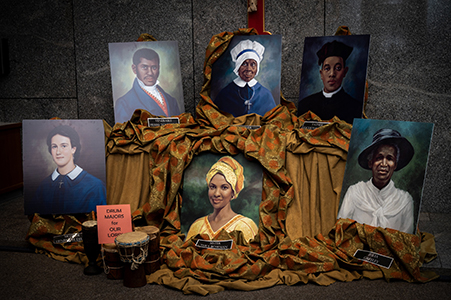
Sister Thea Bowman, our own Servant of God, personifies this journey to Catholicism for many in the Black communities. In addition, there are Black Catholics from Africa and the Caribbean, but this commemoration has featured the journey, struggle and accomplishments of African American Catholics. This month often highlights prominent Black American Catholics on the path to sainthood, frequently referred to as the “Saintly Six” – Venerable Pierre Toussaint, Venerable Mother Mary Elizabeth Lange, Venerable Henriette Delille, Venerable Augustus Tolton, the first recognized African American priest, Servant of God Julia Greeley and the Diocese of Jackson’s own Servant of God Sister Thea Bowman. This column will focus on the unique circumstances of three of the “Saintly Six,” recognizing that each has a marvelous story that is well documented and extensively studied in Rome.
Venerable Pierre Toussaint (1766-1853) was born a slave in Haiti and came to New York City in 1787 with the family of Pierre Berard, who had lost everything in Haiti. Toussaint apprenticed to a hairdresser, becoming the sole supporter of the household. He went on to become the most successful hairdresser of his day, a lucrative position. His profitable trade supported the household and bought the freedom of many slaves, including that of his wife, Juliette Noel.
Toussaint was a devout Catholic who contributed to many Catholic schools and orphanages. He paid for the education of many Black youths as well as several impoverished white seminarians. He also cared for the many victims of yellow fever, which struck the city every August. The Toussaint papers consist largely of his correspondence with friends and relatives in the United States, the Caribbean and France. (The New York Public Library) In 1951, a petition was begun for his canonization, and his remains were reinterred in the crypt beneath St. Patrick’s Cathedral in 1990, making him the only layman buried there among the archbishops and bishops.
Venerable Father Augustus Tolton (1854-1897) was born into slavery on April 1, 1854, in Brush Creek, Missouri, and his family escaped to Illinois during the Civil War where he eventually received his calling to the priesthood. Unable to study in any seminary in the United States because he was a Black man, he was forced to receive his education in Rome. After his ordination in 1886, he returned to serve at St. Joseph Church in Quincy, Illinois and afterward at St. Monica’s on the South Side of Chicago where he died tragically at 43 years of age.
The Chicago Daily News published the following account on July 9, 1897, describing his collapse during an extreme heat wave in Chicago:
“All through the scorching morning the sun poured down its deadliest rays. The white pavements gave back the heat with redoubled fervor. All through the night the wretched inhabitants of the town tried to sleep as best they could. The doorsteps were dotted with them, every window was populous, the roofs were crowded. With the morning came more heat, more suffering. The Rev. Augustus Tolton was struck down at 36th street and Ellis Avenue, but a short distance from his home. He was about to make several calls in his parish, and it was just before noon. He was seen to reel and then he fell heavily to the sidewalk. Several pedestrians rushed to the assistance of the prostrate clergyman and removed him to a cool spot where everything possible was done to relieve his condition. Every attempt was made to save his life at the hospital. The priest is one of the foremost colored clergyman of the catholic church in this part of the country and is remarkably popular.”
Pope Francis declared him venerable in 2019.
Julia Greeley (birth year unknown; died 1918), known as “Denver’s Angel of Charity,” pulled a little red wagon around Denver collecting donated food, clothing and fuel for poor families. She often went at night so that the recipients wouldn’t be embarrassed to be seen accepting help. She was born into slavery in Missouri and lost her sight in one eye as a child when a slaveholder’s whip struck her while he was beating her mother. In her adult life, she was a devout Catholic, a Secular Franciscan and known for her devotion to the Sacred Heart. Every month, she visited on foot every fire station in Denver, delivering literature of the Sacred Heart League to Catholic and non-Catholic firefighters alike. Her cause for sainthood was opened in 2016, and in 2017 her remains were moved to the Cathedral Basilica of the Immaculate Conception in Denver.
Toussaint, Tolton and Greeley personify the love of Jesus Christ in remarkably unique ways, revealing the incredible resiliency and faithfulness of many in the African American community. Our Church and nation are richer for their witness to the Lord and their loving service of others.