
FROM THE HERMITAGE
By sister alies therese
“When the soul is willingly emptied for love in order to have Him who is all. Then it is able to receive spiritual rest.” –Julian of Norwich, d. 1416
I had finished my prayer time … in silence, surrounded by my icons … and I gazed out the window to an overcast and cold morning … trying to allow Jesus to give me rest amidst recent anxiety and concern. It was not going to happen, and I was sure of that. I could not make it happen myself, and Jesus seemed far, far away. The middle of Advent and on into the “Os” is a fragile time. The fullness of Christmas had filled everyone else, and many had a lack of peaceful rest.
A few days later, I ran into Cardinal Zen’s “Advent Reflections” while tidying up a bookshelf. Perhaps you have read it or used it for your own reflection?
First, “Who likes darkness? Isn’t the light sure to prevail? Unfortunately, it is not necessarily so. Darkness often tempts us. In the dark, we can do shoddy things.” (p. 23) In so many of our places, the sun sets early. Darkness might be experienced, as Cardinal Zen says, “For Christians, ‘despairing of hope’ for salvation and thinking that God could not save us is indeed a sin … But what is it exactly that you doubt? … the power of God or His mercy? … He is always with us, so His plan must succeed.” (p. 19)
Another: “Because of His excessive love for us, God sent us His Son in the likeness of our sinful bodies – a fragile infant laid in a manger; only with the help of an angel, He could escape the attempt on His life. He wanted to experience all the hardships of human existence, hoping that we might trust Him and recognize Him as one of us.” (p. 74) This reminded me of my favorite saint, Julian of Norwich … who reminds us of the extraordinary love God has for us.
Off I went exploring the nearly end of her “Revelations of Divine Love” … and I read some paragraphs as if I’d never seen them before. I lived for 20 years not some 26 miles from her cell in Norwich (England) and frequently went there to pray.
How could she experience this silence and rest when “surrounded by the Black Death, parts of the Hundred Years War, the peasants’ revolt, Edward III and Richard II, and Henry IV taking the throne”? Does any of that sound in the least like what surrounds you? Pandemics, natural disasters, crime, political intrigue, extreme consumerism … ? How could one be expected to pray in that environment? How can there be spiritual rest?
Today we expect everyone to comment on most things – politics, family, religion. What is our business? What is none of our business? In the day, Julian commented on none of it. “Instead of pointing to men’s failures to be human and Christian, Juliana focuses on the love of a living, loving, personal God, His sufferings, and her response to them. The anchorhold at Norwich might as well have been in China for all the notice she takes of current sins and scandals, local persons and events, or the … immoralities of the failed shepherds of a spiritually starving, helpless flock … she is to observe God alone, to listen to Him and to make her response, and to transmit the experience to her fellow Christians.” (Introduction)
Cardinal Zen’s reflections kept me considering this notion of “excessive love.” Fit right in with Julian. He points to the reality that God wanted from all eternity to be our God, and that we become His people. How do we come to understand this? How do we know we are loved by God?
Julian explained that dread is caused by fright, pain, doubt and reverent dread. Curiously, she says, “Love and dread are brothers. They are rooted in us by the goodness of our Maker and can never be taken from us. We have the power to love from nature and from grace. We have the power to dread from nature and from grace … it is proper for us to love Him for His goodness.” (p. 217)
In considering how we learn to trust, she reminds us that love and dread take on different aspects: “In love we shall be friendly and near to God, and in dread we shall be gentle and courteous.” Advent brings us near to God either through love or dread.
Advent can be a time of renewal or discovery. Cardinal Zen poses this: “How many still do not know Jesus Christ? … How many who know Him are yet unwilling to obey? … But it is undeniable that ‘the light shines in the darkness, and the darkness has not overcome it.’” (p. 144)
The darkness will not prevail. Julian tells us: “All shall be well … not only the noble and great things but also the little and small, lowly and simple things … not one of the smallest things will be forgotten … He wants us to be more at ease in soul and more peaceful in love and to stop looking at all the tempests that could keep us from rejoicing in Him!” (p. 132) That is fruitful spiritual rest.
Blessings.
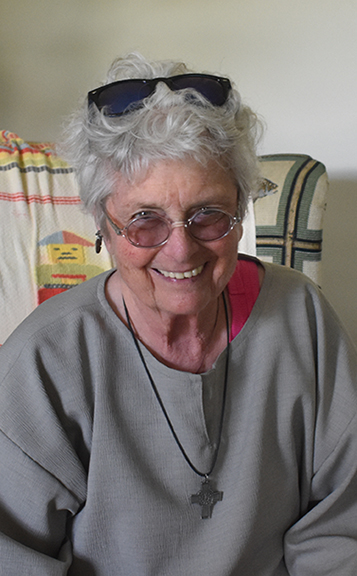
(sister alies therese is a canonical hermit who prays and writes.)